

North Carolina State Capitol
1 E Edenton St
Raleigh, NC
One of the finest Greek Revival statehouses in America, barely changed since 1840, standing free and open on the green square at the center of Raleigh.
The North Carolina State Capitol is that rare public building that has hardly changed since the day it opened. Finished in 1840 after seven years of work, it is a compact, dignified temple of Greek Revival design, and because the legislature outgrew it and moved on rather than remodeling it, the interior survives almost exactly as the 1800s left it. Historians rank it among the finest and best-preserved civic buildings of its style anywhere in the United States.
It stands on Union Square, a green block at the very center of Raleigh, and it is free to walk through. You can wander the domed rotunda, step into the old House and Senate chambers, and see the offices where the whole of state government once fit under one roof. For a traveler passing through the capital, it is a quiet, handsome, and genuinely historic stop that costs nothing but an hour.
What Travelers Love
- A statehouse that looks almost exactly as it did in 1840, one of the best-preserved Greek Revival buildings in the country
- The domed rotunda and its copy of Canova's lost marble statue of George Washington
- Free self-guided and guided tours through the old legislative chambers and offices
- The shady square outside, full of monuments, and the walkable museum district just steps away
Worth Knowing
- It is a working government building, so the governor's offices are still here; visitors stick to the public rooms and tours
- Admission and the guided tours are free, and self-guided visits run on weekdays with tours added on Saturdays
- Downtown parking is metered or in garages, but the Capitol sits at the center of a very walkable district
- Give yourself an hour inside, more if you plan to pair it with the museums that ring the same square
Learn about North Carolina State Capitol
Born from a fire and a lost Washington
The Capitol owes its existence to a disaster. In 1831 a fire tore through the first North Carolina State House and destroyed nearly everything inside, including a prized marble statue of George Washington carved by the great Italian sculptor Antonio Canova. Losing both the building and the celebrated statue stung the young state, and the legislature resolved to rebuild on the same spot with something grander and fireproof.
Work began in 1833, when the cornerstone was laid on the Fourth of July with full Masonic ceremony, and it took until 1840 to complete. Today a careful replica of the Canova statue stands once more in the rotunda, so the figure the fire took away has, in a sense, come home to the building raised in its place.
A Greek temple built of granite
The design came out of the New York firm of Ithiel Town and Alexander Jackson Davis, two of the leading architects of the American Greek Revival, with earlier and later hands including William Nichols and David Paton shaping the final result. The building is cross-shaped in plan and crowned with a low copper dome, its exterior columns Doric in the manner of the Parthenon and its House chamber laid out like a Greek theater with ornament copied from ancient Athens.
The whole thing was raised in local granite, a heavy and stubborn stone, and hauling it to the site was such a challenge that the builders laid an experimental railway, one of the earliest in the state, to move the blocks. The result is solid, symmetrical, and beautifully proportioned, a small temple of government that still anchors its square with real presence.
The building time forgot to change
For its first decades the Capitol held everything: the legislature, the governor, the supreme court, the state library, even the state geologist's collection. As North Carolina grew, those functions spread out into their own buildings. The courts and library left, and in 1963 the General Assembly finally moved to a modern legislative building nearby, leaving the old Capitol to the governor's offices and to history.
That gradual departure is exactly why the interior is so remarkable. Because no one gutted it to make room, the original chambers, staircases, and rooms survive largely intact, right down to their 1840 woodwork and plaster. In 1973 the building was named a National Historic Landmark, recognition that it is not merely old but one of the truest surviving examples of how an American statehouse looked and worked in the nineteenth century.
Visiting the Capitol
The Capitol sits at 1 East Edenton Street on Union Square, at the head of Raleigh's downtown grid, and it is open to visitors free of charge. You can tour on your own on weekdays, and free guided tours are offered on Saturdays, walking you through the rotunda, the legislative chambers, and the offices while telling the stories of the people who worked here.
Outside, the square itself is worth a slow loop, shaded by old trees and dotted with monuments. Best of all, the Capitol stands at the center of a compact museum district, so you can pair it with several of the state's free museums and a historic park in a single easy day on foot. It is the kind of stop that rewards curiosity: grand, genuine, and quietly generous with its history.
Closest Boutels
The closest Boutel™ stays, so you can turn this stop into an overnight. Each is a place we chose through independent editorial review, never a paid placement.
Details
Raleigh, NC
Frequently asked questions
What is the North Carolina State Capitol?
The North Carolina State Capitol, in downtown Raleigh, is a beautiful and historic Greek Revival building, one of the finest and best-preserved examples of its architectural style in the country, completed in the mid-nineteenth century. The stately domed capitol once housed all of state government and today is preserved as a National Historic Landmark and museum, with restored legislative chambers, offices, and a rotunda, offering visitors a look at the state's political and architectural history. Set on a historic square in the heart of Raleigh, it is a landmark of the city and state. With its historic architecture and heritage, the North Carolina State Capitol offers a fascinating destination in North Carolina.
What can you do at the North Carolina State Capitol?
You can tour the beautifully preserved Greek Revival capitol, seeing the restored legislative chambers, offices, rotunda, and historic details, learn about the state's political and architectural history, and explore the surrounding historic capitol grounds and monuments. The elegant historic architecture, the restored chambers, and the state history are the highlights, offering an engaging look at North Carolina's past. Guided and self-guided tours help interpret the building. As a historic site, its grounds also reflect the layered history of the state. With its architecture and history, the North Carolina State Capitol offers an engaging visit in Raleigh, North Carolina.
Can you tour the North Carolina State Capitol?
Yes, the North Carolina State Capitol is open to visitors, offering guided and self-guided tours of the historic building, including the restored legislative chambers, rotunda, and offices, with admission typically free. As a working historic landmark, respectful behavior is expected, and because tour availability and hours can vary, checking the current schedule before you go is wise. The historic grounds surrounding the capitol can also be explored. Visiting the preserved chambers offers a vivid sense of nineteenth-century government. With its free tours and historic interiors, the North Carolina State Capitol offers a rewarding visit in North Carolina.
When is the best time to visit the North Carolina State Capitol?
As a mostly indoor historic landmark, the North Carolina State Capitol can be visited year-round, with the mild months of spring through fall pleasant for also exploring the surrounding capitol grounds and downtown Raleigh. Because tour hours can vary, checking the current schedule before you go is wise, and weekdays may differ from weekends. It pairs well with Raleigh's nearby free museums. For comfortable weather to enjoy the grounds and downtown too, aim for spring through fall, or tour the capitol any time of year, in Raleigh, North Carolina.
What is near the North Carolina State Capitol?
The North Carolina State Capitol is in downtown Raleigh, within reach of the North Carolina Museum of Natural Sciences, Moore Square, the North Carolina Museum of Art Park, Pullen Park with its historic carousel, and the Triangle cities of Durham and Chapel Hill. That makes the North Carolina State Capitol a fascinating stop to combine with the North Carolina Museum of Natural Sciences, Moore Square, and the other attractions of Raleigh on a visit to North Carolina.
Nearby
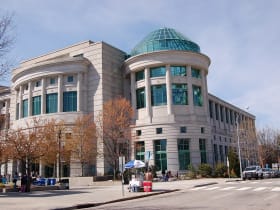
North Carolina Museum of Natural Sciences
0.1 miles away
The Southeast's largest natural history museum, free to enter, home to the world's only real Acrocanthosaurus skeleton, giant whale skeletons, live animals, and working science labs you can watch thro...
Moore Square
0.2 miles away
One of downtown Raleigh's original 1792 public squares, four acres shaded by 200-year-old oaks and marked by the city's giant copper acorn, lowered each New Year's Eve.
Pullen Park Carousel
1.5 miles away
For a quick, genuinely old-fashioned stop in Raleigh, ride the antique carousel at Pullen Park, one of the oldest public parks in the country, opened in 1887.
North Carolina Museum of Art Park
4.1 miles away
Raleigh visitors often miss that the state art museum is free and sits inside a huge sculpture park.