
Moundville Archaeological Park
634 Mound State Parkway, Moundville, AL
Moundville, AL
Great flat-topped earthen mounds rise from a bend of the Black Warrior River here, the remains of one of the largest Native cities in North America a thousand years ago.
Moundville Archaeological Park protects the remains of one of the largest and most sophisticated Native cities that ever existed in what is now the United States. Perched on a bluff above the Black Warrior River, the site holds dozens of great earthen platform mounds arranged around a central plaza, the heart of a thriving community of the Mississippian culture roughly a thousand years ago.
At its height, from about 1000 to 1450, Moundville was a political and religious capital, home to thousands of people and a hub of trade, craft, and ceremony across the Southeast. The flat-topped mounds once supported temples and the houses of leaders, and the artwork left behind, exquisite pottery, engraved shell, and worked copper, ranks among the finest of pre-Columbian North America, much of it on display in the park's museum.
What Travelers Love
- Standing atop the great platform mounds and looking out over the ancient plaza
- A museum of remarkable Mississippian artwork, pottery, and copper
- The quiet, open setting on a bluff above the Black Warrior River
- Interpretive trails and reconstructions that bring the vanished city to life
Worth Knowing
- This is a sacred and archaeologically significant Native site; treat the mounds and grounds with respect and stay on marked paths
- The grounds are open and sunny, so bring sun protection and water in warm months
- The museum brings the site to life, so allow time for both the mounds and the exhibits
- The park hosts a well-known Native American festival in the fall, worth timing a visit around
Learn about Moundville Archaeological Park
A Mississippian capital
Moundville was a center of the Mississippian culture, the mound-building society that spread across the river valleys of the Southeast and Midwest before European contact. Beginning around the year 1000, its people raised a great complex of flat-topped earthen mounds around a rectangular plaza, moving enormous amounts of soil basket by basket to build platforms for temples and elite residences.
For several centuries this was one of the most powerful places in the region, a ceremonial and political capital drawing people and goods from far away. It was carefully planned, ringed by a defensive palisade for a time, and organized around the plaza in a way that reflected the beliefs and social order of its people. By the 1400s the city's population had thinned, and its role faded, though the mounds remained on the landscape long after.
The people and their descendants
The people of Moundville were ancestral to the Native nations of the historic Southeast, whose descendants include the Muscogee, Choctaw, Chickasaw, and other peoples of the region. Their beliefs, art, and social life are woven into the objects recovered from the site and into the oral traditions carried forward by their descendants.
Moundville today is treated as a sacred place, and the park works with Native partners to interpret it with respect. Each fall the park hosts a large Native American festival that brings together artists, dancers, storytellers, and craftspeople from across the region, keeping the living cultures connected to the ancient city on the bluff.
The art and the museum
Moundville is famous among archaeologists for the beauty and craft of its artwork. Its potters produced elegantly shaped and engraved vessels, and its artisans worked shell, copper, and stone into ceremonial objects rich with symbols, part of a widespread religious tradition sometimes called the Southeastern Ceremonial Complex. Some of the finest of these objects were found here.
The park's museum displays a striking collection of these works alongside reconstructions and exhibits that explain daily life, farming, trade, and belief at Moundville. Together with the mounds outside, the museum lets a visitor grasp both the scale of the vanished city and the sophistication of the people who built it.
Walking the mounds and the river bluff
Roads and trails lead among the mounds and across the great plaza, letting visitors climb the largest platforms and look out over the open ground where a city once stood. From the bluff, the Black Warrior River winds below, the same river that carried trade and sustained the community for centuries.
The setting is quiet and open, with grassy expanses shaded here and there by trees, and interpretive signs and reconstructions help visitors imagine the temples and houses that once crowned the mounds. It is a place that rewards a slow walk and a bit of imagination, standing where one of the great cities of ancient America rose and fell.
Closest Boutels
The closest Boutel™ stays, so you can turn this stop into an overnight. Each is a place we chose through independent editorial review, never a paid placement.
Details
Moundville, AL
Frequently asked questions
What is Moundville Archaeological Park?
Moundville Archaeological Park, near Tuscaloosa in west-central Alabama, preserves one of the largest and most important Native American sites in the country, a great center of the Mississippian culture that flourished centuries ago. Along the Black Warrior River, the ancient people built dozens of large earthen mounds arranged around a central plaza, creating a major political and ceremonial center that was once among the largest communities in North America. Today the park protects the mounds, a museum of remarkable artifacts, and interpretive sites that share the story and enduring legacy of the people who lived here. A place of profound history and sacred significance, Moundville Archaeological Park offers a meaningful destination in Alabama.
Who built the mounds at Moundville?
The mounds at Moundville were built by Native Americans of the Mississippian culture, who flourished in the region centuries ago and created here one of the largest and most important communities in North America. These skilled people constructed dozens of large earthen mounds around a central plaza as platforms for structures and centers of political, social, and ceremonial life along the Black Warrior River. Their descendants and related peoples continue to regard the site as significant. The museum and park share their sophisticated culture and history. Understanding this heritage deepens the meaning of a visit to Moundville Archaeological Park in Alabama.
What can you do at Moundville Archaeological Park?
You can walk among the great earthen mounds arranged around the central plaza, climb the designated mound with stairs for a view over the site, explore the museum's remarkable collection of ancient artifacts, follow interpretive trails and markers that share the history and culture of the Mississippian people, and reflect on this significant place along the Black Warrior River. The impressive mounds, the artifact museum, and the interpretive sites are the highlights, offering a moving encounter with ancient history. With its mounds and museum, Moundville Archaeological Park offers a meaningful experience in Alabama.
How should visitors treat the mounds at Moundville?
Visitors should treat Moundville with deep respect, as it is a sacred and profoundly significant place to Native American peoples, the site of an ancient community and ceremonial center. Staying on designated paths and only on mounds where access is permitted, never disturbing, digging, or removing anything, following all posted guidance, and approaching the site with reverence and reflection are essential. The park interprets the site in ways that honor the people who built it. Treating this hallowed ground with care and respect ensures a meaningful and responsible visit to Moundville Archaeological Park in Alabama.
What is near Moundville Archaeological Park?
Moundville Archaeological Park is near Tuscaloosa in west-central Alabama, within reach of the city of Tuscaloosa and the University of Alabama, the Black Belt region with the Safe House Black History Museum in Greensboro, and the routes toward Birmingham to the northeast. That makes Moundville Archaeological Park a meaningful stop to combine with Tuscaloosa, the Black Belt historic sites, and the other attractions of west-central Alabama on a visit to the state.
Nearby
Safe House Black History Museum
21 miles away
This is the kind of place you would never find on your own. In Greensboro stands a small shotgun house where Martin Luther King Jr.
Gaineswood National Historic Landmark
36 miles away
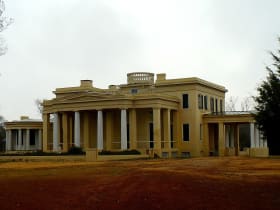
Demopolis hides one of the strangest and finest antebellum houses in America, and few people outside Alabama have heard of it.

Edmund Pettus Bridge Walk
54 miles away
To stand where history turned, walk out onto the Edmund Pettus Bridge in Selma.