
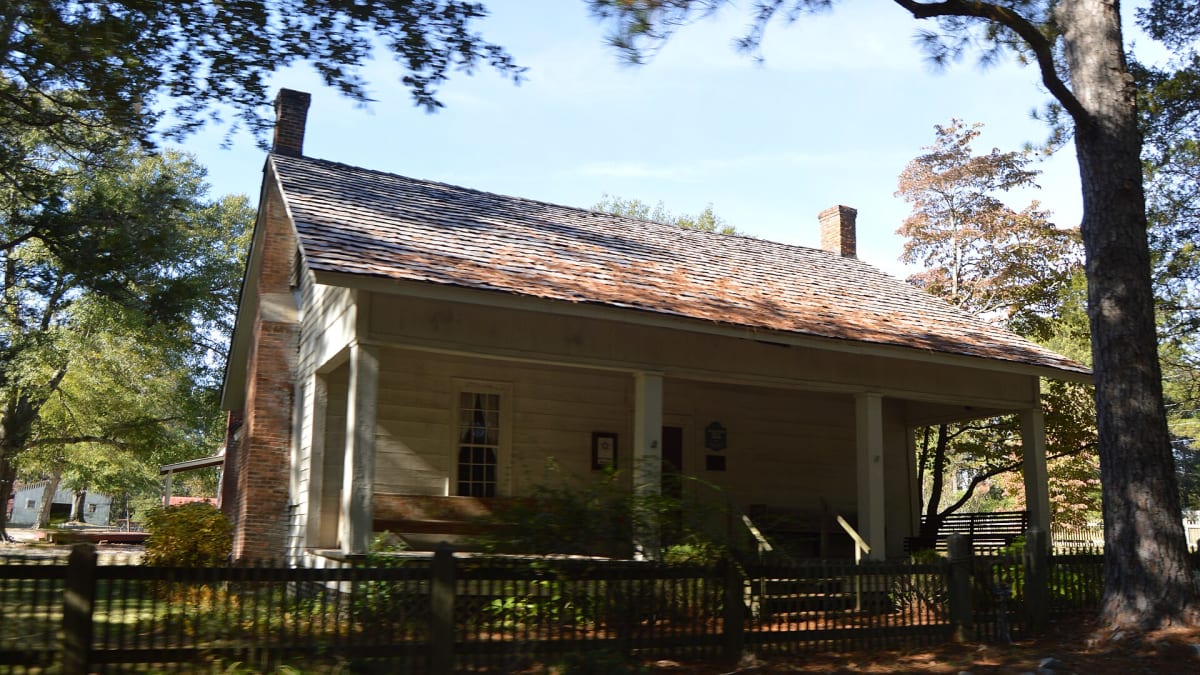
Malcolm Blue Farm
1125 Bethesda Rd, Aberdeen, NC
Aberdeen, NC
One of the last old Scottish homesteads left in the Sandhills, its farmhouse, mill, and barns kept as they were when the region ran on tar, turpentine, and pine.
Malcolm Blue Farm is one of the last surviving nineteenth-century Scottish farmsteads in the North Carolina Sandhills, a preserved homestead that recalls a time before this sandy country became known for golf. The farm belonged to Malcolm Blue, a descendant of the Scottish Highlanders who settled the Cape Fear valley and the Sandhills in large numbers in the 1700s and 1800s, and its farmhouse, gristmill, barns, and outbuildings still stand on their original ground.
In an area now defined by resorts and fairways, the farm is a quiet holdout, a place where you can see how a Sandhills family actually lived and worked when the region ran on farming and on the naval stores trade of tar, pitch, and turpentine drawn from the vast longleaf pine forests. Kept up by a preservation group and best known for its autumn living-history festival, the farm offers an unhurried and increasingly rare look at the roots of this corner of the state.
What Travelers Love
- A rare surviving farmstead that shows Sandhills life in the 1800s
- The old farmhouse, gristmill, and outbuildings preserved on the grounds
- The annual living-history festival with crafts, demonstrations, and reenactors
- A quiet, unhurried window into the region's Scottish farming roots
Worth Knowing
- The farm's buildings and museum keep limited days and seasons, so check before visiting
- The grounds are best enjoyed at a slow pace, on foot
- The autumn living-history festival is the biggest event of the year and draws a crowd
- It pairs naturally with a visit to nearby Aberdeen and the Pinehurst area
Learn about Malcolm Blue Farm
The Scots who settled the Sandhills
Beginning in the 1700s, large numbers of Scottish Highlanders emigrated to the Cape Fear valley and the Sandhills of North Carolina, so many that Gaelic was long a common tongue in these counties. They brought their names, their Presbyterian churches, and their farming ways to the sandy, pine-covered land, and families like the Blues put down deep roots that shaped the culture of the region for generations.
Malcolm Blue was part of that heritage, and his farm reflects the practical, self-reliant life the Highlanders built here. The soil was sandy and demanding, so families combined crops and livestock with the naval stores trade, tapping the abundant longleaf pines for the tar, pitch, and turpentine that were shipped out to a wider world. The farm preserves the physical evidence of that mixed, hard-working way of life.
The farmstead that survived
The heart of the site is the old Blue farmhouse, along with a gristmill and a cluster of barns and outbuildings, kept much as they would have appeared in the 1800s. Where so many old farmsteads across the region were torn down or swallowed by development, this one was saved, restored, and opened as a small museum of Sandhills rural life, complete with period tools and furnishings.
Walking the grounds gives a tangible sense of how a farm family organized daily work, from grinding grain at the mill to tending livestock and storing the harvest. The buildings are modest and honest rather than grand, which is exactly what makes them valuable, because they show ordinary life rather than the wealth of a plantation, in a part of the state where such humble structures have mostly vanished.
The living-history festival
Each autumn the farm comes alive for its annual Malcolm Blue Historical Crafts and Skills Festival, the event it is best known for. Reenactors and craftspeople fill the grounds to demonstrate the old ways, from spinning and weaving to blacksmithing, woodworking, and open-hearth cooking, and the air carries the sounds and smells of a working nineteenth-century farm.
The festival draws visitors from across the Sandhills and beyond, turning a quiet historic site into a lively celebration of regional heritage for a weekend. It is the best time to see the farm in action rather than at rest, with music, food, and demonstrations that make the history feel present rather than shut behind glass.
The Sandhills around the farm
Malcolm Blue Farm sits in the North Carolina Sandhills, a broad belt of sandy soil and longleaf pine that runs across the middle of the state. The same sandy, well-drained ground that once challenged farmers proved perfect for golf, and in the twentieth century the area around Pinehurst and Southern Pines grew into one of the country's great golf destinations.
That makes the farm an unexpected counterpoint to its polished surroundings. Nearby Aberdeen preserves its own railroad and small-town history, the resort village of Pinehurst holds its Tufts Archives and famous courses, and the Sandhills horse country stretches out with its stables and quiet lanes. The farm anchors the older, agrarian story beneath all of it.
Closest Boutels
The closest Boutel™ stays, so you can turn this stop into an overnight. Each is a place we chose through independent editorial review, never a paid placement.
Details
Aberdeen, NC
Frequently asked questions
What is Malcolm Blue Farm?
Malcolm Blue Farm, in Aberdeen in the Sandhills of North Carolina, is a historic nineteenth-century farmstead preserved as a museum, offering a glimpse of early rural life in the region. One of the oldest surviving farms in the area, the site preserves the historic farmhouse, a gristmill, outbuildings, and farm artifacts from the Scottish settlers and farmers who worked the Sandhills, telling the story of agriculture and daily life in the nineteenth century. With its historic buildings, museum, and popular annual heritage festival, Malcolm Blue Farm offers a charming and educational window into the area's rural past. With its historic farmstead and heritage, Malcolm Blue Farm offers a fascinating destination in North Carolina.
What can you do at Malcolm Blue Farm?
You can explore the historic nineteenth-century farmstead, seeing the preserved farmhouse, gristmill, outbuildings, and farm artifacts, learn about early rural life and the Scottish settlers of the Sandhills, and, during the popular annual heritage festival, enjoy demonstrations of traditional crafts and farm skills, music, and activities. The historic buildings, the farm museum, and especially the lively heritage festival are the draws, offering an engaging look at the region's agricultural past. The festival is a favorite time to visit. With its historic farmstead and heritage, Malcolm Blue Farm offers an enjoyable experience in Aberdeen, North Carolina.
When is the best time to visit Malcolm Blue Farm?
The mild months of spring through fall offer the most pleasant weather for exploring the outdoor historic farmstead, with the popular annual heritage festival, typically held in the fall, being a highlight when the farm comes alive with demonstrations, crafts, and activities. Because the site and its programming can keep limited or seasonal hours, checking the current schedule before you go is wise, especially to catch the festival. For the liveliest experience aim for the annual heritage festival, or visit in the mild months, at Malcolm Blue Farm in Aberdeen, North Carolina.
What should I know before visiting Malcolm Blue Farm?
Malcolm Blue Farm is a historic site that may keep limited or seasonal hours outside of special events, so checking the current schedule before you go is important, and the popular annual heritage festival is a special time when the farm is most active. As an outdoor historic farmstead, comfortable shoes and mild weather make for the best visit. Treating the historic buildings and artifacts with care is appreciated. Confirming hours or timing a visit to the festival ensures a rewarding visit to Malcolm Blue Farm in North Carolina.
What is near Malcolm Blue Farm?
Malcolm Blue Farm is in Aberdeen in the Sandhills of North Carolina, near the Aberdeen Rockfish Railroad Depot, within reach of the Sandhills horse country, the Tufts Archives in Pinehurst, Weymouth Woods near Southern Pines, and Fayetteville with the Airborne and Special Operations Museum. That makes Malcolm Blue Farm a fascinating stop to combine with the Aberdeen Rockfish Railroad Depot, the Pinehurst area, and the other attractions of the Sandhills on a visit to North Carolina.
Nearby
Aberdeen Rockfish Railroad Depot
1.0 miles away
For a quick railroad-history pause in the Sandhills, stop at the Aberdeen and Rockfish Railroad depot in downtown Aberdeen.
Weymouth Woods Sandhills Nature Preserve
2.6 miles away
The longleaf pine forest that once covered 90 million acres of the Southeast is nearly gone, and Weymouth Woods near Southern Pines protects one of its finest remnants.
Sandhills Horse Country Drive
3.5 miles away
For horse-loving kids, the roads around Southern Pines are a treat in themselves.
Tufts Archives
5.3 miles away
Golf pilgrims flock to Pinehurst without knowing the free treasure inside the village library.