
L.C. Bates Museum
14 Easler Road
Hinckley, ME
A century-old cabinet of wonders where hand-painted dioramas, mounted birds, and glass cases have barely changed, a museum that is itself a museum piece.
The L.C. Bates Museum is one of Maine's most singular small museums, a natural history collection housed in a 1903 brick building that has changed so little it now preserves not just its specimens but the very idea of an old museum. Rows of glass cases hold mounted birds and mammals, minerals and fossils, and curiosities gathered from around the world, arranged much as they were generations ago.
Its treasures are the habitat dioramas, whose curved backgrounds were hand-painted by accomplished early twentieth-century artists, turning cases of taxidermy into small landscapes. To walk through is to experience the atmosphere of a century-old teaching museum kept intact, a rarity in an age of interactive screens.
What Travelers Love
- Diorama backgrounds hand-painted by noted early twentieth-century artists
- The unchanged, slightly dim, deeply atmospheric feel of an old-fashioned museum
- An eclectic mix of taxidermy, minerals, fossils, and cultural curiosities under one roof
- The sense of stepping into how natural history was taught a hundred years ago
Worth Knowing
- It keeps limited seasonal hours, so confirm the schedule before making a special trip
- The building is a historic structure rather than a modern climate-controlled museum
- Nature trails on the surrounding grounds pair well with a visit
- It is part of the working Good Will-Hinckley campus, so respect posted areas
Learn about L.C. Bates Museum
A museum for a school
The museum belongs to the Good Will-Hinckley home and school, founded in 1889 by the Reverend George Walter Hinckley as a residential home and educational community for children in need. The campus grew into a self-contained village of farms, cottages, and workshops along the Kennebec.
The museum building opened in 1903 and was named for L.C. Bates, a Massachusetts businessman whose gift helped fund it. From the start it was meant as a teaching collection, a place where the home's students could study the natural world directly through specimens and displays.
That founding purpose is why the museum survives in its original form. It was never remodeled to chase trends, and so it kept the fittings, cases, and layout of an early twentieth-century natural history museum, becoming over time a genuine artifact of how such museums once looked and taught.
The dioramas and the collections
The heart of the collection is its series of habitat dioramas, in which mounted animals stand before curved, hand-painted backdrops depicting the landscapes they came from. Several backgrounds were painted by skilled artists of the era, and they lift the displays from mere taxidermy into small works of scenic art.
Beyond the dioramas, the cases run to a remarkable variety: birds and their eggs, mammals, minerals and rocks, fossils, mounted insects, and cultural objects gathered from far afield. The effect is that of a Victorian cabinet of curiosities scaled up to fill a building.
Because so little has been modernized, the museum doubles as a lesson in the history of museums themselves, showing how earlier generations organized and interpreted the natural world before dioramas gave way to interactive exhibits.
The grounds and the river
The museum sits within the wider Good Will-Hinckley campus, which includes nature trails, an arboretum, and open ground along the Kennebec River, so a visit can combine the indoor collections with an easy walk outdoors.
The Kennebec Valley here is part of the homeland of the Wabanaki peoples, and the river has shaped the region's history from Indigenous travel routes through the later era of log drives and mills.
The trails and plantings make the campus a quiet destination in its own right, a place to stretch your legs among the pines before or after stepping back a century inside the museum.
Why it endures
In an age when most museums have modernized, the L.C. Bates survives precisely because it did not. Its dim rooms, aged cases, and hand-painted dioramas preserve a way of seeing and organizing nature that has all but vanished elsewhere.
That makes a visit a double experience. You come to look at the specimens, but you leave having also toured the history of the museum itself, a rare survivor that lets you feel what it was like to learn about the world in a small teaching collection a hundred years ago.
Closest Boutels
The closest Boutel™ stays, so you can turn this stop into an overnight. Each is a place we chose through independent editorial review, never a paid placement.
Details
Hinckley, ME
Frequently asked questions
What is the L.C. Bates Museum?
The L.C. Bates Museum, in the town of Hinckley in central Maine, is a wonderfully old-fashioned natural history museum located on the campus of a historic school. Housed in a historic building, the museum preserves an extensive and charmingly vintage collection of natural history specimens, including mounted birds and animals in dioramas, rocks and minerals, fossils, Native American artifacts, and curiosities, much of it displayed in the style of a century ago. A delightful time capsule of a museum, it offers a nostalgic and educational look at the natural world. With its vintage dioramas and natural history collections, the L.C. Bates Museum offers a charming destination in central Maine.
What can you see at the L.C. Bates Museum?
You can see an extensive collection of natural history specimens displayed in a charmingly old-fashioned style, including mounted birds and animals in classic dioramas, rocks, minerals, and fossils, Native American and other artifacts, and various curiosities, along with nature trails on the grounds. The vintage dioramas and the nostalgic, century-old display style are highlights, giving the museum the feel of a delightful time capsule. It is engaging for nature lovers and those who appreciate historic museums. With its vintage natural history collections and dioramas, the L.C. Bates Museum offers a charming visit in Hinckley, central Maine.
When is the best time to visit the L.C. Bates Museum?
The L.C. Bates Museum is typically open seasonally, often from around spring through fall, so checking current days and hours before you go is wise, as they can vary. As a largely indoor museum, it is enjoyable in any weather during its open season, while the nature trails on the grounds are best in mild weather. Summer and fall are pleasant times to visit central Maine. For the fullest access to the museum and grounds, aim for the warmer months and check current hours at the L.C. Bates Museum in Hinckley, Maine.
Is the L.C. Bates Museum good for families?
Yes, the L.C. Bates Museum can be a charming stop for families, with its mounted animals, classic dioramas, fossils, minerals, and curiosities that fascinate children interested in nature and animals, plus nature trails on the grounds to explore. The old-fashioned displays offer a different, nostalgic experience from modern interactive museums, which many families enjoy. Its manageable size suits a family visit. With its natural history collections, dioramas, and nature trails, the L.C. Bates Museum makes an engaging and charming family stop in central Maine.
What is near the L.C. Bates Museum?
The L.C. Bates Museum is in the town of Hinckley in central Maine, within reach of the Kennebec Valley, Augusta with the Maine State House and Old Fort Western, the Belgrade Lakes with Messalonskee Lake, and the central Maine countryside. That makes the L.C. Bates Museum a charming stop to combine with the Augusta attractions, the Belgrade Lakes, and the other sights of central Maine on a visit to the state.
Nearby
Children's Discovery Museum
9.3 miles away
This is a let-them-loose kind of stop. The Children's Discovery Museum in downtown Waterville is built around four hands-on zones: a forest kids climb through, a maker mill with changing projects, a p...
Messalonskee Lake
13 miles away
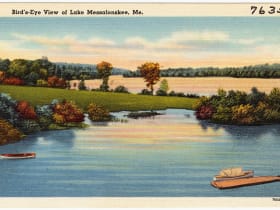
Messalonskee Lake anchors the southern end of the Belgrade chain, and its real draw for nature is the broad marsh at the head of the lake, nearly 1,300 acres of significant wading-bird and waterfowl h...

Old Fort Western
27 miles away
Most people driving through the capital never realize the oldest wooden fort in America sits right on the riverbank.