
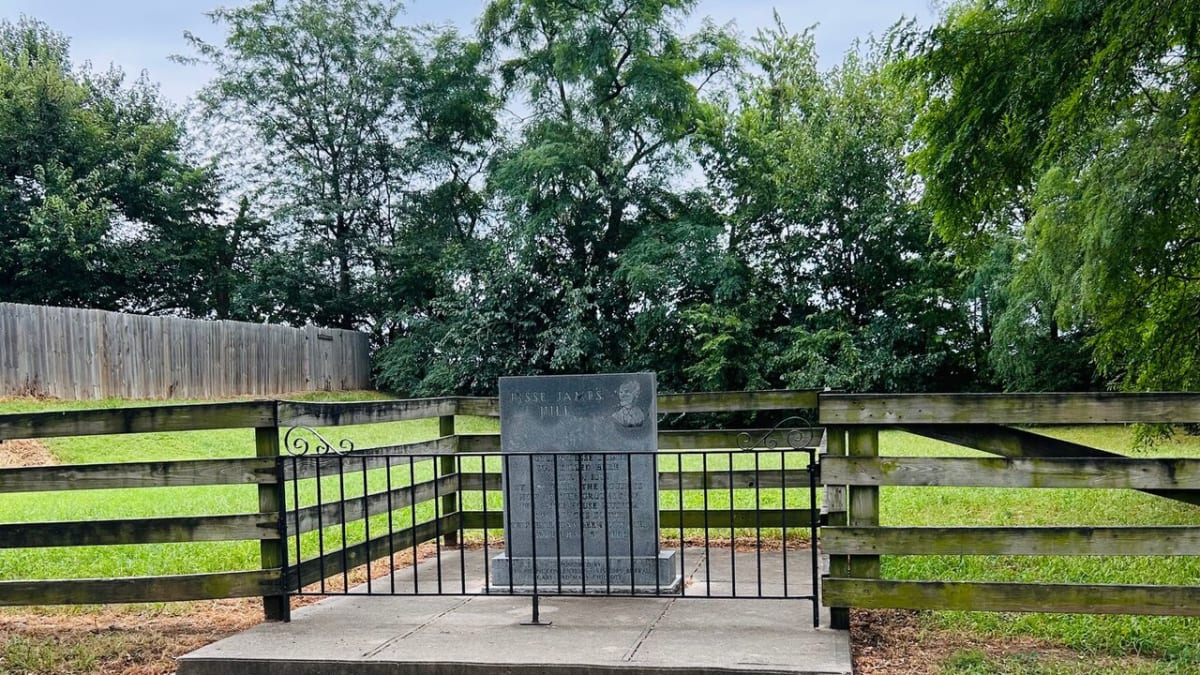
Jesse James Home
1202 Penn St, St Joseph, MO
St. Joseph, MO
A plain one-story cottage on a hill in St. Joseph where the most famous outlaw in America was shot in the back of the head while dusting a picture.
The Jesse James Home is a modest white frame cottage on a St. Joseph hillside, and its fame rests entirely on a single morning. On April 3, 1882, the outlaw Jesse James was living here quietly under the alias Thomas Howard, a supposedly respectable family man with a wife and children. That morning he stood on a chair to straighten and dust a framed picture on the wall, and a member of his own gang, Robert Ford, shot him in the back of the head for the reward money.
James had spent more than fifteen years as the most wanted man in America, robbing banks, trains, and stagecoaches across the Midwest and gathering a legend that outran the facts. His death in this small rented house turned him from a hunted fugitive into an American myth almost overnight. The home is preserved much as it was, and generations of visitors have come to see the very room, and the bullet hole, where the legend ended.
What Travelers Love
- Standing in the actual room where Jesse James was killed in April 1882
- The bullet hole in the wall, long a magnet for visitors who chipped at it over the years
- How small and ordinary the outlaw's hideout house really was
- Pairing the visit with the neighboring Patee House Museum for the fuller story
Worth Knowing
- The house was moved from its original site to sit beside the Patee House Museum, so the two are toured together
- It is a small historic house, best appreciated for its story rather than its size
- St. Joseph has a cluster of history museums, so it rewards a half day or more
- Photography is usually welcome, but check with staff before touching anything inside
Learn about Jesse James Home
The outlaw and his double life
Jesse Woodson James grew up in Clay County, Missouri, in a border region torn apart by the Civil War. As a teenager he rode with Confederate guerrillas in the brutal bushwhacker warfare that scarred the Missouri countryside, and when the war ended, he and his brother Frank turned to robbing banks and, later, trains. Over roughly sixteen years the James gang carried out a long string of holdups across Missouri, Kansas, Iowa, and beyond, and newspapers built James into a Robin Hood figure, a reputation the historical record only partly supports.
By 1881 the law was closing in, and James moved his family to St. Joseph, renting this house on the hill under the name Thomas Howard. Neighbors knew him as a quiet man with a wife and two young children. He kept guns close and windows watched, but to the block he was simply Mr. Howard. It was in that ordinary domestic disguise, dusting a picture in his own parlor, that he was finally caught off guard.
The morning of April 3, 1882
Robert Ford and his brother Charley had been taken into the gang, but Robert had secretly struck a deal with the governor of Missouri for a reward and a pardon. On the morning of April 3, with James unarmed and his back turned as he stepped up to dust the picture, Robert Ford drew and fired. James died on the floor of his own home, and word raced across the country within hours.
The Fords expected to be hailed as heroes. Instead they were charged with murder, pardoned, and then hounded by public scorn, cast as cowards who shot a man in the back. A popular ballad soon fixed that judgment in the national memory, calling Robert Ford the dirty little coward who laid poor Jesse in his grave. Robert Ford himself was shot dead in a Colorado tent saloon a decade later, and the strange afterlife of the story only deepened the legend of the man killed in this house.
The house, the bullet hole, and the relics
The home has been preserved as a memorial to the event, and its most famous feature is the bullet hole in the wall, left by the shot that killed James. For decades curious visitors picked and chipped at the plaster around it for souvenirs, enlarging the hole over the years, a small illustration of how relentlessly the public wanted a piece of the story.
The house was moved from its original location to its present spot beside the Patee House Museum, where the two sites are visited together. Inside are furnishings, family belongings, and materials tied to James and his death, including items connected to the later exhumation and forensic testing that confirmed the body in the grave was his. It is a small place, but standing in the actual room brings the myth down to human scale.
St. Joseph, a town of firsts and lasts
St. Joseph earned its place in history well before Jesse James arrived. In 1860 it became the eastern terminus of the Pony Express, the short-lived mail relay that galloped letters across the frontier to California, and for years it was one of the great outfitting points for pioneers heading west by wagon. The wealth of that river-and-rail trade left the city with grand Victorian streets and mansions.
Today the James home anchors a cluster of St. Joseph attractions that tell the story of the westward frontier and the Gilded Age town that grew up on it. The neighboring Patee House, once a fine hotel and later a Pony Express headquarters, is now a sprawling museum, and downtown holds other collections devoted to the city's outsized role in the settling of the West.
Closest Boutels
The closest Boutel™ stays, so you can turn this stop into an overnight. Each is a place we chose through independent editorial review, never a paid placement.
Prairie Lodge Motel
Honorable Mention1219 Old US Highway 56, Council Grove, KS
116 miles away|Learn More ›
Details
St. Joseph, MO
Frequently asked questions
What is the Jesse James Home?
The Jesse James Home, in St. Joseph, Missouri, is the historic house where the notorious Old West outlaw Jesse James was killed in 1882, now a museum preserving the site and story. Jesse James, the infamous bank and train robber who became a legendary and controversial figure of the American West, was living under an alias in this modest St. Joseph house when he was shot and killed by a member of his own gang seeking a reward. The preserved home, with its famous bullet hole and exhibits on James and the era, draws visitors fascinated by Old West history. With its outlaw history, the Jesse James Home offers a fascinating destination in Missouri.
Who was Jesse James?
Jesse James was one of the most notorious outlaws of the American West, a bank and train robber who, along with his gang, gained fame and infamy in the years after the Civil War for a series of daring and violent robberies. A controversial figure, romanticized by some as a folk hero and condemned by others as a criminal, James became a legend of the Old West. He was living under an assumed name in St. Joseph when he was killed by a fellow gang member in 1882. Understanding his story adds context to a visit to the Jesse James Home in Missouri.
What can you see at the Jesse James Home?
You can tour the historic house where Jesse James was killed, see the site and the famous bullet hole in the wall, and view exhibits on James, his gang, and the Old West era. The preserved historic home, the story of James's death, and the exhibits on the outlaw and his times are the draws, offering a fascinating glimpse into a legendary chapter of the American West. The modest house where the outlaw met his end is memorably evocative. With its history and exhibits, the Jesse James Home offers an engaging visit in St. Joseph, Missouri.
When is the best time to visit the Jesse James Home?
As an indoor historic house museum, the Jesse James Home is enjoyable year-round in various weather, making it a rewarding stop in any season while exploring St. Joseph's history. It can be busier on weekends. Because hours can vary, checking the current schedule before you go is wise. It pairs well with the Pony Express Museum and other St. Joseph sites. Because it is indoors, the Jesse James Home makes a rewarding stop any time of year in Missouri.
What is near the Jesse James Home?
The Jesse James Home is in St. Joseph, Missouri, within reach of the Pony Express Museum, the Glore Psychiatric Museum, the historic city of St. Joseph, and the Kansas City area to the south. That makes the Jesse James Home a fascinating stop to combine with the Pony Express Museum and the other historic attractions of St. Joseph on a visit to Missouri.
Nearby
Pony Express Museum
0.2 miles away
This is the real starting line. The Pony Express Museum at 914 Penn St is built into the surviving 1858 stable where the first rider mounted up for the run west.

Glore Psychiatric Museum
2.4 miles away
Most visitors to St. Joseph never hear about this one. The Glore Psychiatric Museum sits at 3406 Frederick Ave, on the grounds of the old state asylum, and it traces the treatment of mental illness fr...

Loess Bluffs National Wildlife Refuge
32 miles away
Loess Bluffs sits at the base of the loess hills, deep windblown silt bluffs that give the refuge its name and rise sharply from the flat Missouri River floodplain.