
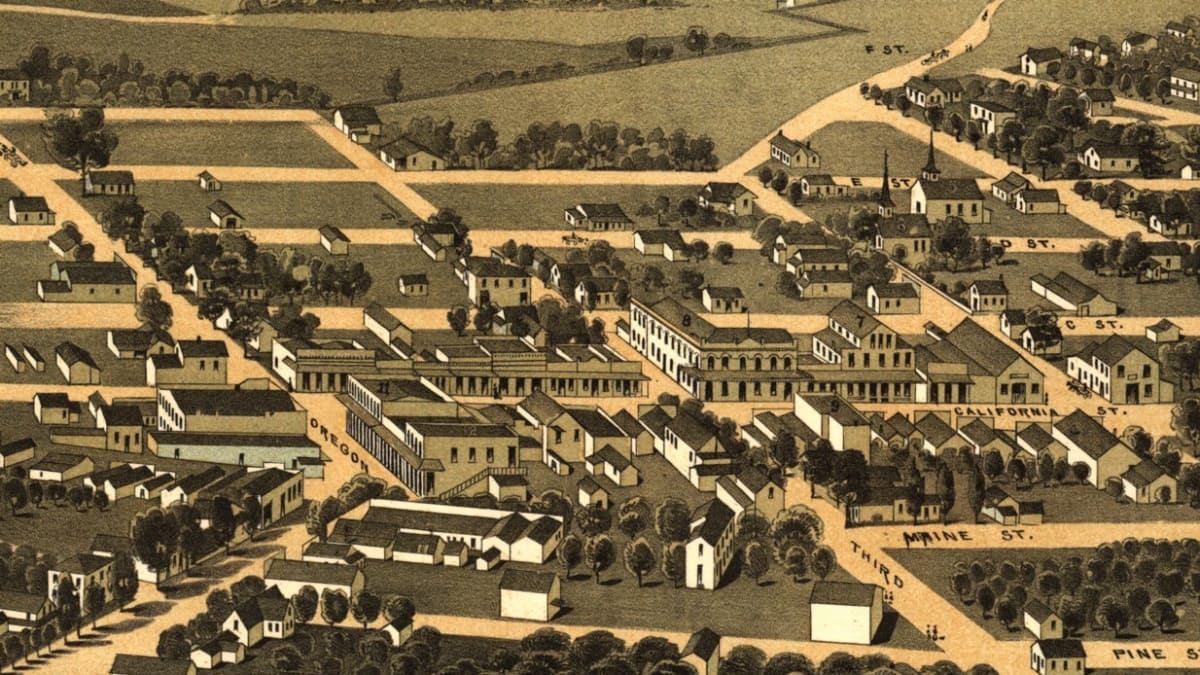
Jacksonville
California Street
Jacksonville, OR
A whole gold-rush town, its brick storefronts and gaslit streets left almost exactly as they were when the railroad passed it by.
Jacksonville is a rare thing: an entire gold-rush town that never got torn down and rebuilt. When prosperity moved on in the late 1800s, the money to modernize simply was not there, and so the brick banks, wooden storefronts, and fine old houses stayed put. Today the whole town is a National Historic Landmark, and a walk down California Street feels less like a museum than like a place that quietly forgot to change.
That preservation gives Jacksonville a double life. By day it is a strolling, tasting, browsing kind of town, full of history, shops, and Rogue Valley wine. By night in summer it becomes one of the Northwest's beloved music destinations, when the hillside estate of a pioneer photographer fills with concerts under the stars.
What Travelers Love
- Walking a downtown of brick and wood storefronts that looks much as it did in the 1880s
- Summer nights of music on the lawn at the Britt Festival
- The Beekman Bank, a gold-era business left as a time capsule
- Wine tasting and farm dinners in the surrounding Applegate and Rogue valleys
Worth Knowing
- The historic core is compact and best seen on foot, so park and wander
- Britt Festival concerts are the town's busiest draw, so book a stay and tickets well ahead for summer shows
- Summers in the Rogue Valley run hot and can be smoky in a bad wildfire year, so watch the forecast
- The historic cemetery on the hill and the woodland trails behind it are worth the short climb for the views and the stories
Learn about Jacksonville
Gold on Rich Gulch
The story starts in the early 1850s, when gold was struck at Rich Gulch and Jackson Creek. Prospectors poured in, and almost overnight a rough camp became one of the richest and busiest towns in the young Oregon country. By the time Oregon became a state in 1859, Jacksonville was among its largest inland trade centers, with banks, hotels, saloons, newspapers, and a lively, rowdy mix of miners, merchants, and immigrants.
The gold did not last, and neither did the boom. When the main railroad line was routed a few miles away in the 1880s, the trade and growth shifted to the new town of Medford, and Jacksonville was left behind. What felt like a misfortune at the time is exactly why the town survives: with no reason to tear down and rebuild, its Gold Rush streetscape simply stayed.
Beekman and Britt
Two names shaped the town more than any others. Cornelius Beekman arrived as a gold-country express rider and went on to run what became one of Oregon's oldest banks. The Beekman Bank building is one of the most remarkable survivals in town, a business preserved almost as it was left, its ledgers and fixtures offering a direct look at how money moved in a frontier economy.
Peter Britt was a Swiss immigrant who came chasing gold and stayed to become the region's great photographer and horticulturist, documenting the valley and its people for decades. His hillside estate is now the home of the Britt Music and Arts Festival, a summer-long series of outdoor concerts that has become Jacksonville's signature event and one of the best-loved music settings in the Northwest.
The town today
The heart of Jacksonville is its walkable historic district, a few blocks of brick and clapboard buildings now filled with shops, tasting rooms, restaurants, and inns. Interpretive markers and guided walks help you read the layers of history, from the elegant to the hard-edged, including the story of the Chinese miners and merchants who were an important and often mistreated part of the early town.
Above town, the pioneer cemetery climbs a wooded hill, its old headstones telling the story of the boom years in miniature, and the woodland trails beyond offer easy walking and valley views. It is a town made for slowing down.
The Rogue Valley around it
Jacksonville sits at the edge of a serious wine region. The warm Rogue and Applegate valleys have become one of Oregon's most exciting wine areas, and dozens of tasting rooms lie within a short drive, many set among oak-dotted hills and family farms.
The surrounding country is classic southern Oregon: hot, dry summers, oak and pine woodland, and the Rogue River not far off. Spring brings wildflowers and green hills, fall brings the grape harvest and cooler air, and the season shapes what a visit feels like as much as the town itself.
Closest Boutels
The closest Boutel™ stays, so you can turn this stop into an overnight. Each is a place we chose through independent editorial review, never a paid placement.
Details
Jacksonville, OR
Frequently asked questions
What makes Jacksonville, Oregon special?
Jacksonville is a beautifully preserved 1850s gold-rush town in the Rogue Valley of southern Oregon, so intact that the entire town is designated a National Historic Landmark. Its walkable core of brick and wood-frame storefronts now holds shops, galleries, tasting rooms, and restaurants, giving you a genuine step back into frontier Oregon without it feeling like a staged attraction. History, wine country, and a famous summer music festival all meet here.
What is there to do in Jacksonville?
Stroll the historic downtown, explore pioneer-era sites like the old bank and preserved homes, and wander up to the atmospheric historic cemetery on the hill for views and history. The surrounding Applegate and Rogue valleys are dotted with wineries for tasting, and in summer the town hosts a beloved outdoor concert series. It is an easy, charming place to spend a relaxed day of history, food, and wine.
What is the Britt Festival?
The Britt Music and Arts Festival is a cherished summer tradition in Jacksonville, an outdoor concert series held on a shaded hillside where audiences bring low chairs or blankets and enjoy music under the stars, from classical to popular acts. It is the cultural heart of the town's summer. Since the lineup and dates change each year, check the current season's schedule if you would like to plan a visit around a show.
Is Jacksonville a good base for wine tasting?
Yes, it sits at the doorstep of southern Oregon's Applegate and Rogue Valley wine country, known for warm-climate reds and scenic vineyard drives, with many tasting rooms both in town and a short drive away. You can easily combine a stroll through the historic district with an afternoon of tastings. As always, plan for a designated driver or a tour if you intend to sample at several wineries.
When is the best time to visit Jacksonville?
Late spring through fall is ideal, with summer bringing the Britt concerts and peak wine-country activity, though southern Oregon summers run hot, so plan for warm afternoons. Fall adds harvest season and lovely color, while spring is green and mild. The walkable historic town is pleasant year-round, and it pairs well with nearby Ashland and the Table Rocks hikes for a fuller Rogue Valley trip.
Nearby

Lithia Park
15 miles away
Ashland's crown-jewel park runs a wooded canyon along Ashland Creek from the downtown Plaza back into real forest, with duck ponds, a marble fountain, a Japanese garden, and hiking trails.

Table Rocks, Rogue Valley
17 miles away
The summit plateaus at Table Rock preserve vernal pools, seasonal pools that form in basalt depressions and dry by early summer, creating microhabitats for rare fairy shrimp and endemic plant species....
Natural Bridge on Upper Rogue River
55 miles away
Natural lava tubes that capture a full river are rare. The tube here is large enough that the Rogue runs through it at full volume rather than seeping.

Crater Lake National Park
58 miles away
The deepest lake in the United States, filling the caldera of a collapsed volcano with impossibly blue water.