
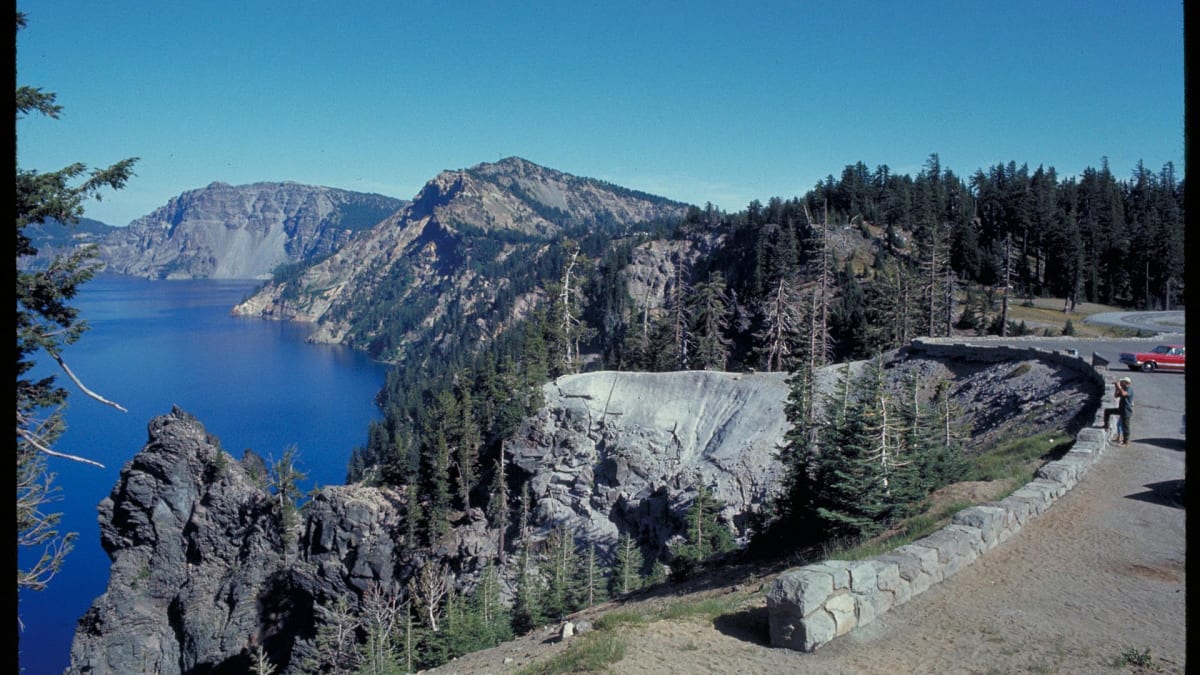
Crater Lake National Park
Crater Lake, Oregon
Southern Oregon
Some places are hard to believe even while you are standing in front of them. Crater Lake is one of them. It sits in the blown-out heart of a volcano, a nearly round bowl almost six miles across, filled to a depth of 1,943 feet with the deepest, and quite possibly the bluest, water in the United States. No rivers flow in and none flow out. Every drop is rain and melted snow, so clean and so deep that the lake drinks up all the other colors of light and gives back a blue that photographs never quite capture.
This is the only national park in Oregon, and one of the oldest in the country, protected in 1902. A 33-mile road rings the rim, hikes drop to the shore and climb the cinder cone in the middle, and the whole place is buried under some of the heaviest snow in America for much of the year. However you come at it, the first look over the edge tends to stop conversation.
Learn about Crater Lake National Park
The Park
Crater Lake fills the caldera of Mount Mazama, a Cascade volcano that once stood around 12,000 feet tall. About 7,700 years ago it erupted with staggering force and then collapsed in on itself, leaving a deep circular basin. Over the centuries that followed, rain and snowmelt slowly filled the bowl. Because nothing drains in or out, the water stays extraordinarily pure and clear, and its great depth is what turns it that famous, almost unreal shade of blue.
Rising from the water near the west shore is Wizard Island, a small cinder cone that grew after the collapse, its own tiny crater visible from the rim. A jagged rock formation called the Phantom Ship drifts in and out of view near the southeast shore, looking for all the world like a ghostly sailing vessel. Ringing it all is the caldera rim, where the road and the overlooks perch hundreds of feet above the surface and the views stretch clear across to the far wall.
Around the lake the park spreads out into old-growth forest, wildflower meadows in the short summer, and pumice plains left by the eruption. It is high country, most of the rim sitting above 7,000 feet, which means cool days, cold nights, and a season that runs late. The reward for the altitude and the snow is air so clear that Crater Lake has some of the darkest night skies and cleanest views anywhere in the Cascades.
How to Enter
- South Entrance, off OR-62 near Fort Klamath, is open year-round and is the main way in during winter. It leads to the Rim Village area and the Steel Visitor Center.
- North Entrance, off OR-138 near Diamond Lake, is seasonal and snow-dependent, generally closed through the winter and reopening once the plows catch up in late spring or early summer.
- From Medford and Interstate 5 to the west, follow OR-62 for about 80 miles to the south entrance. From Bend and central Oregon, come down US-97 and OR-138 to reach the north side in season.
Things to Do
- Rim Village is the first stop for most visitors: the cafe, gift shop, and the classic overlooks where the whole lake opens up in front of you for the first time.
- The Cleetwood Cove Trail is the only legal route down to the water, a steep 2.2-mile round trip, and the launch point for the summer boat tours.
- The Wizard Island boat tour runs in summer only and must be reserved in advance through recreation.gov; some tours let you get off and climb the island cone.
- The Discovery Point Trail is an easy 2.2-mile rim walk to the spot where a party of prospectors first stumbled onto the lake in 1853.
History
Long before any road or park, the Klamath people knew this mountain and its violent end. Their oral tradition tells of a battle between Llao, the spirit of the underworld who lived inside the mountain, and Skell, the spirit of the sky, a story that lines up remarkably well with the real eruption and collapse of Mount Mazama around 7,700 years ago. To the Klamath the caldera has long been a sacred place.
The lake stayed unknown to newcomers until 1853, when a small group of gold prospectors crested the rim, named it Deep Blue Lake, and moved on. It was a young man named William Gladstone Steel who fell under its spell and spent seventeen years campaigning to protect it. His effort paid off on May 22, 1902, when Crater Lake became the fifth national park in the United States and, to this day, the only one in Oregon.
In the 1930s the Civilian Conservation Corps went to work here, completing the 33-mile Rim Drive around the caldera and laying up many of the stone walls and overlooks that still frame the views. Scientists have studied the lake for more than a century, lowering instruments into water so clear that sunlight reaches far deeper than in almost any other lake on Earth, which is part of what makes the blue so intense.
Little-Known Facts
- At 1,943 feet, Crater Lake is the deepest lake in the United States and one of the deepest in the world. There are no inlets or outlets, so the water is almost entirely rain and snowmelt.
- A full-size tree trunk known as the Old Man of the Lake has been bobbing upright in the water for well over a century, drifting for miles and still floating vertically like a slow, silent buoy.
- Crater Lake is one of the snowiest places in America, averaging more than 40 feet of snow a year, which is why the rim road and north entrance close for much of the year.
- The lake had no fish at all until people stocked it in the late 1800s and early 1900s; a couple of introduced species still live there today, swimming in some of the clearest water ever measured.
- The eruption of Mount Mazama was one of the largest in North America in the last several thousand years, and its ash has been found in layers as far away as Canada.
- Wizard Island is a volcano within a volcano: a cinder cone that erupted up out of the caldera floor after the big collapse, with its own small crater at the top.
Plan Your Visit
- An entrance fee applies (per vehicle, good for seven days); check the park website for current rates.
- The park is open year-round, but Rim Drive is closed from late October through late June while crews clear the deep snow.
- The Steel Visitor Center near the south entrance (Annie Spring) is open year-round; Rim Village facilities are mostly summer only.
- Fuel is limited: gas is available at Mazama Village in summer only, and otherwise Medford is about 80 miles to the south, so fill up before you come.
Inside the Park
Crater Lake Rim Drive
The 33-mile Rim Drive circles the caldera with thirty overlooks, each gazing down hundreds of feet to the water. The Cleetwood Cove Trail, the only path down to the shore, and the summer boat tours to Wizard Island both start along this loop. It is the classic Crater Lake experience, weather and snow permitting.
Outside the Park
Natural Bridge on the Upper Rogue River
On the way in from the west, the Upper Rogue River vanishes into a basalt lava tube roughly a hundred yards long and roars back out the far end. A short paved walk from Highway 62 reaches the viewpoint over this unusual disappearing act, part of the same volcanic story as the park itself.
Diamond Lake
A clear, spring-fed lake above 5,000 feet, ringed by pumice flats and lodgepole pine, with the sharp volcanic spire of Mount Thielsen rising across the water. Just north of the park, it is a favorite for fishing, cycling the shoreline path, and camping near the seasonal north entrance.
Details
Southern Oregon
Frequently asked questions
How deep is Crater Lake?
Crater Lake is 1,943 feet deep, which makes it the deepest lake in the United States and one of the deepest in the world. It sits in the caldera of Mount Mazama, a volcano that collapsed about 7,700 years ago, and the great depth is a big part of why the water looks so intensely blue.
Why is the water so blue?
The lake is fed only by rain and snowmelt, with no streams flowing in to carry sediment, so the water is exceptionally pure and clear. Sunlight travels very deep into water this clean, and the great depth absorbs the reds and yellows while scattering back a deep, saturated blue. On a clear day the color can look almost artificial.
When is Crater Lake open, and is the Rim Drive always accessible?
The park itself is open year-round through the south entrance, but the 33-mile Rim Drive and the north entrance close under heavy snow from around late October until late June. If seeing the full loop around the lake is important to you, plan for July through September, when the road is usually clear.
Is there an entrance fee?
Yes. Crater Lake charges a per-vehicle entrance fee that is good for seven days, and interagency annual passes are accepted. Check the National Park Service website for the current rate before you go.
Can you swim in Crater Lake or touch the water?
You can, in one place. The Cleetwood Cove Trail is the only legal route down to the shore, a steep 2.2-mile round trip, and it is the single spot where you can reach the water and, for the brave, take a very cold swim. The trail is usually open in summer only.
How do you get to Wizard Island?
Wizard Island is reached by boat tour from Cleetwood Cove in summer only. Tours must be reserved in advance through recreation.gov, and some let you get off on the island to hike up the cinder cone. Getting there means hiking down the Cleetwood Cove Trail first, then climbing back out afterward.
What is the best time of year to visit?
Mid-July through September is the reliable window: the Rim Drive is open, the boat tours are running, and the wildflowers are out. Late June can be beautiful with snow still on the rim. Winter is quiet and stunning if you are prepared for deep snow, but most roads and services are closed.
How much time do you need at Crater Lake?
You can take in the main overlooks and drive part of the rim in a half day. To circle the full Rim Drive, walk a trail or two, and not feel rushed, give it a full day. Add more if you want to do the Cleetwood Cove hike and a Wizard Island boat tour.
Are pets allowed in the park?
Pets are allowed in developed areas, parking lots, and along roads, but not on most trails or in the backcountry, so they cannot go down to the lake on the Cleetwood Cove Trail. Bring water and never leave a pet in a vehicle, and check the park website for the current pet rules.
Does the lake ever freeze over?
Very rarely. Despite the deep snow and long winters, the lake is so large and deep that it holds enough heat to keep from freezing solid in most years. A full surface freeze has happened only a handful of times in recorded history.