
Glass Buttes
US-20, Hampton, OR
Hampton, OR
A cluster of high-desert volcanic domes where the ground itself glitters with obsidian, black, mahogany, and rainbow-sheened, some of the finest and most varied volcanic glass in the country, free for the taking.
Glass Buttes is exactly what it sounds like: a group of volcanic domes in the Oregon high desert where the mountain is made, in large part, of glass. Obsidian litters the slopes and washes so thickly that in places the ground catches the light and glints. This is one of the largest and most varied obsidian deposits in North America, and unlike most such sites, a broad stretch of it is open free-use land where anyone can walk up and collect a reasonable amount for their own use without a permit.
The variety is what makes rockhounds drive hours to get here. Most obsidian anywhere is plain black, but Glass Buttes produces black, brown, green, pumpkin, mahogany, snowflake, and lace-patterned glass, along with prized pieces that flash gold, silver, or full rainbow sheen when you turn them in the sun. It is a strange and wonderful place, a mountain you can hold a piece of in your hand.
What Travelers Love
- Finding gem-quality obsidian lying loose on the ground, no digging required
- The astonishing range of colors and sheens, from jet black to mahogany, midnight lace, and rainbow
- Collecting is free and legal for personal use on the BLM land here, no permit needed
- Huge high-desert views and the deep quiet of country with almost no one in it
Worth Knowing
- It is remote, with no water, fuel, or services, so bring everything you need and a full tank
- Access roads off the highway are rough gravel and dirt that can turn to slick mud when wet; high clearance helps
- Obsidian is natural glass and breaks into razor edges, so wear sturdy gloves and closed shoes
- This is culturally significant ground; leave any worked stone tools or arrowheads where they lie, as taking artifacts is illegal
Learn about Glass Buttes
A mountain built of glass
Glass Buttes formed several million years ago, in the late Miocene and Pliocene, as a set of silicic volcanic domes pushed up out of the high desert. Rather than erupting as runny basalt lava, the magma here was thick and rich in silica, the same stuff as window glass, and when it reached the surface and cooled it did so in stages: early basalt flows, then the thick rhyolite that built the domes, then more basalt over the top. The highest point rises to a little over 6,388 feet.
Obsidian is what happens when that silica-rich lava cools so fast it never has time to organize into crystals. Instead it freezes into a smooth, glassy solid that fractures in sweeping curves and holds an edge sharper than surgical steel. The unusual colors and sheens at Glass Buttes come from trace minerals and from microscopic bubbles and crystals trapped inside the glass, which scatter light into gold, silver, and rainbow flashes. Geothermal activity in the buttes also left behind mineral deposits in the rock, part of why the area has drawn interest for geothermal energy as well as its glass.
Nine thousand years of toolmakers
Long before anyone called it Glass Buttes, this was a workshop and a quarry. Native peoples came here to gather obsidian for at least nine thousand years, and possibly far longer, chipping it into knives, scrapers, arrowheads, and spear points. Fine-grained volcanic glass was one of the most valuable toolmaking materials in the ancient West, and Glass Buttes obsidian was among the best.
Because every obsidian source carries its own chemical fingerprint, archaeologists can trace where a given piece was quarried. Glass Buttes obsidian has turned up across a vast reach of the continent: throughout the Pacific Northwest, north into British Columbia, south into California, east into Idaho, and, remarkably, in archaeological sites as far away as Ohio. That tells the story of trade networks moving this stone hand to hand across thousands of miles.
The Northern Paiute and other Indigenous peoples hold deep, ongoing ties to this high-desert country, and it remains culturally important today. When you visit, treat the ground with respect. Loose raw obsidian is yours to collect within the free-use limits, but any worked stone, a finished point or a flaked tool, is an artifact protected by law, and it should be left exactly where you found it for others and for the people whose ancestors made it.
Rockhounding the free-use area
The Bureau of Land Management manages a large stretch of Glass Buttes as a free-use rockhounding area, where you can collect obsidian for personal, non-commercial use without a permit, up to a yearly limit of about 250 pounds. Most visitors never come close to that; a few good pieces fill a day. Much of the best glass is simply lying on the surface, weathered out of the slopes, so a lot of collecting is really just slow, happy walking with your eyes down.
There are informal dig sites scattered around the buttes known for particular varieties, rainbow, gold sheen, double-flow, and word of them passes between rockhounds. Because the specifics of roads and dig spots shift over time, it is worth checking current BLM information before you go rather than relying on any single set of directions.
A few practical truths: this is genuine backcountry. The spur roads off US-20 are unpaved and can be washboarded, sandy, or slick after rain, and cell service is unreliable. Bring plenty of water, food, and fuel, tell someone your plan, and wear gloves and good shoes, because freshly broken obsidian is as sharp as a scalpel.
Life in the high desert
Glass Buttes sits in classic Oregon high desert: an ocean of big sagebrush and rabbitbrush over dry, rocky ground, with scattered western juniper adding the only real height. It looks spare at first, but it is quietly full of life adapted to cold nights, hot days, and very little water.
Pronghorn, the fastest land animal in North America, range across these flats, and mule deer move through as well. Overhead you may see golden eagles, prairie falcons, and red-tailed hawks riding the wind, while the sagebrush hides jackrabbits, ground squirrels, and the occasional coyote. This is also sage-grouse country, part of the vast sagebrush sea that species depends on.
The high desert rewards patience and quiet. Come at dawn or dusk, when the light goes gold and low, animals move, and the obsidian on the ground throws back the sun in tiny sparks all across the hillside.
Season by season
Late spring and early fall are the sweet spots. Days are mild, the roads are usually dry and firm, and the biting cold and deep summer heat both hold off. This is when most rockhounds plan their trips.
Summer brings hot, dry, dusty days and strong sun with almost no shade, so an early start, plenty of water, and sun protection are essential. Afternoon thunderstorms can blow up quickly and turn dirt roads greasy.
Winter is harsh and often impassable. Snow, ice, and mud can close the spur roads entirely, and the exposed high desert gets bitterly cold and windy. Most people wait for the ground to firm up again in spring.
Closest Boutels
The closest Boutel™ stays, so you can turn this stop into an overnight. Each is a place we chose through independent editorial review, never a paid placement.
Details
Hampton, OR
Frequently asked questions
Can you collect obsidian at Glass Buttes?
Yes, and it is the one place in Oregon where collecting obsidian is legal. The federal government has set aside a large area here as a free, open rockhounding site, and no permit is needed to gather a reasonable amount for personal use, generally up to a trunk load. If you dig, keep holes shallow and fill them back in when you are done, and take only what you will actually use.
What kinds of obsidian can you find at Glass Buttes?
Far more than plain black. Glass Buttes is famous among rockhounds for its remarkable variety, including fiery red, mahogany, and the swirled patterns known as midnight lace, along with pieces that flash gold, silver, or rainbow sheen in the light. Part of the fun is never quite knowing what you will turn up, which is why collectors return again and again.
What should I bring to Glass Buttes?
For collecting, simple tools like a rock hammer, a shovel, and a pry bar help you work the ground and break loose good pieces. Just as important is your own safety: obsidian is volcanic glass and extremely sharp, so wear sturdy gloves and eye protection when hammering, and bring plenty of water, sun protection, and sturdy shoes for the exposed high desert.
Is Glass Buttes remote, and how do I get there?
Yes, it lies out in the open high desert along the highway between Bend and Burns, reached by dirt and gravel roads off the main route. Those back roads can be rough, so a higher-clearance vehicle is wise, and you should come self-sufficient with a full tank of gas, water, food, and a spare tire, since there are no services out there. Downloading a rockhounding map ahead of time makes finding the collecting areas much easier.
When is the best time to visit Glass Buttes?
Spring through fall is the practical window, avoiding the deep snow and mud of winter. Summer can be very hot with no shade, so the milder days of late spring and early fall are often most pleasant for a day of digging. Whenever you go, start early, take breaks, and drink plenty of water, since the high desert sun is intense and the nearest help is far away.
Nearby
Prineville Reservoir State Park
50 miles away
Prineville Reservoir sits in Oregon's high desert near Prineville, a calm lake ringed by open sagebrush country and Oregon's very first Dark Sky Park.
Fort Rock State Natural Area
54 miles away
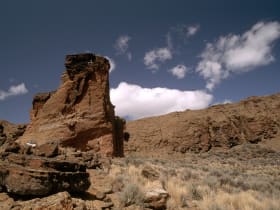
The cave adjacent to Fort Rock is where archaeologist Luther Cressman discovered sagebrush sandals in 1938.

Malheur National Wildlife Refuge
63 miles away
The refuge sits in a closed basin with no drainage to the ocean, a remnant of a much larger prehistoric lake that covered much of the Harney Basin during the last ice age.