Cabot's Pueblo Museum
67616 E Desert View Ave
Desert Hot Springs, CA
A four-story, 35-room pueblo raised by hand from salvaged wood and sun-dried brick by one stubborn desert homesteader, and never quite finished.
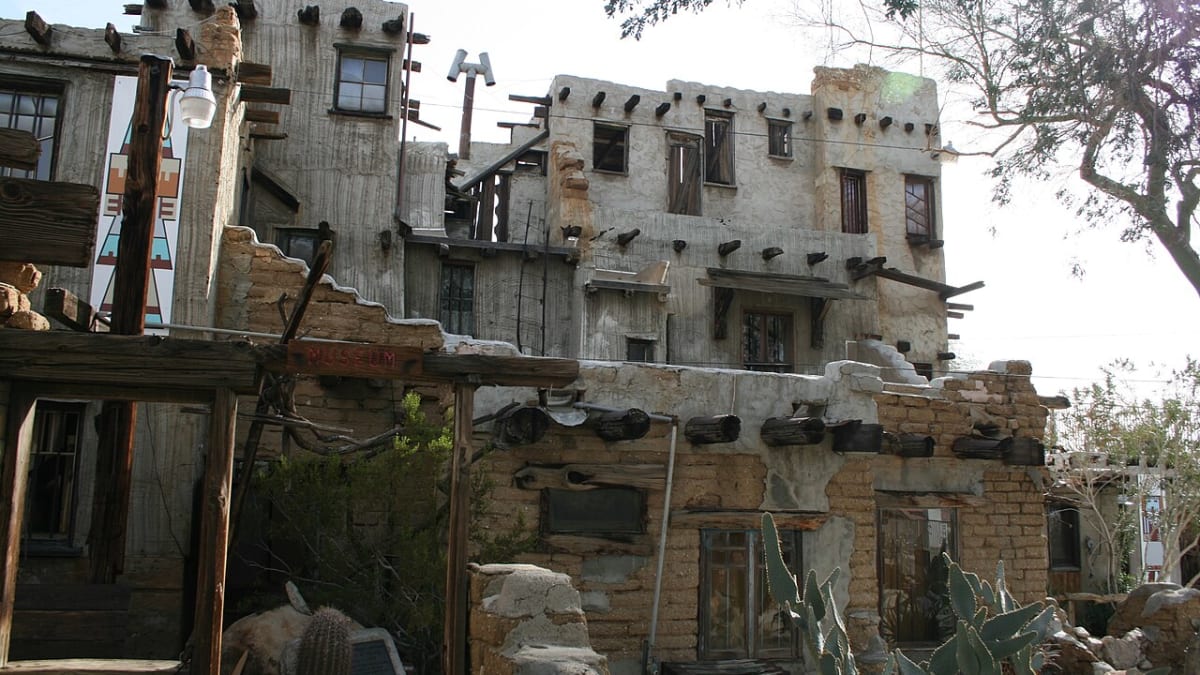
Cabot's Pueblo Museum is the strange and wonderful home that Cabot Yerxa built by hand in the Coachella Valley desert, a four-story, thirty-five-room pueblo in the Hopi Revival style made almost entirely from materials he scavenged. Doorways lean, windows come in every size, and the whole rambling structure looks less designed than grown, because Yerxa added to it room by room for the last twenty-four years of his life and never considered it done.
What makes it more than a folk-art curiosity is the man behind it. Yerxa was an adventurer who homesteaded here in 1913, and while digging wells by hand he struck two aquifers on opposite sides of his hill, one of them a natural hot spring. That water is the reason the town of Desert Hot Springs exists at all, which makes this odd handmade pueblo something close to the place where the whole community began.
What Travelers Love
- The wonderfully irregular hand-built pueblo, where no two windows or doorways match
- Cabot Yerxa's story, told room by room on the guided tour
- The folk-art feel of a place built entirely from what the desert and its ghost cabins gave up
- Meditative Trails and the towering Waokiye monument carved from a single log outside
Worth Knowing
- The interior is seen by guided tour; check the current schedule before you drive out
- It is a hot-summer desert, so morning visits in the warm months are far more comfortable
- The building is historic and uneven, with stairs and narrow passages, so wear steady shoes
- It sits above the town on a hill, so bring water and sun protection even for the grounds
Learn about Cabot's Pueblo Museum
The story of Cabot Yerxa and his pueblo
Cabot Abram Yerxa was born in 1883 and lived several lives before the desert, including a stint selling goods in Alaska during the Klondike gold rush. In 1913 he filed a homestead claim on 160 acres of raw Coachella Valley desert, hauling water and supplies by hand across ground that most people considered worthless.
Digging wells with a pick and shovel, he found two separate aquifers on either side of his hill, split by the Mission Creek Fault, a branch of the great San Andreas. One well came up cold and one came up hot, around 110 degrees, and that hot mineral water is what later gave rise to the spas and resorts that named the town.
Yerxa began the pueblo itself in 1941, when he was already in his late fifties, and kept building until he died in 1965. He used sun-dried adobe bricks he made himself and lumber salvaged from abandoned homestead cabins, reusing old nails and windows, which is why nothing quite lines up. He dedicated the Hopi-style pueblo as a tribute to Native peoples, though the Cahuilla are the people whose homeland this desert actually is.
After Yerxa's death the building fell into disrepair and was nearly lost, until an actor named Cole Weston and later the city stepped in to save it. Today it is a museum and a designated historic site, still full of the artifacts, art, and homesteading gear Yerxa gathered over a lifetime.
Walking through the pueblo
Inside, the pueblo is a warren of small rooms, low passages, and staircases that turn in unexpected directions. Yerxa built it to work with the desert climate the way older Pueblo builders did, using thick adobe walls and clever placement of windows to hold the cool of the night deep into the day.
The rooms are hung with Yerxa's collection of Native American and Alaska Native art and artifacts alongside the plain tools and furniture of a homesteader's life, so a single visit moves between the personal and the museum-like. Because the whole place was improvised, the pleasure is in the details: a window salvaged from one cabin set beside a door from another, a wall that bulges where the hillside pushed back.
Waokiye and the grounds
Standing guard outside is Waokiye, which means Traditional Helper, a forty-three-foot monument carved from a single giant sequoia log by the sculptor Peter Wolf Toth. It is one of a series of large Native American tributes Toth placed in all fifty states, and it gives the entrance its unmistakable landmark.
The grounds also hold short interpretive and meditative trails and a trading post, and the hillside setting opens onto long views across the valley toward the San Jacinto and San Gorgonio mountains. Even without a tour ticket, the exterior and the sculpture are worth the drive up the hill.
The desert around it
This is the Colorado Desert, the low, hot western arm of the Sonoran, and the plants and animals here are built for extremes: creosote and smoke trees, roadrunners, black-tailed jackrabbits, and the occasional coyote crossing at dusk. Spring can bring wildflowers to the surrounding slopes after a wet winter.
Summers are genuinely severe, with daytime highs that can push past 110 degrees, so the comfortable seasons run from about October into May. Winter days are often warm and clear, which is exactly why the mineral-water spa town below fills up in the cooler months.
Closest Boutels
The closest Boutel™ stays, so you can turn this stop into an overnight. Each is a place we chose through independent editorial review, never a paid placement.
Miracle Manor Boutique Hotel & Spa
Boutel67621 Desert View Ave, Desert Hot Springs, CA
1 miles away|Learn More ›
Details
Desert Hot Springs, CA
Frequently asked questions
What is Cabot's Pueblo Museum?
Cabot's Pueblo Museum, in Desert Hot Springs near Palm Springs, California, is a fascinating historic home and museum, a sprawling, handmade pueblo-style dwelling built over decades by the eccentric pioneer Cabot Yerxa using largely reclaimed and found materials. Inspired by Hopi architecture, the rambling, multi-story adobe structure with its many rooms, nooks, and irregular windows is filled with Yerxa's collections of Native American and other artifacts from his adventurous life. A quirky architectural marvel and a window into desert pioneer history, Cabot's Pueblo Museum offers a unique and intriguing tour of one man's remarkable handmade creation.
What can you see at Cabot's Pueblo Museum?
On a tour of the pueblo, you can explore the many rooms of the fascinating handmade adobe structure, admire its quirky, irregular architecture built from reclaimed materials, and view Cabot Yerxa's extensive collections of Native American artifacts, art, and mementos from his travels and pioneering life. The grounds also feature artwork and gardens. Guided tours share the remarkable story of Yerxa and his creation. With its extraordinary architecture, historical collections, and the compelling tale of its builder, Cabot's Pueblo Museum offers a distinctive and memorable glimpse into desert pioneer history and one man's creative vision.
How do you visit Cabot's Pueblo Museum?
The pueblo's interior is typically seen by guided tour, which leads visitors through the rooms while sharing the history of Cabot Yerxa and the building, and the grounds and some areas may be explored as well, so checking current tour times, hours, and admission before you go is important, since the museum keeps specific hours and may vary seasonally. Reservations may be recommended for tours. Planning around the tour schedule ensures you can experience the interior of this remarkable structure. Confirming the latest visiting information helps you make the most of a visit.
When is the best time to visit Cabot's Pueblo Museum?
The cooler months from fall through spring are the most comfortable for visiting, especially since part of the experience involves the grounds and the desert climate, while summer in Desert Hot Springs is very hot, so if visiting then, morning tours are best. The museum keeps set hours that can vary seasonally, so checking the current schedule before you go is essential. A visit including a tour takes about an hour or two. For the most pleasant experience, plan a visit during the cool season, confirming tour times in advance.
What is near Cabot's Pueblo Museum?
The museum is in Desert Hot Springs, known for its natural hot springs and spas, near Palm Springs and the Coachella Valley resort towns with their shopping, dining, and the Palm Springs Aerial Tramway, and within reach of Joshua Tree National Park to the north. That makes Cabot's Pueblo Museum a quirky and historic stop to combine with the hot springs of Desert Hot Springs, the attractions of Palm Springs and the Coachella Valley, and nearby Joshua Tree on a Southern California desert visit.
Nearby

Palm Springs Art Museum
9.1 miles away
A surprisingly serious art museum for a desert resort town, and a landmark of Palm Springs midcentury desert modernism in its own right.
Palm Springs Aerial Tramway
13 miles away
The world's largest rotating tram car climbs two and a half miles up the sheer walls of Chino Canyon, lifting you from the hot desert floor of Palm Springs to the cool pine forest of Mount San Jacinto...
Pioneertown
14 miles away
A frontier town built in 1946 as a movie set you could actually live in, where the false-front saloons hid real ice cream parlors and cowboy stars owned the street.

Indian Canyons
14 miles away
Indian Canyons is a set of palm-shaded desert canyons in the San Jacinto foothills just south of Palm Springs, cared for by the Agua Caliente Band of Cahuilla Indians.
Pioneertown Mountains Preserve
15 miles away
Twenty-five thousand free-to-explore acres of red-rock canyons, granite boulders, desert springs, and Joshua trees above Pioneertown, the uncrowded flip side of nearby Joshua Tree.

Joshua Tree National Park
16 miles away
Where the Mojave and Colorado deserts meet, dotted with twisting Joshua trees and giant granite boulders.
Noah Purifoy Outdoor Desert Art Museum
17 miles away
A free, ten-acre desert field of more than a hundred monumental sculptures built from salvaged, found materials by pioneering assemblage artist Noah Purifoy.
Living Desert Zoo and Gardens
18 miles away
The Living Desert is a zoo and botanical garden in Palm Desert focused specifically on desert ecosystems from around the world.

Desert View Trail
20 miles away
The Desert View Nature Trail near the Jumbo Rocks campground in Joshua Tree National Park is a 1.3-mile self-guided loop with interpretive signs explaining desert ecology, geology, and specific plants...