

Bonneville Salt Flats
Bonneville Salt Flats, Utah
Wendover, UT
A vast, dead-flat plain of blinding white salt stretching to the horizon, where the fastest cars on earth chase land-speed records and rain turns the ground into a mirror.
The Bonneville Salt Flats are one of the strangest and most striking landscapes in the country, a vast plain of hard, blindingly white salt that stretches dead flat to the horizon in Utah's western desert. Nothing grows here, no landmark breaks the surface, and the curve of the earth is nearly visible across the shimmering white, a place that feels closer to another planet than to the mountains and canyons Utah is known for.
The flats are world famous as the home of land-speed racing, where for a century daredevils and engineers have brought their fastest machines to chase records across the long, level salt. After a rain, a thin sheet of water can turn the whole plain into an enormous mirror that reflects the sky and clouds, one of the most surreal sights in the American West.
What Travelers Love
- The surreal, blindingly white expanse of hard salt stretching flat to the horizon
- Mirror-like reflections that appear when a thin sheet of water covers the flats
- The legendary history of land-speed racing at the Bonneville Speedway
- Otherworldly photography and the strange silence of a place with no plants or landmarks
Worth Knowing
- Never drive onto the salt when it is wet, as vehicles sink and get stuck fast, and the salt corrodes them
- There is no shade, water, or services, so bring sun protection, water, and everything you need
- The glare is intense, so sunglasses are essential, and the surface can be blinding at midday
- Conditions vary with weather and season, so what looks like a hard crust can hide soft, wet salt beneath
Learn about Bonneville Salt Flats
How the salt came to be
The salt flats are the dried-up bed of an ancient lake. During the Ice Age, a huge body of water called Lake Bonneville covered much of western Utah, far larger and deeper than the Great Salt Lake that survives as its remnant. As the climate warmed and the lake shrank and evaporated, it left its dissolved minerals behind on the basin floor.
What remains is a crust of salt, mostly common table salt, laid down in a layer that in places is many feet thick and packed hard and smooth. Each winter, water pools on the flats and dissolves the surface, then evaporates in the dry summer to redeposit it, a yearly cycle of flooding and drying that keeps the plain so remarkably level and white.
The land-speed legend
The flats' extraordinary flatness and length made them the natural stage for the pursuit of pure speed. Beginning in the early twentieth century, racers laid out a course on the salt, and the Bonneville Speedway became the place where many of the world's land-speed records were set, drivers pushing streamlined cars and jet-powered machines to astonishing velocities across the white.
The tradition continues in the events known collectively as Speed Week and beyond, when enthusiasts bring homemade and factory machines of every description to see how fast they can go. The very idea of Bonneville, the long shot at a record on a plain of salt, has become part of American automotive lore, drawing pilgrims to a place that is empty most of the year.
The mirror and the light
The flats are transformed by water. When a shallow layer of rain or runoff spreads across the salt without any wind to ripple it, the plain becomes a perfect mirror, reflecting the sky, clouds, and distant mountains so completely that the horizon dissolves and photographs look like the subject is standing on the surface of the sky.
This mirror effect, along with the blinding white by day and the vivid colors of sunrise and sunset, has made the flats a magnet for photographers and filmmakers. The same water, though, is a warning: when the salt is wet it will not bear a vehicle, and countless cars have sunk to their axles by driving out onto a surface that only looked solid.
A fragile and remote place
For all their toughness, the salt flats are a fragile resource. The crust has thinned over the decades, and there is ongoing work to restore salt to the flats to keep the racing surface and the landscape intact. Visitors help by staying off the salt when it is wet and treating the surface with care.
This is genuinely remote country, hot and shadeless in summer, with no water or services on the flats themselves and the small border town of Wendover as the nearest base. Coming prepared with water, sun protection, and a full tank is essential. In return, the flats offer an experience of scale and emptiness found in few other places, a horizon of pure white under an enormous sky.
Closest Boutels
The closest Boutel™ stays, so you can turn this stop into an overnight. Each is a place we chose through independent editorial review, never a paid placement.
Details
Wendover, UT
Frequently asked questions
What are the Bonneville Salt Flats?
The Bonneville Salt Flats are a vast, otherworldly expanse of hard white salt crust in western Utah near Wendover, a remnant of the ancient Lake Bonneville that once covered much of the region. Stretching flat to the horizon, they are famous worldwide for land-speed racing and for their surreal, mirror-like beauty. Free to visit, the flats offer a landscape unlike anywhere else, whether cracked into geometric salt patterns when dry or reflecting the sky like glass when wet.
Can you drive on the Bonneville Salt Flats?
Sometimes, but only when the salt is dry and stable and only in the designated areas. Driving on wet salt damages both the flats and your vehicle and can get you stuck, so avoid it entirely when the surface is damp. When conditions allow, start slowly, since the salt drives unlike any normal road, and steer clear of any spots that feel soft. Afterward, rinse your car thoroughly, since the salt is highly corrosive to vehicles.
When is the best time to visit the Bonneville Salt Flats?
For walking or driving on the flats, the dry season, roughly summer into early fall, is best, when the salt is firm. The wetter months create a stunning mirror-like surface that is beautiful for photography but not for driving. The famous land-speed racing events, including Speed Week in August, are a spectacular time to visit, weather permitting. Sunrise and sunset are magical and cooler, so many visitors time their trip for the soft light.
What should I bring to the Bonneville Salt Flats?
Come prepared, since there are no services, shops, shade, or shelter on the flats. Bring plenty of water, snacks, sunscreen, and a full tank of fuel, and make sure your car is in good shape, since there is no help nearby. The open terrain is prone to strong wind gusts and intense sun and heat, so dress accordingly. Sunglasses help against the blinding white glare, and a hat and sun protection are essential year-round.
What is near the Bonneville Salt Flats?
The flats lie near Wendover on the Utah-Nevada border, about ninety minutes west of Salt Lake City along Interstate 80, with Wendover offering the nearest services, fuel, and lodging. The nearby Tree of Utah sculpture along the highway is a quirky roadside stop. Because the drive crosses a lot of empty desert, the salt flats are usually visited as a dedicated trip or a memorable break on a cross-state journey along I-80.
Nearby
Great Salt Lake
69 miles away
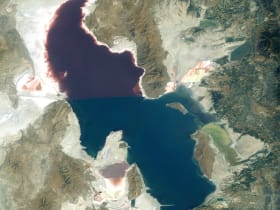
The Great Salt Lake is the largest remnant of ancient Lake Bonneville, which covered much of western Utah 14,000 years ago at depths over 1,000 feet.
Pony Express Trail, UT-36 corridor
69 miles away
The Pony Express National Historic Trail crosses the Utah West Desert on a route parallel to UT-36 and then gravel road south of I-80.