
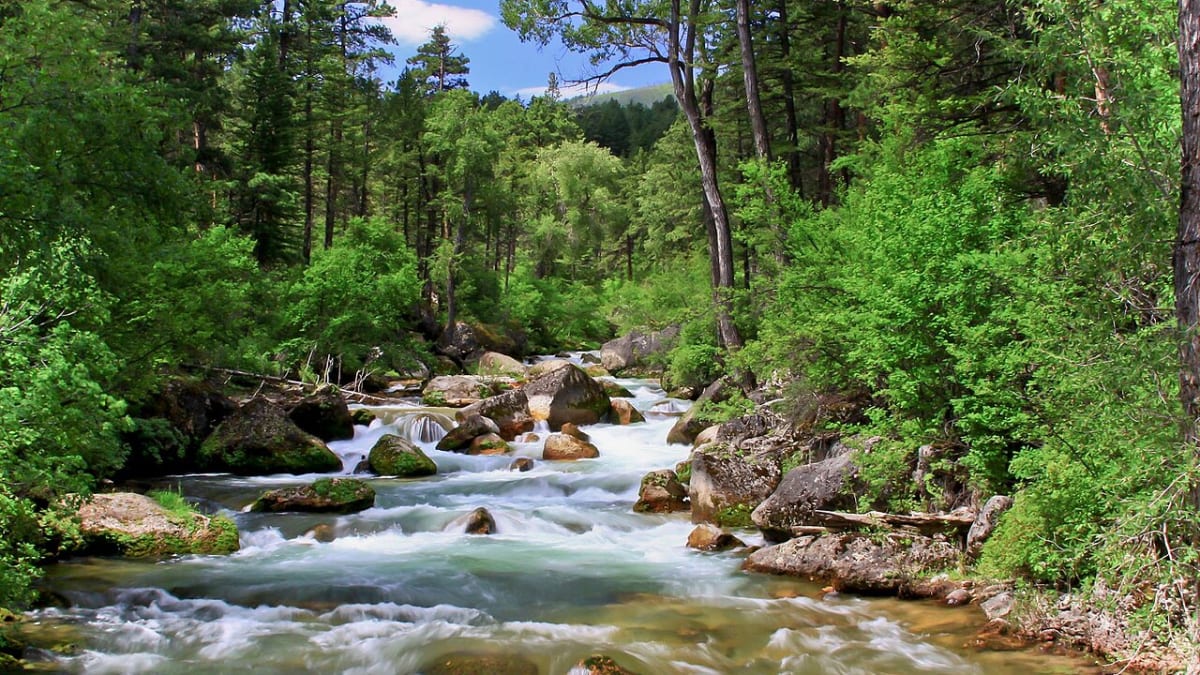
Bighorn National Forest
US Highway 16, Ten Sleep Canyon
Ten Sleep, WY
A whole mountain range hiding in plain sight, where a two-lane highway climbs from red-rock canyon to alpine tundra in under an hour.
The Bighorn National Forest is one of those places that surprises people who thought they knew the West. It is more than a million acres of true mountain country, a range that stands apart from the Rockies out on its own in north-central Wyoming, rising in a single wall from the plains around Ten Sleep to alpine tundra and 13,000-foot peaks. Set aside as a forest reserve in 1897, it is one of the oldest protected forests in the country, and it still feels wild.
What makes it special from Ten Sleep is how fast the world changes as you drive up into it. One minute you are among red canyon cliffs and cottonwoods on the valley floor, and a short climb later you are in cool spruce and fir, then in open meadows dotted with lakes, with snow lingering on the high ground into summer. Few places let you travel through so many landscapes so quickly, all on a quiet two-lane road.
What Travelers Love
- Driving the Cloud Peak Skyway, which lifts you from canyon floor to over 9,000 feet on one unhurried afternoon
- The limestone walls of Ten Sleep Canyon, world-famous among rock climbers and dramatic even from a car window
- Alpine lakes like Meadowlark, ringed by forest and open to fishing, paddling, and quiet camping
- How empty it stays, with big country, few crowds, and stars that pour out at night
Worth Knowing
- The high country is a mountain climate, so pack layers even in summer, and expect the top of the pass to close under snow from roughly fall through spring
- There are no services once you leave Ten Sleep or Buffalo, so fuel up and carry water, snacks, and a paper map before you climb
- Cell coverage is thin to none across most of the forest, which is part of the appeal but worth planning around
- Watch for cattle, deer, and slow RVs on the byway, and pull off at the marked overlooks rather than stopping in the road
Learn about Bighorn National Forest
A mountain range standing on its own
The Bighorns are not part of the main chain of the Rocky Mountains. They rise as a separate island of high country in north-central Wyoming, lifted up over the plains, which is why they feel so abrupt and so grand when you approach from the flats around Ten Sleep. At their heart is the Cloud Peak Wilderness, a rugged core of granite peaks, cirques, and hundreds of small lakes, crowned by 13,167-foot Cloud Peak, the highest point in the range.
The land was protected early. In 1897 the federal government set it aside as the Bighorn Forest Reserve, making it one of the first forest reserves in the nation, born in the same wave of conservation that created the national forest system. That long protection is part of why the range stays so intact today, a working landscape of grazing, logging, and recreation that still holds real wilderness at its center.
Long before the forest had a name on any map, the mountains were and remain deeply meaningful to Native peoples of the northern plains, including the Crow, and the range still holds sites and stories sacred to them. Traveling here means moving through a landscape that has mattered to people for a very long time.
Ten Sleep Canyon and the Cloud Peak Skyway
The gateway from the west is Ten Sleep Canyon, a deep cut of layered limestone and dolomite that the highway threads on its way up. The canyon walls are tall, pale, and pocketed, and they have made this one of the most celebrated rock-climbing destinations in the country, with hundreds of routes drawing climbers from around the world to grip that steep gray stone. Even if you never leave the car, the drive up the canyon is a show, with the creek tumbling below and the cliffs closing in overhead.
The road itself is US Highway 16, known here as the Cloud Peak Skyway. It climbs from Ten Sleep up through the canyon, over Powder River Pass at nearly 9,700 feet, and down the far side to the old cow town of Buffalo, roughly forty-five miles of steady, scenic driving. Along the way there are pull-offs and overlooks where the whole range opens up, and on a clear day you can pick out Cloud Peak itself standing above the wilderness.
The name Ten Sleep comes from the way Plains tribes measured distance in days of travel, or sleeps. This spot sat about ten sleeps, ten nights on the trail, from a large camp on the Platte River to the south and roughly the same from another camp to the north, a midway marker on an old route between them. The name is a small reminder that people have been crossing this country on foot and horseback for centuries.
Lakes, trails, and four seasons of high country
Up on the plateau the forest opens into meadows and lakes. Meadowlark Lake is the best known, a blue mountain reservoir ringed by pines just off the byway, popular for fishing, small boats and paddleboards, and easygoing camping right at altitude. Countless smaller lakes and streams lace the high country, and the fishing for trout is a big part of why people keep coming back.
For those who want to walk, trailheads lead off the highway into the forest and toward the Cloud Peak Wilderness, from short strolls to lakes and waterfalls to multi-day backpacking trips deep into the granite basins. It is a place where you can tailor the effort to the day, an hour of easy wandering or a serious mountain trek, and either way find water, rock, and long views.
The forest changes hard with the calendar. Summer is short, green, and glorious, with wildflowers in the meadows and cool nights. Fall brings gold to the aspens and elk bugling in the timber. Winter buries the high road and turns the range over to snowmobiles and cross-country skis, with a small ski hill near Meadowlark, and spring comes late, with snow on the peaks well into the warm months.
Visiting from Ten Sleep
Ten Sleep sits right at the western doorstep of the forest, so a stay here puts you minutes from the canyon and the start of the climb. The simplest first outing is just to drive up the Cloud Peak Skyway, stopping at the overlooks, poking into the canyon, and turning around whenever you like, or continuing all the way over the pass to Buffalo and back for a full-day loop through the mountains.
Plan for a real mountain trip even on a warm day. Bring layers, water, snacks, and a full tank, because once you leave town there are no stores and little to no cell signal. Give the forest more time than you think you need, since the overlooks, the lake, and a short walk to moving water have a way of stretching an afternoon. It is the kind of place that rewards slowing down, a huge, quiet range rising straight out of the plains for anyone willing to point the car uphill.
Closest Boutels
The closest Boutel™ stays, so you can turn this stop into an overnight. Each is a place we chose through independent editorial review, never a paid placement.
Details
Ten Sleep, WY
Frequently asked questions
What is Bighorn National Forest?
Bighorn National Forest covers a large, scenic swath of the Bighorn Mountains in north-central Wyoming, a rugged range of high peaks, alpine meadows, forests, glacial lakes, and rushing streams rising dramatically above the surrounding plains. The forest offers a wealth of recreation, including hiking, camping, fishing, scenic drives over the mountains, wildlife viewing, and winter snow sports, along with striking sights like deep canyons and the historic Medicine Wheel. Its high country, including the Cloud Peak Wilderness, holds some of the state's most beautiful mountain scenery. With its peaks, lakes, trails, and scenic byways, Bighorn National Forest offers a magnificent outdoor destination in north-central Wyoming.
What can you do in Bighorn National Forest?
You can hike trails ranging from easy strolls to rugged treks into the Cloud Peak Wilderness, camp at numerous campgrounds, fish the streams and glacial lakes, drive the spectacular scenic byways that cross the mountains, watch for wildlife, picnic, and in winter enjoy snowmobiling, cross-country skiing, and snow sports. Highlights include the alpine lakes, deep canyons like Shell and Ten Sleep, and the historic Medicine Wheel. The high country is a paradise for outdoor lovers. With its hiking, camping, fishing, scenic drives, and winter recreation, Bighorn National Forest offers a magnificent outdoor experience in north-central Wyoming.
What should I know before visiting Bighorn National Forest?
The forest reaches high elevation where weather changes quickly and can turn cold, windy, or stormy even in summer, with afternoon thunderstorms and lingering snow, so bring warm layers, rain gear, water, and sun protection, and be ready for thin air. The high passes and roads are often snowbound and closed in the colder months, so check road and trail conditions before you go. It is wildlife country, including bears, so store food properly. Being prepared for the high-country weather, seasonal road closures, and wildlife ensures a safe visit to Bighorn National Forest in north-central Wyoming.
When is the best time to visit Bighorn National Forest?
Summer through early fall is the prime time for hiking, camping, fishing, and scenic driving, when the high roads are open, the weather is mildest, and the alpine meadows bloom, with fall bringing beautiful color, while winter transforms the forest into a snowmobiling and snow-sports destination once the high roads close to cars. Even summer nights are cold at elevation. For warm-weather mountain recreation aim for summer through early fall, and for snow sports visit in winter, enjoying Bighorn National Forest's year-round appeal in north-central Wyoming.
What is near Bighorn National Forest?
Bighorn National Forest spans the Bighorn Mountains of north-central Wyoming, near the towns of Sheridan, Buffalo, Lovell, and Ten Sleep, containing Shell Canyon and Shell Falls, Ten Sleep Canyon, the Medicine Wheel, and near Bighorn Canyon National Recreation Area. That makes Bighorn National Forest a magnificent outdoor destination to combine with the Medicine Wheel, Shell Canyon, Ten Sleep Canyon, and the other attractions of north-central Wyoming on a visit to the state.
Nearby

Ten Sleep Canyon and the Cloud Peak Skyway
6.8 miles away
The Cloud Peak Skyway climbs from the ranch town of Ten Sleep up through Ten Sleep Canyon, a deep cut walled in pale limestone cliffs, then over 9,666-foot Powder River Pass and across the high green...
Shell Canyon and Shell Falls
40 miles away
Shell Canyon on US-14 east of Greybull is a 10-mile slot through Precambrian granite and limestone where Shell Creek drops 120 feet over a hard granite ledge at Shell Falls.
Wyoming Dinosaur Center
57 miles away
The Wyoming Dinosaur Center has one of the most complete Supersaurus specimens ever found (105 feet long) alongside Triceratops, Stegosaurus, and other Jurassic-era fossils excavated from the Morrison...
Hot Springs State Park
57 miles away
Hot Springs State Park in Thermopolis contains the world's largest mineral hot springs by volume, with Big Spring releasing 3.6 million gallons of 135-degree water every day.