
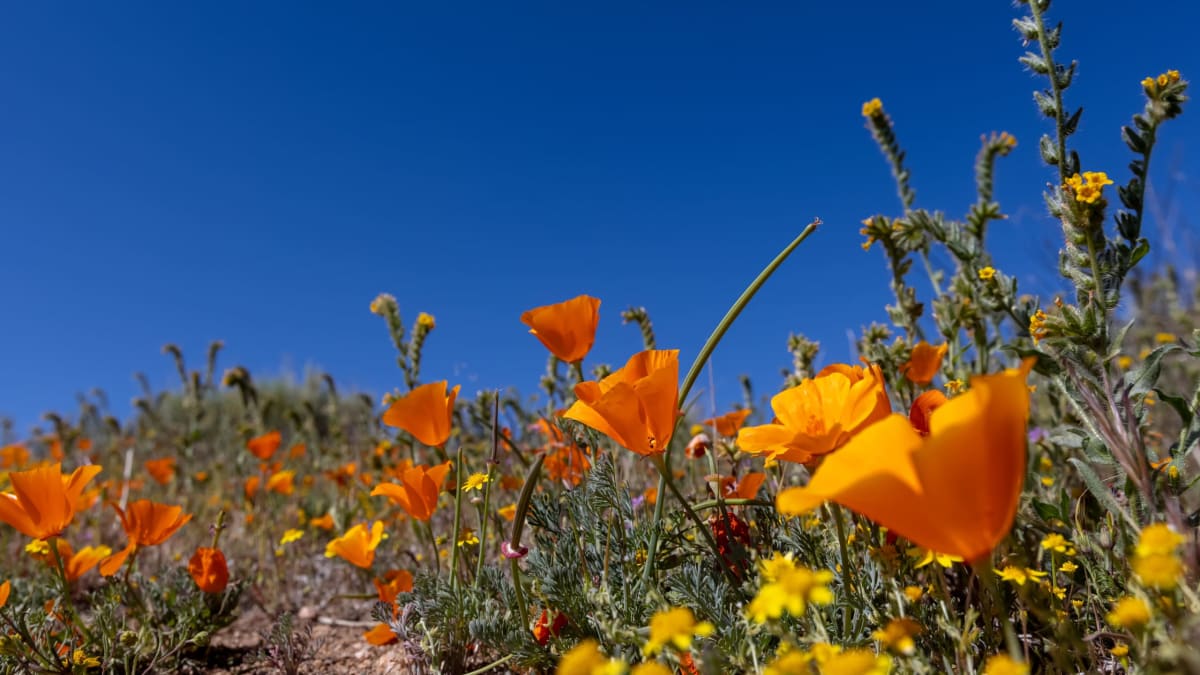
Antelope Valley California Poppy Reserve
15101 Lancaster Rd
Lancaster, CA
In a good spring the hills here turn solid orange with California's state flower, a wildflower show a self-taught artist spent years fighting to protect.
For a few weeks most springs, the Antelope Valley California Poppy Reserve becomes one of the most vivid landscapes in the state, when its rolling hills fill in with California poppies until whole slopes glow a deep, saturated orange. On a good year the color runs to the horizon, and the reserve draws tens of thousands of visitors chasing the state flower at its peak.
What almost no one realizes as they walk the loops is that this protected valley exists because one determined person refused to let it be paved over. The poppies are wild and fickle, tied entirely to the winter rains, but the land they grow on was saved on purpose, with help from schoolchildren across California.
What Travelers Love
- Whole hillsides glowing orange with California poppies in a strong bloom year
- Miles of gentle loop trails that let you walk out into the color
- The Jane S. Pinheiro Interpretive Center and the story behind the reserve
- Other desert wildflowers, from goldfields to owl's clover, mixed through the poppies
Worth Knowing
- The bloom is entirely weather-dependent; it hinges on winter rain and can be spectacular one year and sparse the next
- Peak color usually lands somewhere between mid-March and mid-April, but it shifts, so check the current bloom report before driving out
- Poppies close up on cold, gray, or windy days, so aim for a warm sunny midday for the fullest display
- Stay on the trails; the flowers and the fragile soil are easily trampled, and peak weekends draw big crowds
Learn about Antelope Valley California Poppy Reserve
The woman who saved the poppies
In the 1940s a Lancaster resident named Jane S. Pinheiro, a self-taught wildflower artist, watched development creep across the Antelope Valley and worried that its famous poppy fields would vanish. She dreamed of a Poppy Park and spent years working with the Wildflower Preservation Committee, the Lancaster Woman's Club, and state parks advocates to raise money and buy the land.
Part of the funding came from an unlikely source: schoolchildren across California collected Pennies for Poppies to help protect the state flower. Those combined efforts paid off, and the Antelope Valley California Poppy State Natural Reserve officially opened in 1976. The interpretive center at the reserve carries Jane Pinheiro's name and displays her wildflower paintings.
Why the bloom comes and goes
The California poppy is a wildflower, not a planted crop, and its show here depends almost entirely on the weather. A wet winter with well-timed rain and mild temperatures can trigger a blanket bloom, while a dry year can leave the hills mostly green or brown. That unpredictability is the whole character of the place, and part of why a big year feels like such an event.
Timing matters even day to day. Poppies open to the sun and close in cold, wind, or heavy overcast, so the reserve looks completely different at nine in the morning than at noon. The reliable advice is to come on a warm, calm, sunny day near the middle of the day, and to check the current bloom status first, since peak can arrive anywhere from March into April.
More than poppies: a high-desert grassland
The reserve protects a slice of the Mojave grassland, a transition zone where the western desert grades into the Tehachapi foothills. Even in the poppies you will find a wider palette of spring wildflowers, including yellow goldfields, cream cups, and purple owl's clover, that fill the spaces between the orange.
It is living habitat as well as a flower show. Meadowlarks and horned larks sing over the grass, and the open country supports jackrabbits, ground squirrels, and the raptors that hunt them. The valley took its name from the pronghorn antelope that once ranged here in large numbers before settlement pushed them out.
Walking the reserve
A network of gentle loop trails threads out from the visitor center across the hills, so you can choose a short stroll or a longer walk into the color. Even in a modest bloom year, getting out on the trails and down among the flowers is far more rewarding than viewing from the parking lot.
The wind is nearly constant out here, and there is little shade, so a hat and layers help. The reserve is busiest on peak-bloom weekends, when parking fills early; a weekday visit, or an early or late hour, trades a little light for a lot more room.
Closest Boutels
The closest Boutel™ stays, so you can turn this stop into an overnight. Each is a place we chose through independent editorial review, never a paid placement.
Safari Inn, a Coast Hotel
Honorable Mention1911 West Olive Avenue, Burbank, CA
39 miles away|Learn More ›
Details
Lancaster, CA
Frequently asked questions
What is the Antelope Valley California Poppy Reserve?
The Antelope Valley California Poppy Reserve, near Lancaster in the high desert north of Los Angeles, California, is a state natural reserve famous for its spectacular spring displays of California poppies, the state flower. In years with good rainfall, the reserve's rolling hills erupt in dazzling carpets of brilliant orange poppies, along with other wildflowers, creating a breathtaking natural spectacle that draws visitors from far and wide. With trails winding through the blooming hills and a visitor center, the reserve offers a beautiful and uniquely Californian experience celebrating the golden poppy in its natural high-desert grassland habitat.
When do the poppies bloom at the Antelope Valley California Poppy Reserve?
The California poppies typically bloom in spring, usually sometime from around March through May, with the exact timing and intensity varying significantly from year to year depending on winter and spring rainfall and temperatures. In wet years, the bloom can be a spectacular superbloom of vivid orange, while in dry years it may be sparse or brief. Because it is so weather-dependent, checking recent bloom reports and the reserve's updates before you go is essential to time your visit for peak color. When conditions align, the poppy display is truly unforgettable.
What can you do at the Antelope Valley California Poppy Reserve?
During the bloom, you can walk the network of trails winding through the hills covered in brilliant orange poppies and other wildflowers, take in the stunning scenery, photograph the vivid displays, and learn about the poppies and desert ecology at the visitor center. The trails range from easy paved paths to longer routes. It is important to stay on the trails to protect the delicate flowers. With its breathtaking spring wildflower displays and scenic trails, the reserve offers a beautiful and memorable experience celebrating California's iconic golden poppy in the high desert.
What should I know before visiting the Antelope Valley California Poppy Reserve?
The bloom is highly weather-dependent and varies by year, so check current bloom reports before you go, since visiting outside peak bloom or in a dry year may mean few flowers. Stay on the trails to protect the fragile poppies, and note the reserve can be windy, cold, or hot depending on the day, so dress accordingly and bring water and sun protection. During peak bloom, it gets very crowded with limited parking, so arrive early. Timing your visit to the bloom, staying on trails, and preparing for the weather ensure the best experience.
What is near the Antelope Valley California Poppy Reserve?
The reserve is near Lancaster in the Antelope Valley of the high desert north of Los Angeles, within reach of the Mojave Desert, the town of Lancaster and Palmdale, and the broader Los Angeles region to the south. That makes the Antelope Valley California Poppy Reserve a spectacular spring wildflower stop to combine with the high desert attractions of the Antelope Valley and, with a drive, the many attractions of the Los Angeles area on a Southern California visit, especially during the springtime poppy bloom.
Nearby
Mulholland Drive Overlook
42 miles away
Mulholland Drive runs 24 miles along the crest of the Santa Monica Mountains from Cahuenga Pass (at US-101) to Leo Carrillo State Beach on the Pacific Coast Highway.
Griffith Park
42 miles away
Griffith Park covers 4,310 acres in the eastern Santa Monica Mountains within Los Angeles, making it one of the largest urban parks in North America.

Griffith Observatory
42 miles away
A free public observatory high on Mount Hollywood in Griffith Park, open since 1935.

Channel Islands National Park
59 miles away
Five undeveloped islands off the California coast, home to plants and animals found nowhere else on Earth.