
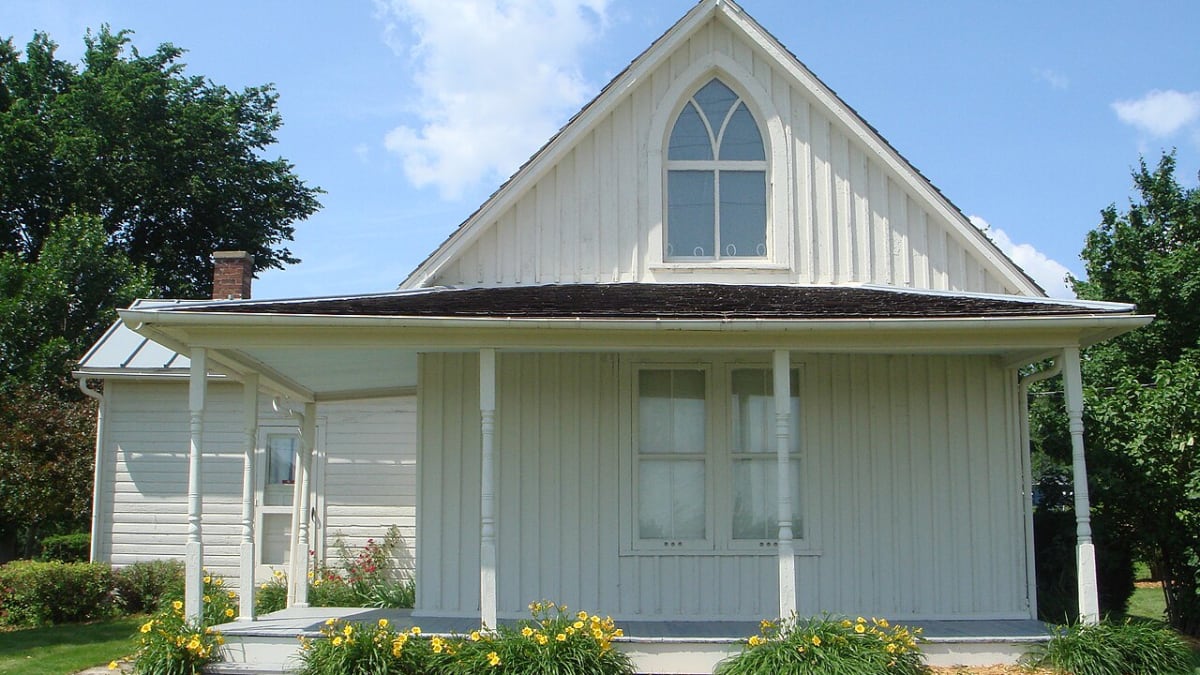
American Gothic House
305 American Gothic St, Eldon, IA
Eldon, IA
The plain white cottage with the pointed window that Grant Wood turned into the most parodied painting in America, still standing in a quiet southern Iowa town.
The American Gothic House is the small white cottage in Eldon, Iowa, that Grant Wood placed behind the stern farmer and his daughter in his 1930 painting American Gothic, one of the most recognized images in American art. Wood was struck by the house's odd, pretentious touch, a pointed Gothic Revival window set into an otherwise humble frame home, and it became the backdrop for a picture that has been endlessly copied and parodied ever since.
The house still stands on its quiet street, now cared for by the State Historical Society of Iowa, with a visitor center next door that tells the story of the painting and the man who made it. Travelers come from around the world to pose out front in the pose of the famous couple, making a plain Iowa cottage into an unlikely pilgrimage site.
What Travelers Love
- Posing in front of the exact house from the painting, pitchfork optional
- The pointed Gothic Revival window that inspired the whole picture
- A visitor center that tells the story of Grant Wood and the painting
- The chance to see a small Iowa town that became world-famous
Worth Knowing
- The house interior is preserved, so respect that it is a historic building
- The visitor center has costumes and props for the classic photo out front
- The site welcomes visitors and is easy to pair with nearby river towns
- Eldon is small, so plan meals and fuel around the larger towns nearby
Learn about American Gothic House
Grant Wood and the painting
Grant Wood was a Cedar Rapids painter and a leading figure of American Regionalism, the movement that turned away from European modernism to depict the rural Midwest with clear-eyed affection. In 1930, on a visit to Eldon, he spotted the little frame house with its incongruous Gothic window and sketched it on the back of an envelope, taken with the idea of the people who might live in so pretentiously trimmed a cottage.
Back in his studio he painted the house behind two figures: his dentist stood in as the grim farmer, and his sister Nan posed as the woman beside him. The finished work, American Gothic, won a prize at the Art Institute of Chicago and made Wood famous almost overnight. The painting has been read as everything from a tribute to Midwestern steadfastness to a gentle satire, and Wood himself kept its meaning teasingly open.
The house itself
The house was built in the 1880s in a modest style sometimes called Carpenter Gothic, in which builders added Gothic Revival flourishes to ordinary wood-frame homes. The upstairs window with its pointed arch, meant to lend a touch of grandeur to a small house, is precisely the detail that caught Grant Wood's eye and gave the painting its name.
Now owned by the State Historical Society of Iowa, the house has been preserved much as it looked in Wood's day, and the adjacent visitor center interprets both the building and the painting. Visitors are welcome to stand in front for the classic photo, and the center often has a pitchfork and old-fashioned costumes on hand to complete the scene.
American Regionalism and Iowa
Grant Wood was part of a trio of American Regionalist painters, alongside Thomas Hart Benton and John Steuart Curry, who in the 1930s celebrated the everyday life and landscapes of the American heartland. Their rise coincided with the Great Depression, when many Americans looked to the steady rhythms of farm and small-town life for a sense of national identity.
Wood spent most of his life in eastern Iowa and drew constantly on its rolling fields, rounded hills, and tidy farms, which he painted with an almost sculptural smoothness. American Gothic remains his best-known work, but his stylized Iowa landscapes, on view in museums in Cedar Rapids and elsewhere, are equally beloved, and the American Gothic House anchors his legacy in the very place that inspired it.
The southern Iowa river country
Eldon lies in the Des Moines River country of southeast Iowa, ancestral homeland of the Ioway, for whom the state is named, along with the Sauk and Meskwaki peoples who lived and traveled these river valleys. Their descendants remain part of Iowa today, with the Meskwaki owning their Settlement to the northwest near Tama.
The surrounding region is a quiet quilt of farm towns and historic river settlements, including the well-preserved villages of Van Buren County a short drive south. Travelers who make the trip for the famous house often find the slow back roads, courthouse squares, and river bluffs of southern Iowa a reward in themselves.
Closest Boutels
The closest Boutel™ stays, so you can turn this stop into an overnight. Each is a place we chose through independent editorial review, never a paid placement.
Details
Eldon, IA
Frequently asked questions
What is the American Gothic House?
The American Gothic House, in the small town of Eldon in southeastern Iowa, is the modest white farmhouse that served as the backdrop for Grant Wood's iconic 1930 painting American Gothic, one of the most famous and most parodied images in American art. The little house, with its distinctive pointed Gothic-style upstairs window, still stands and looks much as it did in the painting, and an adjacent visitor center tells the story of the artwork, the artist, and the image's enduring fame. Visitors can pose in front of the house recreating the famous pose. With its art history and photo-worthy fame, the American Gothic House offers a delightful destination in Eldon, Iowa.
What can you do at the American Gothic House?
You can see the famous farmhouse in person, pose in front of it recreating the iconic American Gothic painting, sometimes with costumes and a pitchfork provided by the visitor center for fun photos, and explore the visitor center's exhibits on Grant Wood, the making of the painting, and the countless parodies and pop-culture references it has inspired. The photo opportunity and the art history are the highlights. It is a fun, quick stop for art lovers and travelers. With its iconic house, playful photo op, and visitor center, the American Gothic House offers an enjoyable visit in Eldon, southeastern Iowa.
What is the American Gothic painting?
American Gothic is a famous 1930 painting by Iowa artist Grant Wood, depicting a stern-looking farmer holding a pitchfork standing beside a woman, in front of a white house with a distinctive pointed Gothic window, the very house in Eldon. One of the most recognizable works in American art, it has been endlessly reproduced and parodied and is often seen as an emblem of rural American values and the Midwest. Wood used the Eldon house as inspiration for the setting. Learning the painting's story enriches a visit to the American Gothic House, its real-life backdrop, in Eldon, Iowa.
When is the best time to visit the American Gothic House?
The house itself can be viewed from outside year-round as an outdoor landmark, with late spring through fall offering the mildest weather for photos and lingering, while the adjacent visitor center typically keeps seasonal hours and is often closed some days, so checking current times before you go is wise, especially if you want the costumes and exhibits. Summer is the peak visiting season. For the best combination of pleasant weather and full visitor-center access, aim for late spring through fall at the American Gothic House in Eldon, Iowa.
What is near the American Gothic House?
The American Gothic House is in the town of Eldon in southeastern Iowa, within reach of the historic Villages of Van Buren and Lacey-Keosauqua State Park, the Old Threshers Heritage Museum at Mount Pleasant, and Lake Wapello State Park. That makes the American Gothic House a fun stop to combine with the Villages of Van Buren, the Old Threshers Heritage Museum, and the other attractions of southeastern Iowa on a visit to the state.
Nearby
Lacey-Keosauqua State Park
19 miles away
Lacey-Keosauqua State Park fills a big bend of the Des Moines River near Keosauqua, among the largest parks in Iowa.
Lake Wapello State Park
20 miles away
Lake Wapello State Park near Drakesville is an easy family lake base in the southern Iowa hills.

Villages of Van Buren and Bentonsport
20 miles away
The Villages of Van Buren are a set of small, deeply preserved river towns along the Des Moines River in southeast Iowa, a corner of the state that time mostly passed over.