
Alaska SeaLife Center
301 Railway Ave
Seward, AK
Part aquarium, part research lab, and part wildlife hospital, standing on the shore of Resurrection Bay as Alaska's only center of its kind.
The Alaska SeaLife Center is the only public aquarium, cold-water marine research institute, and wildlife rehabilitation hospital in Alaska, all under one roof on the Seward waterfront. Visitors come for the Steller sea lions, harbor seals, puffins, and octopus, but the tanks are only the front half of the building. Behind them, scientists study the cold seas of the North Pacific and veterinarians treat animals found sick, injured, or orphaned along Alaska's coast.
The center owes its existence to a disaster. It was built with funds from the settlement over the 1989 Exxon Valdez oil spill, which killed hundreds of thousands of seabirds and thousands of marine mammals in these waters. The building that resulted turned that grief into a permanent place for research and rescue, so the next crisis would meet a prepared response.
What Travelers Love
- Watching Steller sea lions cruise past two-story underwater viewing windows
- The seabird habitat where puffins dive and swim at eye level
- Touch tanks with anemones, sea stars, and other tidepool life
- Knowing that admission helps fund the rescue of stranded seals, otters, and birds
Worth Knowing
- It is a working research and rehabilitation facility, so some animals on view are patients or study subjects
- Behind-the-scenes and animal encounter programs are worth booking ahead if you want a closer look
- Plan for one to two hours, longer if you catch a feeding or a talk
- Seward's weather is cool and often wet even in summer, so the indoor center is a good rainy-day option
Learn about Alaska SeaLife Center
Born from the Exxon Valdez spill
On March 24, 1989, the tanker Exxon Valdez ran aground on Bligh Reef in Prince William Sound and spilled roughly eleven million gallons of crude oil into some of the richest marine waters in the world. The toll on wildlife was staggering, and the spill exposed how little scientific and veterinary capacity existed to respond in Alaska.
Part of the legal settlement that followed was directed toward building a permanent marine science and rehabilitation facility. The Alaska SeaLife Center opened in Seward in 1998, giving the state a year-round base for cold-water research and a hospital ready to receive stranded and oiled animals.
That origin still shapes the mission. The center is not only a place to see marine life but a place built to protect it, with the spill a standing reminder of why that work matters.
What you see inside
The signature exhibits are the deep habitat tanks, where Steller sea lions and harbor seals glide past tall windows that let you watch them swim and dive from below. Steller sea lions are enormous, and seeing one bank past the glass at close range is the moment most visitors remember.
The seabird habitat is an open aviary where horned and tufted puffins, common murres, and other North Pacific birds nest on rock ledges and dive into a pool, often swimming right up to the viewing glass. Touch tanks let visitors gently feel sea stars, anemones, and other tidepool creatures, and rotating exhibits feature giant Pacific octopus and the strange life of the cold deep.
Because it is a research and rehab facility, some of what you see is active science. Talks and feedings throughout the day explain the animals and the work behind them.
The wildlife hospital
The center runs the only permanent marine mammal and seabird rehabilitation program in Alaska. Each year its staff respond to reports of stranded harbor seal pups, orphaned sea otters, sick sea lions, and struggling seabirds from across the state's vast coastline.
Animals that recover are released back to the wild when possible. Some that cannot survive on their own become long-term residents or ambassadors at accredited facilities. A share of every admission and membership goes toward this work, so visiting directly supports the rescues.
The hospital also positions Alaska to respond to future oil spills or mass strandings with trained people, equipment, and space already in place, exactly the readiness that was missing in 1989.
Seward and Resurrection Bay
Seward is a compact town wrapped around a working harbor at the head of Resurrection Bay, ringed by steep peaks and glaciers. It marks the southern end of the historic Iditarod Trail and the terminus of the Alaska Railroad's run down from Anchorage, a spectacular ride in its own right.
The town is the launching point for boat tours into Kenai Fjords National Park, where tidewater glaciers calve into the sea and whales, sea otters, and seabird colonies are common. Between the fjords, the trail up to Exit Glacier, and the SeaLife Center, Seward packs a lot of Alaska into a small footprint.
Closest Boutels
The closest Boutel™ stays, so you can turn this stop into an overnight. Each is a place we chose through independent editorial review, never a paid placement.
Details
Seward, AK
Frequently asked questions
What is the Alaska SeaLife Center?
The Alaska SeaLife Center, in Seward on the Kenai Peninsula, Alaska, is a wonderful public aquarium, marine research center, and wildlife rescue facility on the shore of Resurrection Bay. The center lets visitors get close to the marine life of Alaska's cold waters, with habitats for seabirds, seals, sea lions, sea otters, fish, and other creatures, along with touch tanks and exhibits, while also serving as an important center for marine research and for rescuing and rehabilitating stranded marine animals. Its combination of engaging exhibits and real conservation work makes it a fascinating stop. A delightful and meaningful marine center, it educates and charms visitors. With its marine life, the Alaska SeaLife Center offers a compelling destination in Alaska.
What can you see at the Alaska SeaLife Center?
You can see habitats for seabirds like puffins, seals, sea lions, sea otters, fish, and other Alaska marine life, explore touch tanks and exhibits, watch the animals up close, and learn about the center's marine research and wildlife rescue work. The marine animal habitats, the touch tanks, the seabirds and marine mammals, and the conservation work are the draws, making it a fascinating and family-friendly visit. Getting close to Alaska's sea creatures is a highlight. With its exhibits, the Alaska SeaLife Center offers a rewarding visit in Seward, Alaska.
Is the Alaska SeaLife Center good for families?
Yes, the Alaska SeaLife Center is wonderful for families, with touch tanks, close-up views of puffins, seals, sea otters, and other marine life, and engaging exhibits that delight and educate children and adults alike. The hands-on tanks and charming animals especially captivate kids, while the conservation work adds meaning. Its indoor setting is comfortable in any weather. Its family appeal makes the Alaska SeaLife Center a delightful destination in Alaska.
When is the best time to visit the Alaska SeaLife Center?
As a mostly indoor center, the Alaska SeaLife Center is enjoyable year-round in any weather, making it a great stop and a welcome refuge on a cool or rainy day, with summer bringing the fullest hours and the liveliest season in Seward. Because hours can vary by season, checking the current schedule before you go is wise. Because it is indoors, the Alaska SeaLife Center makes a rewarding stop any time of year in Seward, Alaska.
What is near the Alaska SeaLife Center?
The Alaska SeaLife Center is in Seward on the Kenai Peninsula, Alaska, on Resurrection Bay, within reach of Kenai Fjords National Park and Exit Glacier, Mount Marathon above the town, the Seward harbor, and the routes toward Anchorage. That makes the Alaska SeaLife Center a compelling stop to combine with Kenai Fjords National Park and the other attractions of Seward on a visit to Alaska.
Nearby

Mount Marathon
0.6 miles away
Mount Marathon rises almost straight up behind Seward and hosts North America's oldest mountain race every Fourth of July.
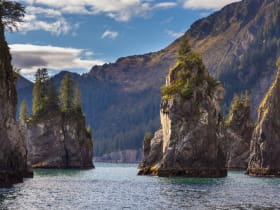
Kenai Fjords National Park
8.7 miles away
Nearly 40 glaciers pour off the Harding Icefield down to a coast of fjords, whales, and seabirds.

Exit Glacier
8.9 miles away
The only road-accessible part of Kenai Fjords National Park, Exit Glacier is a walk-up river of ice flowing off the vast Harding Icefield.

Harding Icefield Trail
9.7 miles away
The Harding Icefield Trail climbs about 3,500 feet in roughly four miles from the Exit Glacier area to a jaw-dropping overlook of the Harding Icefield, a vast sheet of ice that feeds dozens of glacier...

Bear Glacier
9.7 miles away
Bear Glacier is the largest glacier in Kenai Fjords National Park, ending in a lagoon studded with enormous, sculpted icebergs that break off its face and drift on the water.

Aialik Glacier
16 miles away
Aialik Glacier is a massive tidewater glacier at the head of Aialik Bay and one of the great destinations of the boat tours that leave Seward for Kenai Fjords.