
Woods Bay State Park
3540 Narrow Paved Rd
Lynchburg, SC
This is one of the last great Carolina bays left, a mysterious oval wetland where a boardwalk and a paddling trail lead into a black-water cypress swamp.
Woods Bay State Park preserves one of the last large, undisturbed examples of a Carolina bay, one of the mysterious oval wetlands scattered by the thousands across the coastal plain of the Southeast. These shallow, elliptical depressions all point in roughly the same direction, and their origin has puzzled scientists for generations. Most have been drained and plowed under for farmland, which makes an intact one like Woods Bay a genuine rarity worth protecting.
Inside its bounds lies a black-water swamp of bald cypress and tupelo, ringed by marsh and sheltering an abundance of wildlife. A boardwalk leads visitors out over the dark water, and a marked canoe trail lets paddlers slip among the drowned trees and knobby cypress knees. Alligators cruise the shallows, herons stalk the margins, and the whole place has the still, watchful quality of a wetland little changed by human hands. It is a quiet, wild pocket in the middle of the Pee Dee farm country.
What Travelers Love
- A boardwalk that carries you out over a black-water cypress and tupelo swamp
- Paddling the marked canoe trail among the drowned trees
- Spotting alligators, wading birds, and turtles in a pristine wetland
- The strange, quiet beauty of one of the last intact Carolina bays
Worth Knowing
- This is real swamp, so bring insect repellent and expect biting insects in warm months
- Watch for alligators and snakes and keep a respectful distance
- The boardwalk can be slick after rain, so step carefully
- Canoe rentals and facilities keep seasonal hours, so check ahead before a paddle
Learn about Woods Bay State Park
The mystery of the Carolina bays
Carolina bays are one of the natural puzzles of the Southeast. Across the coastal plain lie thousands of these shallow, oval-shaped depressions, nearly all of them oriented the same way, northwest to southeast, as if some vast force had raked the landscape in a single direction. They range from tiny to enormous, and where they hold water they become rich wetlands, though most have long since been drained for agriculture.
Scientists have debated their origin for a century. Ideas have ranged from ancient meteor showers to the action of wind and water on the flat coastal plain during past ice ages, and the wind-and-water explanation is the one most researchers favor today. Whatever formed them, the bays that survive intact are precious remnants, and Woods Bay is among the largest and best preserved anywhere, which is exactly why it was set aside as a park.
Into the swamp
The heart of a visit is getting out over the water. A boardwalk extends from the upland edge into the black-water swamp, letting visitors walk dry-shod among towering bald cypress and water tupelo whose flared trunks rise straight out of the dark, still water. Interpretive stops explain the ecology of the bay, and the reflections of the trees double the scene in the mirror-like surface.
For a deeper experience, a marked canoe trail winds through the flooded forest, offering paddlers a quiet glide among the cypress knees and hanging moss where only a boat can go. Moving slowly and silently through the swamp is the best way to see its wildlife and feel its stillness, a rare chance to enter a landscape that most of the coastal plain has lost.
A haven for wildlife
The undisturbed wetland at Woods Bay teems with life. American alligators are the headline residents, cruising the open water and basking on the banks, and the swamp shelters a rich cast of wading birds, herons, egrets, ibis, and the occasional wood stork, that hunt the shallows. Turtles line the logs, frogs and insects fill the air with sound, and songbirds work the canopy.
The bay is also home to snakes, both harmless and venomous, which is one more reason to keep to the boardwalk and canoe trail and to give all wildlife a wide berth. Otters, deer, and other mammals move through the surrounding woods and marsh, and the whole preserve functions as a living island of habitat in a landscape otherwise given over to farming, a refuge for the plants and animals of the coastal plain.
Season by season
Spring and fall are the most comfortable times to explore Woods Bay, with mild air, active wildlife, and fewer insects. Spring brings nesting birds and fresh green to the swamp, while fall cools things down and quiets the crowds, opening the water and the woods to easy walking and paddling.
Summer is lush and alive but hot and buggy, so early mornings and plenty of repellent are the rule, and the alligators are at their most active in the warm water. Winter strips the cypress bare and stills the swamp, offering long views through the trees and a peaceful, cool-season boardwalk stroll for those who do not mind the chill and the quiet.
Closest Boutels
The closest Boutel™ stays, so you can turn this stop into an overnight. Each is a place we chose through independent editorial review, never a paid placement.
The Station by Compo Hotels
Boutel745 Old Buncombe Rd, Travelers Rest, SC 29690, Travelers Rest, SC
153 miles away|Learn More ›
Details
Lynchburg, SC
Frequently asked questions
What is Woods Bay State Park?
Woods Bay State Park, in the Midlands of South Carolina near Olanta, protects one of the largest and best-preserved Carolina bays remaining in the state, a fascinating and mysterious type of natural wetland. Carolina bays are elliptical, shallow depressions of unknown origin found across the coastal plain, and Woods Bay's bay is a lush oval wetland of cypress-tupelo swamp, marsh, and sandhills teeming with wildlife. The park offers a boardwalk over the swamp, canoeing, hiking trails, and abundant birds, alligators, and plants. A window into a unique landform, it is a natural gem. With its Carolina bay swamp and boardwalk, Woods Bay State Park offers a fascinating destination in South Carolina.
What is a Carolina bay?
A Carolina bay is a mysterious natural landform found across the coastal plain of the Southeast, an elliptical, shallow depression, often oriented in the same direction, that typically holds wetland habitats like swamp, marsh, or bog. Their origin has long puzzled scientists, with theories ranging from wind and water action to other natural processes, adding to their intrigue. Woods Bay State Park preserves one of the largest intact Carolina bays in South Carolina, a lush cypress-tupelo swamp. Exploring this rare and mysterious landform is what makes Woods Bay State Park such a fascinating destination in South Carolina.
What can you do at Woods Bay State Park?
You can walk the boardwalk out over the cypress-tupelo swamp for close views of the wetland, canoe or kayak the bay, hike the trails through swamp, marsh, and sandhills, watch for abundant birds, alligators, turtles, and plants, and learn about the mysterious Carolina bay landform. The boardwalk over the swamp and the rich wildlife are highlights, offering an immersive look at this unique ecosystem. It is a rewarding stop for nature lovers. With its swamp boardwalk, paddling, trails, and wildlife, Woods Bay State Park offers a fascinating outdoor experience in South Carolina.
What safety tips apply at Woods Bay State Park?
The park is a natural swamp home to alligators, so keep a safe distance from any alligators, never approach or feed them, and watch children and pets closely near the water. On the boardwalk and trails, watch your footing, as surfaces can be damp or slippery, and bring insect repellent, as the swamp can be very buggy in the warm months, along with sun protection and water. Respecting the alligators and wildlife, watching your footing, and preparing for insects ensure a safe visit to Woods Bay State Park in South Carolina.
When is the best time to visit Woods Bay State Park?
Spring and fall offer the most pleasant weather and good wildlife viewing, with mild temperatures and fewer insects than summer, which is hot, humid, and very buggy in the swamp, while winter is mild and quiet. Spring brings active wildlife and greenery. Bring insect repellent in the warm months. For the best combination of comfortable weather, wildlife, and fewer bugs, aim for spring or fall at Woods Bay State Park in the Midlands of South Carolina.
Outside the Park
Lynches River County Park
8.0 miles away
A well-built county park that gives kids a lot to do beside a wild blackwater river.
Swan Lake Iris Gardens
20 miles away
Kids love this one for the swans. Swan Lake Iris Gardens in Sumter is one of the few places anywhere with all eight of the worlds swan species on one lake, black swans, mute swans, trumpeters and more...
Florence County Museum
21 miles away
A free art and history museum of real ambition is not what most travelers expect in Florence, but here it is.
Congaree National Park
47 miles away
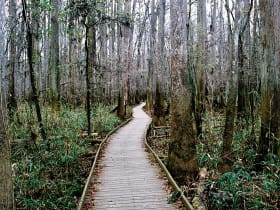
One of the tallest deciduous forests left in the world, a floodplain of champion old-growth hardwoods.