
Wolves and Moose
Wolves and Moose of Isle Royale National Park, MI
Isle Royale, MI
The stage for one of the world's longest-running wildlife studies.
Isle Royale is home to one of the longest-running wildlife studies in the world, a decades-long look at the predator-prey relationship between the island's wolves and moose. Because the island is isolated in Lake Superior, its wildlife community is simple enough to study closely, making it a natural laboratory that has taught scientists a great deal about how predators and prey shape each other and their environment.
Moose swam to the island long ago, and wolves later crossed on a winter ice bridge, and ever since, their populations have risen and fallen in a complex dance. Lucky visitors may spot a moose feeding in a pond or wading in the shallows, though the elusive wolves are rarely seen. Simply sharing this remote island with such large wild animals is a memorable part of an Isle Royale visit.
What Travelers Love
- A world-famous predator-prey wildlife study
- The chance to see moose feeding in ponds and shallows
- Sharing a truly wild island with large mammals
- Learning how wolves and moose shape the ecosystem
Worth Knowing
- Wolves and moose range across Isle Royale National Park
- Moose are often seen; wolves are rarely glimpsed
- Keep a safe distance from all wildlife, especially moose
- The island is reached only by ferry or seaplane
Learn about Wolves and Moose
A natural laboratory
Since the late 1950s, scientists have studied the wolves and moose of Isle Royale, making it one of the longest continuous predator-prey studies anywhere. The island's isolation is the key: with few other large mammals and no roads or development, the relationship between the two species can be observed with unusual clarity.
Over the decades, the study has documented dramatic swings, moose populations booming when wolves are scarce, then declining as wolves recover or as harsh winters and food shortages take a toll. These findings have deepened our understanding of how predators help regulate prey, and how weather, disease, food, and chance all influence wild populations.
A changing story and watching wildlife
The wolf population on Isle Royale has fluctuated over time, at points dropping very low, which raised difficult questions about whether and how to intervene in a wilderness. In recent years, wolves have been brought to the island to bolster the population, and the study continues to follow how the wolves and moose respond, an ongoing chapter in this famous scientific story.
For visitors, moose are the large animal most likely to be seen, often feeding on aquatic plants in ponds and along shorelines, especially in the early morning and evening. Wolves are shy and rarely glimpsed. Whatever you encounter, keep a safe distance, never approach or feed wildlife, and remember that moose in particular can be dangerous if they feel threatened, so give them plenty of room.
Closest Boutels
The closest Boutel™ stays, so you can turn this stop into an overnight. Each is a place we chose through independent editorial review, never a paid placement.
Details
Isle Royale, MI
Frequently asked questions
What is the Isle Royale wolves and moose study?
The Isle Royale wolves and moose study is one of the longest-running predator-prey wildlife studies in the world, ongoing since the late 1950s. It examines the relationship between the wolves and moose that live on Isle Royale, a remote, isolated island in Lake Superior. The island's isolation, with few other large mammals and no development, makes it a natural laboratory where scientists can closely observe how the two species affect each other. Over the decades, the study has documented how moose and wolf populations rise and fall in response to predation, weather, food, and disease, deepening our understanding of how predators help regulate prey and how ecosystems work. It is a landmark in ecological science and a defining part of what makes Isle Royale scientifically important.
Can you see wolves and moose at Isle Royale?
You have a reasonable chance of seeing moose at Isle Royale, but wolves are rarely seen. Moose are large and often feed on aquatic plants in ponds, lakes, and shallow shorelines, especially in the early morning and evening, so patient, quiet visitors hiking or paddling frequently spot them. Wolves, by contrast, are shy, few in number, and range widely across the island, so glimpsing one is uncommon and considered a special stroke of luck; more often, visitors might hear them or see tracks or signs. Whatever wildlife you encounter, it is important to keep a safe distance, never approach or feed animals, and be especially cautious around moose, which are powerful and can become aggressive if they feel threatened, particularly cows with calves.
How did wolves and moose get to Isle Royale?
Wolves and moose reached Isle Royale in different ways, since the island lies isolated in Lake Superior, far from shore. Moose are believed to have arrived first, likely swimming to the island from the mainland or nearby land in the early 1900s, or possibly reaching it another way, and finding abundant food, they established a population. Wolves arrived later, most famously by crossing an ice bridge that occasionally forms between the island and the mainland during very cold winters, allowing them to walk across the frozen lake. Once wolves reached the island, they found moose as prey, setting up the predator-prey relationship that scientists have studied ever since. These ice bridges have become rarer as winters have warmed, which is one reason the wolf population has sometimes struggled to sustain itself naturally.
Are the moose dangerous to visitors?
Moose are generally not aggressive toward people, but they are very large, powerful wild animals and can be dangerous if they feel threatened or cornered, so visitors should treat them with respect and caution. On Isle Royale, moose are commonly seen feeding in ponds and along shorelines, and it can be tempting to approach for a closer look or photo, but this is unwise. Keep a generous distance, never get between a cow and her calf, and back away slowly if a moose shows signs of agitation, such as raised hackles, ears back, or moving toward you. Give them plenty of room on trails, and never feed or crowd them. With sensible precautions and respect for their space, watching moose is one of the highlights of a visit, and it keeps both you and the animals safe.
Nearby

Rock Harbor
0.1 miles away
Rock Harbor is the main hub of Isle Royale National Park, a small harbor on the island northeast end reached by ferry or seaplane from the mainland.
Rock Harbor Lighthouse
5.8 miles away
The Rock Harbor Lighthouse is a historic stone lighthouse built in the 1850s to guide ships past the rocky reefs of Isle Royale during the copper mining boom.
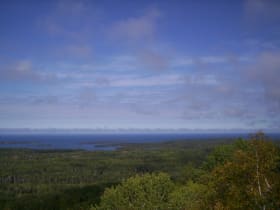
Greenstone Ridge Trail
10 miles away
The Greenstone Ridge Trail runs the length of Isle Royale, following the high rocky spine of the island for about 40 miles through forest, past inland lakes, and over open ridgetops with views across...