
Whiteface Veterans Memorial Highway Summit
5021 NY-86
Wilmington, NY
One of the great Adirondack High Peaks made reachable by a mountain highway, a stone castle, and an elevator bored through the rock to a summit with views for a hundred miles.
Whiteface is one of the highest of the Adirondack High Peaks and, uniquely among them, a summit you can nearly drive to the top of. The Veterans Memorial Highway climbs the mountain by a winding road to a parking area near the peak, from which visitors reach the true summit by a short, steep stone stairway or by an elevator bored straight through the heart of the mountain, an engineering feat as memorable as the view.
Because it stands somewhat apart from the crowded cluster of the other High Peaks, Whiteface commands an enormous, open panorama. On a clear day the summit looks out over the whole Adirondack wilderness, across Lake Champlain to Vermont's Green Mountains, and north toward Canada, a hundred-mile view earned with far less effort than a High Peak usually demands.
What Travelers Love
- Driving the memorial highway almost to the top of an Adirondack High Peak
- The stone castle and gift shop built near the summit from native rock
- An elevator bored through the mountain that carries visitors up to the peak
- Panoramic views across the Adirondacks, Lake Champlain, and beyond on a clear day
Worth Knowing
- The highway is a seasonal road that operates in the warmer months and closes in winter
- The summit is high and exposed, so it is cold and windy even in summer; bring layers
- A short, steep stairway or the rock elevator covers the final stretch to the true summit
- Clear days give the best views; the summit can be socked in by cloud when the valley is sunny
Learn about Whiteface Veterans Memorial Highway Summit
A highway up a High Peak
The Veterans Memorial Highway was built in the 1930s and dedicated to the state's war veterans, conceived as a way to open one of the great Adirondack summits to people who could not make the long climb on foot. Governor Franklin Roosevelt championed the road, and it was carved up the mountainside to reach a stone castle and parking area just below the peak.
The road climbs through the changing forest zones of a northern mountain, from thick hardwoods at the base to stunted, wind-bent spruce and fir near the top, and finally into the open alpine world above the trees. It remains one of very few places in the Adirondacks where a High Peak summit is within reach of anyone, and the drive itself, with its overlooks and switchbacks, is part of the experience.
The castle and the elevator
Near the top of the highway stands a small castle built of native Whiteface stone, housing a gift shop and shelter and blending into the rocky summit as though it had grown there. From the castle, visitors face the final stretch to the true summit, and here the mountain offers a remarkable choice.
One option is a steep stone stairway up the exposed rock ridge to the peak. The other is an elevator, reached through a tunnel bored horizontally into the mountain, that rises through solid rock to emerge near the summit, a piece of Depression-era engineering that lets even those who cannot manage the stairs stand on top of a High Peak. Either way, the reward is the same soaring, open view.
The summit and the view
The summit of Whiteface is a true alpine environment, one of the few places in the eastern United States where fragile mountain tundra survives above the trees, home to hardy plants that cling to life in the wind and cold. Signs urge visitors to stay on the rock and paths to protect these rare communities.
The view is the payoff for the climb. On a clear day the whole Adirondack High Peaks wilderness spreads to the south, Lake Champlain shines to the east with Vermont's mountains beyond, and the land rolls north toward Montreal. The summit is high, exposed, and often far colder and windier than the valley below, so even on a warm summer day a jacket is essential.
Wildlife, seasons, and Olympic ties
The mountain's forests hold the wildlife of the northern Adirondacks, black bear, deer, and a rich birdlife that shifts as you climb, with hardy species like the gray jay and boreal chickadee near the top. Ravens and hawks ride the winds around the summit ridge.
The memorial highway is a seasonal road, open in the warm months and closed by snow in winter. In winter the mountain becomes a major ski area with a storied Olympic pedigree, having hosted the alpine events of the Lake Placid Winter Games. Fall is spectacular, when the lower slopes flame with color while the summit may already wear its first frost, and clear autumn days offer some of the longest views of the year.
Closest Boutels
The closest Boutel™ stays, so you can turn this stop into an overnight. Each is a place we chose through independent editorial review, never a paid placement.
Details
Wilmington, NY
Frequently asked questions
What is the Whiteface Veterans Memorial Highway?
It is a scenic toll road that climbs about five miles up Whiteface Mountain, one of the highest peaks in New York, ending near the summit high in the Adirondacks. Built as a memorial to veterans, it lets almost anyone reach a nearly 5,000-foot summit by car, with panoramic High Peaks views along the way. On a clear day you can see across the Adirondacks all the way to Vermont and Canada, a genuinely spectacular drive.
How do you reach the very top of Whiteface?
The highway ends at a stone castle and parking area a few hundred feet below the true summit, and from there you have two options. You can walk the short but steep Stairway Ridge nature trail with handrails, or take a long tunnel bored into the mountain to an elevator that rises to the summit. The elevator route is fully accessible, while the trail is not, so choose the option that suits your group.
When is the Whiteface highway open?
The toll road is seasonal, usually open from around May through October, and closed in winter. Because it is a high mountain road, it can also close temporarily for weather even in season, so check current conditions before driving up. There is no fuel available on the mountain, so top off your tank in Lake Placid or Wilmington first, and allow a few hours to enjoy the drive and summit.
What should I bring and know before driving up Whiteface?
Bring warm layers, since the summit runs at least ten degrees colder than the base and is often windy, even on a summer day. Along the five-mile road are several marked pullouts to stop, take in the views, and read about the mountain, so take your time. There is a toll, and the summit has a gift shop, a small restaurant, an observation deck, and short trails to explore.
When is the best time to drive the Whiteface highway?
Clear days deliver the fullest views, so aim for good weather and check the forecast, since the summit can be socked in by cloud even when the valley is sunny. Summer brings the most reliable conditions and full amenities, while fall is spectacular for foliage across the Adirondacks. Mornings often have the clearest air, and going early also means a quieter drive and summit.
Nearby

Lake Placid Olympic Center
7.1 miles away
This is where kids can stand on Olympic ice. The Olympic Center holds the arena where the 1980 Miracle on Ice happened, and the museum inside packs in real medals, torches, bobsleds, and the story of...
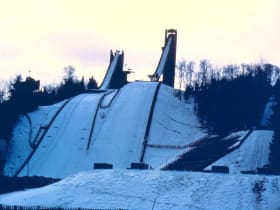
Olympic Jumping Complex
8.7 miles away
Standing at the top of the 120-meter jump tower rearranges your sense of what Olympians actually do.
Saranac Laboratory Museum
12 miles away
Most people passing through Saranac Lake never learn why the porches everywhere are so long and glassed in. This small museum explains it.