
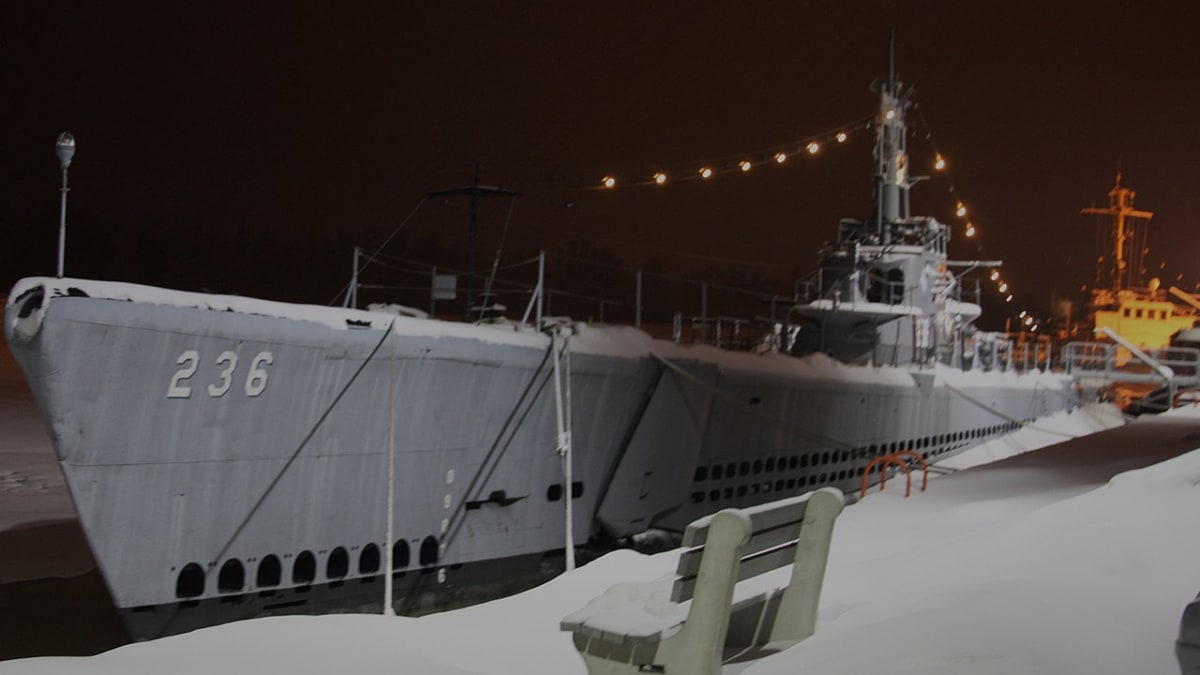
USS Silversides Submarine Museum
1431 Beach St, Muskegon, MI
Muskegon, MI
One of the most decorated submarines of the Second World War, tied up on a Great Lakes channel and open for you to squeeze through its tight steel compartments.
The USS Silversides is one of the most decorated American submarines of the Second World War, and today it floats along a channel in Muskegon as a museum you can walk through. Launched just after the attack on Pearl Harbor, the Silversides carried out a long string of war patrols in the Pacific, sinking enemy ships and earning a chestful of battle honors before returning home to a long second life as a memorial.
Stepping aboard, you climb down into the same cramped steel world its crew lived in, from the torpedo rooms to the control room to the roaring engine spaces, all preserved much as they were. The museum on shore tells the boat's story and the wider story of submarine warfare, and the waterfront site includes a Coast Guard cutter as well, making it one of the most immersive military-history stops on the Great Lakes.
What Travelers Love
- Walking through a real World War II submarine, from torpedo room to engine room
- The cramped, authentic quarters that show how a wartime crew lived
- The story of one of the most decorated American subs of the war
- A waterfront setting on the channel to Lake Michigan, with a Coast Guard cutter alongside
Worth Knowing
- Touring the submarine means climbing through tight hatches and steep ladders, so wear sturdy shoes
- The interior is cramped and can be warm; it is not suited to those who cannot manage narrow spaces
- The museum runs on a seasonal schedule, fullest in the warmer months
- The site also includes a Coast Guard cutter and land exhibits to round out a visit
Learn about USS Silversides Submarine Museum
A submarine at war
The USS Silversides was a Gato-class fleet submarine launched in 1941 and commissioned soon after the United States entered the Second World War. Over the course of the conflict she carried out many war patrols in the Pacific, hunting enemy shipping across vast distances and returning again and again to the fight. By the war's end she ranked among the most successful and decorated American submarines of the entire conflict.
Her service included moments of real drama, among them an emergency appendectomy performed on a crewman by a pharmacist's mate deep beneath the surface, using improvised instruments while the boat was on patrol. Stories like that, of ordinary sailors doing extraordinary things in a steel tube far from home, are part of what the museum works to keep alive.
Life in a steel tube
What visitors remember most is the sheer tightness of the space. A wartime submarine packed dozens of men into a hull barely wide enough to pass through, and every inch was given to machinery, torpedoes, bunks, and stores. Crewmen slept among the torpedoes, ate in shifts, and lived for weeks without fresh air or sunlight, sharing the boat with the noise, heat, and smells of its engines.
Walking through the Silversides, you pass from the forward torpedo room through the crew quarters, the control room with its periscopes and dials, the galley, and the loud engine spaces, ducking through narrow watertight hatches all the way. It is a visceral lesson in what submarine service demanded, far more immediate than any book or film.
From the Pacific to the Great Lakes
After the war the Silversides served on in training roles before being retired, and rather than being scrapped she was preserved as a memorial. She eventually came to Muskegon, brought up through the locks and waterways to the Great Lakes, where she was established as the centerpiece of a museum honoring submariners and the sailors who served aboard boats like her.
The site has grown into a broader maritime museum. Alongside the submarine sits a former Coast Guard cutter also open for touring, and shore exhibits explore submarine and naval history, the technology of undersea warfare, and the men who crewed these vessels. Together they make the channelside a genuine center of Great Lakes military history.
Season by season
Summer is the prime season, when the museum runs its fullest schedule and the Muskegon lakefront is at its best, an easy pairing with the city's beaches and waterfront. The submarine's interior can be warm in the heat, so a morning visit is often more comfortable.
Spring and fall bring cooler air and thinner crowds, pleasant times to tour the boat and the grounds. Winter narrows the schedule as the channel and lakefront settle into the cold, though the museum has become known for special after-dark events that lean into the eerie atmosphere of the old submarine.
Closest Boutels
The closest Boutel™ stays, so you can turn this stop into an overnight. Each is a place we chose through independent editorial review, never a paid placement.
Details
Muskegon, MI
Frequently asked questions
What is the USS Silversides Submarine Museum?
The USS Silversides Submarine Museum, in Muskegon on Lake Michigan, preserves the USS Silversides, one of the most decorated American submarines of World War II, which visitors can actually board and tour. Alongside the submarine, the museum tells the story of Great Lakes naval history and features other historic vessels. Climbing through the cramped, authentic interior of a real combat submarine offers a powerful, hands-on glimpse into the lives of the sailors who served aboard, making it a memorable and educational destination.
Can you go inside the submarine at the museum?
Yes, touring the interior of the USS Silversides is the highlight, letting you climb through the actual compartments, from the torpedo rooms to the control room and cramped crew quarters, and experience firsthand how sailors lived and fought in such tight quarters. The narrow hatches and steep ladders make it an immersive but physical experience, so comfortable clothing and shoes help, and those with mobility concerns should keep the tight spaces in mind. It is a vivid, unforgettable look at submarine life.
What else can you see at the USS Silversides Submarine Museum?
Besides the famous submarine, the museum features exhibits on Great Lakes and naval history and other historic vessels, including a former Coast Guard cutter, giving a fuller picture of maritime service and history. Displays of artifacts, photographs, and stories honor the sailors who served. For an especially memorable experience, the museum offers popular overnight programs where groups can sleep aboard the submarine, adding a unique, immersive way to connect with this piece of living history.
When is the best time to visit the USS Silversides Submarine Museum?
The museum and vessels are most fully open in the warmer months from spring through fall, so that is the best time to tour the submarine and other ships, with summer being peak season. Hours are often more limited in the off-season, so checking the current schedule before you go is wise. Since much of the experience involves climbing aboard historic vessels, a mild, dry day makes for the most comfortable and enjoyable visit.
What is near the USS Silversides Submarine Museum?
The museum is in Muskegon, a Lake Michigan port city with beaches, the Muskegon Lake waterfront, the Lakeshore Museum Center, and Michigan's Adventure amusement park nearby. The west Michigan coast, with its dunes, lighthouses, and beach towns, stretches north and south. That makes the USS Silversides Submarine Museum an easy and fascinating stop to combine with Muskegon's beaches and attractions on a tour of Michigan's western lakeshore.
Nearby
Mac Wood's Dune Rides
31 miles away
Roaring over mountains of sand in an open-air buggy is pure thrill for kids, and Mac Wood's has been doing it since 1930.
Big Red
32 miles away
For a classic Lake Michigan photo with almost no effort, stop to see Big Red, the bright red Holland Harbor Lighthouse.

De Zwaan Windmill
32 miles away
There is exactly one authentic working Dutch windmill in the entire United States, and it stands on a small island in Holland.