
Topsmead State Forest
Buell Road
Litchfield, CT
A storybook English Tudor cottage on a breezy Litchfield hilltop, left to the public exactly as its owner kept it, ringed by meadows made for a slow walk.
Topsmead is one of Connecticut's most graceful surprises: an English Tudor summer cottage set on a high, open hilltop above Litchfield, surrounded by hundreds of acres of meadow and woodland, and left to the people of the state to enjoy just as its owner did. The house looks as though it was lifted out of the Cotswolds, with steep gables, leaded windows, and hand-hewn beams, and inside it remains furnished with the original owner's own things, so a tour feels less like a museum and more like stepping into a home the family just stepped out of.
That owner was Edith Morton Chase, daughter of a Waterbury brass-industry family, who built the cottage in the 1920s as a country retreat and spent decades shaping the grounds. On her death she left the entire estate to Connecticut as a state forest, with instructions that it be kept simple and open to all. The result is a place with the polish of a private estate and the welcome of a public park, where you can tour a jewel of a house and then walk out into meadows that seem to run to the horizon.
What Travelers Love
- A perfectly preserved English Tudor cottage furnished just as its owner left it
- High, open meadows with long views over the Litchfield Hills
- Easy, gentle walking trails and picnic spots on the grounds
- The rare feeling of a private country estate opened up for everyone
Worth Knowing
- The cottage interior is open for tours only on limited days, usually warm-season weekends
- The grounds and trails are open year-round from morning to sunset and are free
- There is a designated wildflower preserve on the property, best in early summer
- Facilities are minimal by design; this is a quiet walking-and-picnic place, not a developed park
Learn about Topsmead State Forest
Edith Chase and her country cottage
Edith Morton Chase came from one of Waterbury's leading brass-manufacturing families, and in the 1910s and 1920s she assembled the hilltop property that became Topsmead, a name that nods to its situation atop the meadows. She first built a modest cabin, then in the 1920s replaced it with the English Tudor cottage that stands today, designed by architect Richard Henry Dana Jr. to evoke an old English country house.
Chase used the cottage as a summer and country home for the rest of her long life, and she tended the surrounding land with equal care, laying out gardens, meadows, and woodland walks. She never married and had no children, and she planned carefully for the estate's future.
When she died in 1972, she left the whole property to the State of Connecticut to be kept as a public forest, stipulating that it stay unspoiled and freely open. Because the house passed intact with its furnishings, visitors today see it essentially as she lived in it.
The house and grounds
The cottage is a careful piece of romantic architecture, with its steep slate-look roofline, half-timbering, leaded-glass windows, and interiors of exposed beams, paneling, and period furniture. Guided tours on open days walk visitors through the rooms much as they were left, a quiet, personal contrast to grander mansion museums.
Around the house, Chase's landscape survives as a mix of clipped lawn near the cottage giving way to rougher hay meadows, stone walls, and woods. Paths and mowed tracks let you wander the open ground, where the elevation opens up long views across the rolling Litchfield Hills.
A portion of the property is set aside as a wildflower preserve, protecting native meadow plants, and the combination of open field and forest edge makes the grounds good for birds, butterflies, and unhurried walking in every season.
A quiet forest by design
Topsmead is deliberately low-key. There are no big parking lots, snack stands, or crowds of attractions, in keeping with Chase's wish that the land stay simple and unspoiled, and that restraint is much of its charm.
It draws people who want a picnic on a breezy hilltop, a gentle loop through meadow and wood, or a look inside a beautifully preserved house, rather than a busy day-use park. In autumn the surrounding hills color up, and in winter the open meadows are popular with snowshoers and cross-country skiers.
Together with the nearby White Memorial preserve and the historic town of Litchfield, it anchors one of the most appealing corners of rural Connecticut for a slow, scenic day.
Season by season
Summer is when the cottage is most likely to be open for tours and the meadows and wildflower preserve are at their fullest, an ideal time for a picnic on the breezy hilltop with the Litchfield Hills rolling away in every direction.
Autumn brings color to the surrounding hills and crisp air to the open fields, while winter turns the meadows into quiet ground for snowshoeing and cross-country skiing. The grounds stay open year-round from morning to sunset, so even when the house is closed the walking and the views remain, which is much of why locals return in every season.
Closest Boutels
The closest Boutel™ stays, so you can turn this stop into an overnight. Each is a place we chose through independent editorial review, never a paid placement.
Details
Litchfield, CT
Frequently asked questions
What is Topsmead State Forest?
Topsmead State Forest, near Litchfield in the Litchfield Hills of Connecticut, is a lovely and peaceful state forest surrounding a charming English-style country cottage estate, offering beautiful meadows, woodlands, and trails. Once a private summer estate, Topsmead features a graceful English Tudor-style cottage set amid rolling meadows, gardens, and forest, with trails for walking through the scenic countryside and a wildflower preserve. Its refined beauty, tranquil grounds, and lovely cottage make it a delightful and serene destination. A serene and beautiful forest estate, it delights visitors. With its cottage and meadows, Topsmead offers a compelling destination in Connecticut.
What can you do at Topsmead State Forest?
You can stroll the rolling meadows and woodland trails, see the charming English Tudor-style cottage and its gardens, visit the wildflower preserve, picnic, and enjoy the peaceful, refined beauty of the estate and countryside. The graceful cottage, the beautiful meadows and gardens, the woodland trails, and the tranquil setting are the draws, making it a serene and lovely visit. The cottage and the meadows are highlights. With its grounds, Topsmead State Forest offers a rewarding experience in Connecticut.
When is the best time to visit Topsmead State Forest?
The mild months of spring through fall are the loveliest for the meadows, gardens, and trails, with spring and summer bringing wildflowers and green, and fall beautiful with foliage, while the cottage is generally open for tours on a limited seasonal schedule. Because the cottage tours and some access are seasonal, checking current information before you go is wise. For the loveliest grounds and cottage tours, aim for spring through fall at Topsmead State Forest in Connecticut.
Can you tour the cottage at Topsmead State Forest?
Yes, the charming English Tudor-style cottage at Topsmead is generally open for tours on a limited seasonal schedule, allowing visitors to see the graceful home and its furnishings, while the meadows, gardens, and trails can be enjoyed whenever the forest is open. Because cottage tours are seasonal and limited, checking the current schedule before you go is important if you wish to see inside. For a cottage tour, check the current seasonal schedule at Topsmead State Forest in Connecticut.
What is near Topsmead State Forest?
Topsmead State Forest is near Litchfield in the Litchfield Hills of Connecticut, within reach of the historic town of Litchfield, the White Memorial Conservation Center, the Institute for American Indian Studies, and the other attractions of the Litchfield Hills. That makes Topsmead State Forest a compelling stop to combine with the White Memorial Conservation Center and the other attractions of the Litchfield Hills on a visit to Connecticut.
Outside the Park
Action Wildlife Foundation
2.9 miles away
An unexpected safari in the Connecticut hills. Action Wildlife in Goshen lets families drive or walk among fields of bison, elk, zebra, camels, and watusi cattle, then hand-feed goats and smaller anim...
White Memorial Conservation Center
3.5 miles away
This is the wild heart of the Litchfield Hills, the largest nature preserve in the state at around 4,000 acres wrapped around Bantam Lake.
Institute for American Indian Studies
12 miles away
Tucked in the woods outside Washington, this small museum tells a story most travelers never think to look for: the 10,000-year Native history of Connecticut.
West Cornwall Covered Bridge
13 miles away
This is the picture everyone takes of the Litchfield Hills without always knowing where it is.
Kent Falls State Park
14 miles away
Plenty of drivers on Route 7 blow right past it, but the tallest waterfall in Connecticut sits just off the road north of Kent.
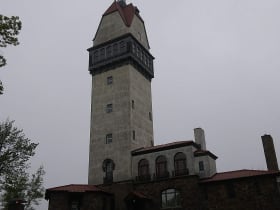
Heublein Tower at Talcott Mountain
20 miles away
Talcott Mountain gives the Hartford region its best summit view, and it comes with a castle at the top.