
South Carolina State House Bronze Stars
1100 Gervais St
Columbia, SC
Six bronze stars set into the stone walls mark the spots where Union cannon struck the unfinished capitol as Sherman's army bore down on Columbia.
The South Carolina State House carries the physical scars of one of the most dramatic episodes in the state's history. As General William Tecumseh Sherman's army swept through in February 1865 near the end of the Civil War, Union artillery shelled Columbia, and several rounds struck the granite walls of the new capitol, which was still under construction at the time. Those impact points are marked today by six bronze stars set into the stone, a quiet and permanent record of the day the war reached the capital.
The building itself is one of the finest state houses in the South, a granite structure topped by a copper dome, set in grounds shaded by old oaks and magnolias and dotted with monuments. Walking the exterior to find the bronze stars is a small act of detective work that connects a visitor directly to the burning of Columbia, while the wider grounds and the building's interior tell the longer, more complicated story of the state and its government.
What Travelers Love
- Finding the bronze stars marking Civil War cannon strikes on the exterior walls
- The monument-filled grounds shaded by old oaks and magnolias
- The copper-domed capitol, one of the handsomest state houses in the South
- Free grounds open for a self-guided walk any day of the year
Worth Knowing
- The stars are set into the west and south exterior walls, so walk the outside to find them
- Building tours keep set schedules, so check ahead if you want to see the interior
- The grounds hold monuments that reflect hard chapters of the state's history
- Downtown parking can be tight on weekdays when the legislature is in session
Learn about South Carolina State House Bronze Stars
The day the shells struck
By February 1865 the Civil War was grinding toward its end, and Sherman's army had turned north from Georgia into South Carolina, the first state to secede. When his forces reached Columbia, they shelled the city, and much of downtown burned in a fire whose exact causes are still debated. In the midst of that day, Union cannon fire struck the new State House, then only partly built and standing exposed on its rise above the town.
The building survived, and when construction was eventually completed the marks left by the cannonballs were preserved rather than patched over. Six bronze stars were later mounted on the west and south exterior walls to mark where the shells hit, turning the damage into a memorial. Standing beside one of those stars, you are looking at the exact spot where the war physically touched the seat of state government.
Building the capitol
The State House had a long and troubled construction history. Work on the granite building began in the 1850s to replace an earlier wooden capitol, but the project was plagued by delays, a dishonest early architect, and then the war itself, which halted everything and brought the shelling. After the war, work resumed in fits and starts, and the building was not truly finished until the very end of the nineteenth century.
The result is a dignified granite structure crowned by a copper dome, considered one of the handsomest capitols in the region. Inside, the chambers of the legislature, marble halls, and historical displays trace the workings and the past of state government, and guided tours lead visitors through the public spaces when the schedule allows.
The grounds and their monuments
The State House grounds are a shaded park in the middle of the city, planted with towering oaks, magnolias, and palmettos, the state tree that gives South Carolina its nickname. Paths wind among a collection of monuments and memorials that together form an outdoor record of how the state has chosen to remember its history, a record that has itself changed over time as attitudes and understandings shift.
Among the grounds' most significant modern additions is the African American History Monument, a large sculptural memorial that traces the journey of Black South Carolinians from the Middle Passage through slavery, emancipation, and the struggle for civil rights. Walking the grounds, a visitor moves through layers of memory, from Revolutionary and Civil War figures to more recent efforts to tell a fuller and more honest story.
A walk in the capital city
The State House sits at the heart of downtown Columbia, so a visit fits easily into a broader walk through the capital. The University of South Carolina's historic Horseshoe, the state museums along the river, and the shops and eateries of the revived downtown are all within a short stroll, making the capitol a natural centerpiece for a day in the city.
The grounds are open and pleasant to walk in any season, though Columbia's summers run hot enough that shade and an early start are welcome. Spring and fall bring the mildest weather for exploring the exterior and hunting down each of the bronze stars, and the old shade trees keep the grounds cool and green through much of the year.
Closest Boutels
The closest Boutel™ stays, so you can turn this stop into an overnight. Each is a place we chose through independent editorial review, never a paid placement.
The Station by Compo Hotels
Boutel745 Old Buncombe Rd, Travelers Rest, SC 29690, Travelers Rest, SC
104 miles away|Learn More ›
Details
Columbia, SC
Frequently asked questions
What are the South Carolina State House Bronze Stars?
The South Carolina State House Bronze Stars, in Columbia, are a series of bronze star markers on the exterior of the state capitol building that mark the spots where the building was struck by cannon fire during the Civil War. When Union forces under General Sherman shelled and occupied Columbia near the end of the war, the State House, then still under construction, was hit, and the bronze stars now commemorate where those cannonballs struck the western and southern walls. A striking and tangible link to the Civil War, the stars draw visitors to the beautiful capitol grounds. With its Civil War markers and historic capitol, the South Carolina State House offers a fascinating destination in South Carolina.
Why are there bronze stars on the South Carolina State House?
There are bronze stars on the South Carolina State House because they mark the exact spots where the building was struck by Union artillery fire during the Civil War. As General Sherman's forces approached and shelled Columbia near the war's end, the still-unfinished State House was hit by cannonballs, and the damage to the stone walls was later marked with bronze stars to commemorate the event. The stars offer a tangible, visible reminder of the war's impact on the city and capitol. Seeing these markers connects visitors to that dramatic history at the South Carolina State House in Columbia.
What can you do at the South Carolina State House?
You can find and view the bronze stars marking the Civil War cannon strikes on the capitol's walls, admire the beautiful historic State House building and its grounds, monuments, and gardens, tour the interior on weekdays to see the legislative chambers and architecture, and learn about the state's history and government. The bronze stars, the historic capitol, and the grounds are highlights, blending Civil War history with civic architecture. With its Civil War markers, historic building, and grounds, the South Carolina State House offers an engaging visit in Columbia, South Carolina.
When is the best time to visit the South Carolina State House?
The State House grounds and the exterior bronze stars can be visited year-round, with spring and fall offering the most pleasant weather to walk the grounds and find the markers, while the interior is generally open for tours on weekdays, so those are the times to see inside, and checking current visiting hours is wise. Summer is hot and humid. For the best combination of comfortable weather outdoors and, on a weekday, interior access, aim for spring or fall at the South Carolina State House in Columbia.
What is near the South Carolina State House Bronze Stars?
The South Carolina State House is in Columbia, South Carolina, near the EdVenture Children's Museum, the Congaree Vista district, within reach of Riverbanks Zoo and Garden and the Columbia area. That makes the South Carolina State House a fascinating stop to combine with the EdVenture Children's Museum, downtown Columbia, and the other attractions of the Columbia area on a visit to South Carolina.
Nearby
Congaree Vista
0.6 miles away
Most visitors to Columbia never learn the Vista used to be the block everyone avoided.
EdVenture Childrens Museum
0.9 miles away
Eddie makes this one unforgettable: a 40-foot model of a child you actually climb inside, crawling through his organs and sliding down his intestine to learn how the body works.

Riverbanks Zoo and Garden
2.7 miles away
This is the day kids ask to repeat. Riverbanks Zoo and Garden at 500 Wildlife Pkwy packs a zoo, an aquarium, and a botanical garden into one riverside campus with more than 3,000 animals, from elephan...
Lake Murray Dam Walkway
11 miles away
It looks like a long grassy hill from the road, but the Lake Murray dam is a piece of engineering history you can walk across.
Congaree National Park
17 miles away
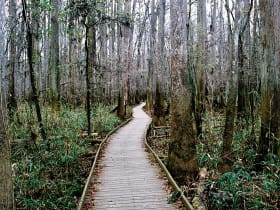
One of the tallest deciduous forests left in the world, a floodplain of champion old-growth hardwoods.

Boardwalk Loop Trail
17 miles away
The Boardwalk Loop is the signature walk at Congaree National Park, a 2.4-mile elevated wooden boardwalk that carries visitors dry-footed through one of the largest tracts of old-growth bottomland har...

Old-Growth Forest
17 miles away
Congaree protects one of the largest remaining stands of old-growth bottomland hardwood forest in the southeastern United States, home to some of the tallest trees in the East.

Weston Lake
17 miles away
Weston Lake is a tranquil oxbow lake, a former bend of the Congaree River cut off long ago, reached from the Boardwalk Loop at the Weston Lake Overlook.

Cedar Creek
18 miles away
Cedar Creek is a blackwater stream winding through the old-growth heart of Congaree, a designated canoe trail that lets paddlers glide beneath towering cypress and tupelo.