
Scotts Bluff National Monument
190276 Old Oregon Trail
Gering, NE
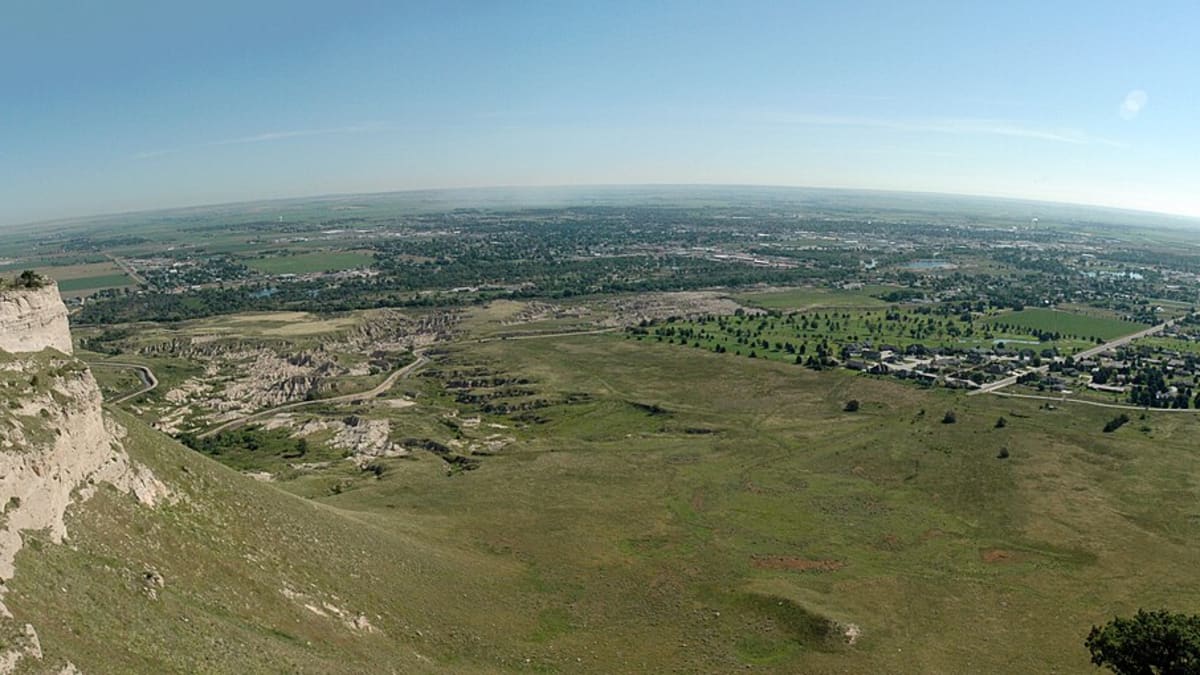
A great pale bluff rising 800 feet over the North Platte, the landmark that told wagon trains they were finally leaving the plains behind.
Scotts Bluff is a huge pale bluff of clay and sandstone that towers roughly 800 feet above the North Platte River, and for the emigrants of the 1840s and 1850s it was one of the most welcome sights on the whole overland trail. Rising abruptly from the flat valley, it marked the point where the monotonous plains gave way to higher, rougher country, a sign that the mountains and the far West were finally drawing near.
Named for a fur trader who died near its base in the 1820s, the bluff guided hundreds of thousands of travelers on the Oregon, California, and Mormon trails, most of them passing through Mitchell Pass in the bluff's shadow. Today the National Park Service preserves the landmark, the trail ruts worn into the ground beside it, and a summit road and trails that let visitors stand where the pioneers only gazed up.
What Travelers Love
- Driving or hiking to the summit for a sweeping view of the North Platte Valley
- Walking a preserved stretch of the Oregon Trail beneath the bluff
- The visitor center's wagon and trail exhibits and the art of William Henry Jackson
- Watching the light and shadow move across the bluff's carved faces
Worth Knowing
- A summit road climbs to the top, with a trail option for those who prefer to hike up
- It is exposed and can be hot, windy, and dry, so carry water and sun protection
- Rattlesnakes live on the bluff, so watch where you step and stay on trails
- The visitor center keeps seasonal hours while the grounds stay open longer
Learn about Scotts Bluff National Monument
A landmark on the road west
For wagon trains grinding up the Platte, Scotts Bluff and nearby Chimney Rock were the great markers of progress, visible for a day or more before travelers reached them and long after they passed. The bluff signaled that the easy prairie miles were ending and the harder climb toward South Pass and the mountains lay ahead. Emigrants filled their diaries with descriptions of it, comparing its ramparts and towers to castles and cathedrals.
Most trains crossed through Mitchell Pass, a gap that cut between the bluff and its neighbor, and the constant grind of iron-rimmed wheels wore ruts into the ground that are still visible today. Before the emigrants, this was fur-trade country, and the bluff took its name from a trader named Hiram Scott who died near it in the 1820s, his story passed down in several conflicting versions.
The people of the valley
Long before the wagon trains, the North Platte Valley was home and hunting ground to Plains peoples, among them the Lakota, the Cheyenne, and the Arapaho, who moved through this country following the bison. The bluffs and the river were part of a landscape they knew intimately, and the flood of emigrants and the forts that grew up to protect them pressed hard on those nations and on the herds they depended on.
The overland migration that made Scotts Bluff famous was, for the tribes of the plains, the beginning of a wrenching change. Treaties, forts, and railroads followed the trail, and within a few decades the open bison country was gone. Standing beneath the bluff, it is worth remembering that the same landmark that meant hope to the emigrants marked a hard turning point for the people who were already here.
The summit and the artist who drew the trail
A road, blasted through the rock with tunnels in the 1930s, climbs to the top of the bluff, where overlooks give a sweeping view of the North Platte Valley, the winding river, Chimney Rock in the distance, and the badlands beyond. A trail also leads to the summit for those who would rather walk up, and shorter paths run along the base past the trail ruts.
The visitor center holds one of the finest collections anywhere of the work of William Henry Jackson, the pioneer photographer and painter who first crossed here as a young man driving oxen and later returned to picture the trail in vivid detail. His images of wagon trains, forts, and landmarks shaped how generations of Americans have imagined the overland journey.
Season by season
Spring greens the valley and brings mild days ideal for climbing to the summit, though wind is a near-constant on the high plains. Wildflowers dot the bluff's slopes.
Summer is hot, bright, and busy, so early mornings are best for the summit road and the trails. Fall brings crisp air, golden cottonwoods along the river, and thinner crowds, and winter is cold and quiet, the bluff often dusted with snow and the valley wide and still under a big sky.
Closest Boutels
The closest Boutel™ stays, so you can turn this stop into an overnight. Each is a place we chose through independent editorial review, never a paid placement.
Details
Gering, NE
Frequently asked questions
What is Scotts Bluff National Monument?
Scotts Bluff National Monument, near Gering in the western Nebraska Panhandle, protects a dramatic set of towering bluffs that rise high above the North Platte River and served as a famous landmark for pioneers on the great westward trails. These striking rock formations were a beacon for travelers on the Oregon, California, and Mormon trails, and long before them a landmark to Native peoples of the plains. Visitors can drive or hike to the summit for sweeping views, walk trails past the bluffs, see wagon-trail ruts, and learn the history at the visitor center. A magnificent blend of natural grandeur and trail history, it inspires visitors. With its towering bluffs and history, Scotts Bluff National Monument offers a spectacular destination in Nebraska.
Why was Scotts Bluff important to pioneers?
Scotts Bluff was important to pioneers as one of the great landmarks of the westward trails, its towering form visible for miles across the plains and signaling to travelers on the Oregon, California, and Mormon trails that they were making progress on their long journey west. The trails passed near the bluff through Mitchell Pass, and wagon ruts from that era can still be seen. Long before the pioneers, the bluffs were a landmark to Native peoples of the region. Understanding this history enriches a visit to Scotts Bluff National Monument in Nebraska.
Can you go to the top of Scotts Bluff?
Yes, visitors can reach the summit of Scotts Bluff by a scenic road, when it is open, or by hiking the summit trail, and from the top, overlooks offer sweeping views of the North Platte valley, the trails, and the plains stretching to the horizon. The summit road and trails have their own conditions and seasonal considerations, so wearing sturdy shoes, bringing water, and staying back from cliff edges and on marked paths are wise. Checking current road and trail status before you go helps. Reaching the summit safely rewards visitors with unforgettable views at Scotts Bluff National Monument in Nebraska.
When is the best time to visit Scotts Bluff National Monument?
The mild months of spring through fall are the most pleasant for hiking the trails and enjoying the summit and its views, with spring and fall especially comfortable and the light beautiful on the bluffs, while summer can be hot and winter cold and windy on the exposed heights. Because the summit road and trails have seasonal conditions, checking current status before you go is wise. For pleasant weather and the best hiking, aim for spring through fall at Scotts Bluff National Monument in Nebraska.
What is near Scotts Bluff National Monument?
Scotts Bluff National Monument is near Gering in the western Nebraska Panhandle, within reach of Gering and Scottsbluff, the Legacy of the Plains Museum, Chimney Rock to the east, and the North Platte River valley. That makes Scotts Bluff a spectacular stop to combine with the Legacy of the Plains Museum, Chimney Rock, and the other attractions of the Nebraska Panhandle on a visit to the state.
Nearby

Oregon Trail Wagon Ruts
0.2 miles away
Oregon Trail wagon ruts: along the Oregon Trail Pathway at the base of Scotts Bluff National Monument, off Highway 92 near the visitor center. Free to walk; the paved pathway is short and level.
Legacy of the Plains Museum
0.4 miles away
Legacy of the Plains Museum: on the Gering side, close to the entrance road for Scotts Bluff National Monument. Best for ages 5 and up, especially any kid who likes big machines.
Chimney Rock National Historic Site
20 miles away
Chimney Rock National Historic Site: visitor center off Highway 92 near Bayard. Small admission at the visitor center; the rock itself is viewed from a distance and cannot be climbed.