
San Antonio Missions National Historical Park
6701 San Jose Dr
San Antonio, TX
Four 300-year-old Spanish missions still standing along the river, the largest cluster in North America and Texas's only UNESCO World Heritage Site.
San Antonio Missions National Historical Park preserves four of the five Spanish colonial missions founded along the San Antonio River in the 1700s, the largest concentration of such missions anywhere in North America. Together with the Alamo downtown, they make up Texas's only UNESCO World Heritage Site, and unlike a ruin or a museum reconstruction they are living places: their churches are still working Catholic parishes, and worshippers fill their pews on Sunday just as they have for three centuries.
What makes the park remarkable is that it preserves not just the churches but the whole colonial machine around them: the walled compounds, the granaries, the workshops, and above all the water system of dams, canals, and a stone aqueduct that turned dry brushland into farm fields. Walk or ride the river trail that links the four sites and you move through a landscape still shaped by the friars, soldiers, and Native families who built it, a rare survival of the Spanish frontier in the United States.
What Travelers Love
- Four whole missions to explore, each different, from tiny Espada to grand San Jose
- The Rose Window at Mission San Jose, a famous masterpiece of Spanish colonial stone carving
- The Espada Aqueduct, the only Spanish aqueduct still standing in the United States
- Free admission and a riverside trail that lets you walk or bike the whole chain
Worth Knowing
- This is not the Alamo; that is the fifth, separate mission downtown, and these four sit farther south along the river
- The four sites are spread over several miles, so plan to drive between them or ride the linked river trail
- The mission churches are active Catholic parishes, so services may be underway; visit respectfully and quietly
- South Texas summers are hot, so come early, carry water, and wear a hat for the open plazas and the aqueduct
Learn about San Antonio Missions National Historical Park
A chain of missions on the frontier
The story begins in 1718, when Franciscan missionaries and Spanish officials founded the first mission on the San Antonio River. Within about thirteen years, five missions lined the river, established to convert the region's Native peoples to Catholicism and turn them into Spanish subjects and farmers. Many of those who came to the missions were from the small hunter-gatherer groups of the South Texas plains often grouped together as Coahuiltecans, peoples whose way of life was already under pressure from disease, drought, and raiding.
Four of those missions make up the park today: San Jose, San Juan, Espada, and Concepcion, with the fifth, the Alamo, standing separately downtown. Grandest of all is Mission San Jose y San Miguel de Aguayo, begun in 1720 and known as the Queen of the Missions, a great walled compound with a carved stone church. Its famous Rose Window, a superbly carved sacristy window, is one of the finest examples of Spanish colonial ornamentation in North America, and its stonework often blends Catholic imagery with designs drawn from nature by Native hands.
Water in the desert: the Espada Aqueduct
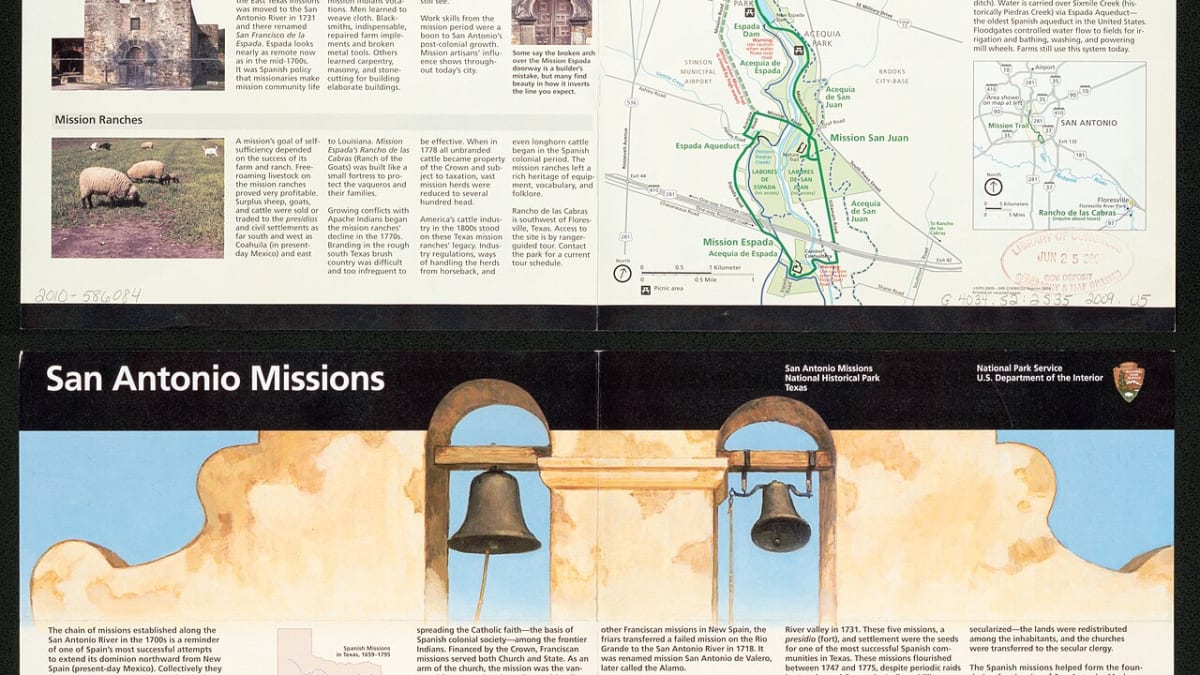
Missions could not survive on faith alone; they had to eat, which in the dry South Texas country meant water. The friars and mission communities built a network of acequias, or irrigation canals, drawing water from the river to green their fields. The most astonishing piece survives near Mission Espada: the Espada Aqueduct, built in the 1730s and 1740s to carry the canal on stone arches across a creek bed, the only Spanish colonial aqueduct still standing in the United States.
Downstream the Espada Dam, a low wall of flagstone laid across a natural ledge in the river, still diverts water into the oldest continuously used acequia in San Antonio. Together they are recognized as a National Historic Civil Engineering Landmark, and water genuinely still flows through them nearly three centuries on. Standing at the aqueduct, watching the canal run beneath your feet, you understand the missions not as churches alone but as whole working farms carved out of the brush.
A living World Heritage Site
In 2015 the San Antonio Missions became a UNESCO World Heritage Site, the first and still only one in Texas and one of only a couple dozen cultural World Heritage sites in the entire United States. The honor recognized not just the beauty of the buildings but the way they document the meeting of Spanish and Native cultures, visible in stonework that fuses European and Indigenous designs, and the completeness of the surrounding farm-and-water landscape.
The missions were also ranching operations. Miles to the south, in Wilson County, the park protects Rancho de las Cabras, the stone-walled ranch that supplied Mission Espada with cattle, run by Native vaqueros and their families. It is a reminder that the missions reached far beyond their church walls into a working countryside, and that the people who built and lived in them left a heritage that endures in the parishes, families, and place names of San Antonio today.
Visiting the missions
The four missions sit along a several-mile stretch of the San Antonio River south of downtown, so plan to drive between them or, better, to walk or bike the paved Mission Reach of the river trail that links them. Admission is free and no reservations are needed, and the visitor center at Mission San Jose is the natural place to start, with exhibits and a film that set the whole chain in context before you explore.
Give yourself the better part of a day to do the park justice, and start early to beat the South Texas heat, since much of the walking is out in open plazas and along the sun-struck aqueduct. Remember that the churches are living parishes; step in quietly, and be ready to give way if a Mass or a wedding is underway. Between the grand carved facade of San Jose, the tiny whitewashed chapel at Espada, and the ancient water still running through the aqueduct, it is one of the richest and least crowded historic experiences in Texas.
Closest Boutels
The closest Boutel™ stays, so you can turn this stop into an overnight. Each is a place we chose through independent editorial review, never a paid placement.
Details
San Antonio, TX
Frequently asked questions
What is San Antonio Missions National Historical Park?
San Antonio Missions National Historical Park, in San Antonio, preserves four beautiful Spanish colonial missions established in the eighteenth century along the San Antonio River, part of the same mission system as the nearby Alamo. A UNESCO World Heritage Site, the park protects these remarkable stone churches and their surrounding grounds, which tell the story of Spanish colonization, Native peoples, and the blending of cultures on the Texas frontier. Visitors can tour the historic missions, including the grand Mission San Jose, connected by a scenic river trail. With its beautifully preserved Spanish colonial missions and rich history, San Antonio Missions National Historical Park offers a profound destination in central Texas.
What can you see at San Antonio Missions National Historical Park?
You can tour four historic Spanish colonial missions, including the grand and beautifully restored Mission San Jose known as the Queen of the Missions, along with Missions Concepcion, San Juan, and Espada, each with its own church, grounds, and history. You can explore the stone architecture, ornate carvings, restored rooms, and grounds, learn about the missions' role in Spanish colonization and Native life, and walk or bike the scenic river trail connecting them. The missions are active churches as well as historic sites. With its four historic missions and river trail, the park offers a rich and moving experience in San Antonio, Texas.
Are the San Antonio Missions still active churches?
Yes, several of the missions within San Antonio Missions National Historical Park remain active Catholic parishes with regular services, so while visitors are welcome to tour them, it is important to be respectful, especially during worship services, keeping quiet and mindful in sacred spaces. The missions are both historic monuments and living places of faith, adding a special dimension to a visit. Checking service times can help you plan a respectful visit. Honoring their role as active churches, alongside their history, makes touring the San Antonio Missions a meaningful experience in central Texas.
When is the best time to visit San Antonio Missions National Historical Park?
Fall through spring offers the most comfortable weather for touring the missions and walking the river trail, with mild temperatures far more pleasant than the intense heat of a San Antonio summer, when midday visits can be hot, so early morning is best in the warm months. The missions are beautiful year-round, and mornings offer softer light and smaller crowds. Checking current hours and any service times before you go is wise. For the most comfortable exploring of the missions and trail, aim for fall through spring at San Antonio Missions National Historical Park in Texas.
What is near San Antonio Missions National Historical Park?
San Antonio Missions National Historical Park is in San Antonio, near the famous Alamo, the River Walk, Brackenridge Park, and within reach of Natural Bridge Caverns, the Texas Hill Country, and Goliad with its own Spanish colonial mission and presidio. That makes the San Antonio Missions a profound stop to combine with the Alamo, Brackenridge Park, and the other attractions of San Antonio and central Texas on a visit to the state.
Nearby
Brackenridge Park
7.0 miles away
San Antonio's historic 340-acre riverside park just north of downtown, with stone WPA bridges, huge shade trees, a Japanese-style garden of koi ponds carved from an old quarry, and one of the country'...

Natural Bridge Caverns
24 miles away
Natural Bridge Caverns: open daily, admission charged, various tour options at different price points. Discovery Tour (60-90 min): most family-friendly, easy walking.
Blue Hole Regional Park
50 miles away
A spring-fed swimming hole on Cypress Creek shaded by giant bald cypress trees, with rope swings out over the deep green pool and a grassy swim lawn.