
Salvation Mountain
603 E Beal Rd
Niland, CA
One man's three-story hillside of adobe and house paint, a folk-art love letter built by hand over decades in the Salton Sea desert.
Salvation Mountain is what happens when one person pours a lifetime into a single idea. Rising about three stories out of the desert near Niland, it is a hillside of adobe and hay bales coated in thousands of gallons of donated house paint, arranged into flowers, waterfalls, and a giant message that God is love. It is folk art on a landscape scale, built entirely by hand.
Its maker was Leonard Knight, who came to the spot chasing a different dream. After a religious awakening in 1967, he spent years trying to launch a hot-air balloon carrying his message. When that failed, he began building a small monument out of concrete and paint, and it grew, and grew, until it became the painted mountain that draws visitors from around the world.
What Travelers Love
- A whole hillside painted in flowing rivers of color, unlike anything else in the desert
- The hand-built rooms and domes made of adobe, straw, and salvaged materials
- The pure, single-minded devotion of one artist visible in every brushstroke
- The strange, free-spirited world of Slab City around it
Worth Knowing
- Summers here are brutally hot, often well over 100 degrees, so visit in the cooler months and bring water
- It is a fragile artwork of adobe and paint, so stay on the marked paths and do not climb where you should not
- Volunteers now maintain it, and donations of paint and support keep it standing
- It is genuinely remote, so fuel up and plan for a long drive with little service nearby
Learn about Salvation Mountain
Leonard Knight and a lifetime of paint
Leonard Knight began the first Salvation Mountain in 1984, but the early version, built partly of unstable concrete, cracked and collapsed after a rainstorm in 1989. Undaunted, he started over the next year using native materials, adobe clay and straw, which proved far stronger. Coat after coat of paint, more than ten layers thick in places, seals and protects the earthen structure.
For the rest of his life Knight lived beside his mountain, adding to it daily and welcoming the strangers who found their way down the dead-end road. He worked on it until age and health forced him to leave, and he died in 2014, leaving behind one of the most singular pieces of American folk art.
Slab City and the desert around it
The mountain sits at the entrance to Slab City, a loose off-grid community that grew up on the concrete slabs of a decommissioned World War Two Marine base. Free of utilities and formal rules, it draws snowbirds, artists, drifters, and people looking to live outside the grid, and it has become part of the pilgrimage for many who come to see the mountain.
All of it sits in the low desert near the Salton Sea, an accidental inland sea created in the early 1900s that is now shrinking and troubled. The setting is stark and elemental, and the flood of color rising out of it is exactly what makes Salvation Mountain feel so improbable.
Preserving a fragile artwork
Because it is made of earth and paint under a punishing desert sun, Salvation Mountain needs constant care. Since Knight's departure, a nonprofit and a rotating crew of volunteers have taken up the work of patching the adobe and repainting the faded surfaces, relying on donated paint to keep the colors alive.
Visitors are asked to treat it gently, staying on the yellow-painted brick path that Knight laid across the face and resisting the urge to climb on the more delicate structures.
When to go
The only real rule is to avoid the summer. From late spring through early fall the Imperial Valley bakes at temperatures that can top 110 degrees, dangerous for a long desert visit. The cooler months, roughly November through March, are the time to come, when the light is soft and the drive is comfortable.
It is a remote destination, so fill your tank, carry plenty of water, and give yourself time for the long, empty road in and out. Early morning and late afternoon light make the colors glow.
Closest Boutels
The closest Boutel™ stays, so you can turn this stop into an overnight. Each is a place we chose through independent editorial review, never a paid placement.
Details
Niland, CA
Frequently asked questions
What is Salvation Mountain?
Salvation Mountain is a remarkable and colorful folk-art monument in the desert near Niland, California, close to the Salton Sea. Created over decades by the late artist Leonard Knight, it is a hillside covered in vibrant, hand-painted murals, biblical messages, flowers, and a giant heart, all built from adobe clay and layers of donated paint. This beloved, larger-than-life work of outsider art, proclaiming a message of love, has become an iconic and photogenic destination, drawing visitors from around the world to marvel at its bright colors, heartfelt spirit, and unique desert setting.
Can you visit and climb Salvation Mountain?
Yes, Salvation Mountain is free and open to the public, and visitors can walk up a designated painted pathway, called the yellow brick road, to the top for photos and views, but it is important to stay only on the marked paths, since the structure is made of fragile adobe and paint that can be easily damaged, and climbing elsewhere harms this delicate artwork. Respecting the paths and the monument helps preserve it for others. Being gentle and considerate, and following any posted guidance from caretakers, keeps this beloved folk-art landmark intact.
What should I know before visiting Salvation Mountain?
Salvation Mountain is in a remote desert area with an extreme, harsh climate, so visit in the cooler months or early in the day, bring plenty of water and sun protection, and be prepared for very hot conditions and limited services nearby. There is no admission fee, but donations of paint or money help maintain it. The nearby area, including the unconventional community of Slab City, is very rustic. Being self-sufficient, respectful of the fragile art, and prepared for the desert heat ensures a safe and rewarding visit to this unique landmark.
When is the best time to visit Salvation Mountain?
The cooler months from late fall through early spring are by far the best time to visit, offering more comfortable temperatures in this harsh desert setting, while summer brings brutal, dangerous heat that makes a visit uncomfortable and risky. Morning light is beautiful on the colorful murals and cooler for exploring. Clear days make the vivid colors pop for photos. For a comfortable and safe visit to admire and photograph this vibrant folk-art monument, plan your trip during the cool season, ideally in the morning to beat the heat.
What is near Salvation Mountain?
Salvation Mountain is near the small town of Niland by the Salton Sea in the Southern California desert, close to the unconventional off-grid community of Slab City and East Jesus art installations, with the Salton Sea's shoreline nearby and the Coachella Valley and Palm Springs area to the north and Anza-Borrego Desert State Park to the west. That makes Salvation Mountain a colorful, offbeat stop to combine with the Salton Sea, the desert art of the area, and the wider attractions of Southern California's deserts on a road trip.
Nearby
Fonts Point
44 miles away
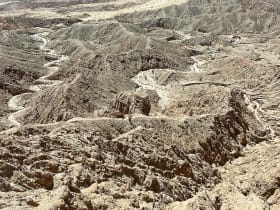
A cliff-edge overlook of the eroded Borrego Badlands inside Anza-Borrego Desert State Park, often called California's Grand Canyon.
Jacumba Wilderness
51 miles away
A 31,000-acre BLM desert wilderness of granite boulders, hidden valleys, and endangered bighorn sheep on the far southeast corner of California, tight against the Mexico border.
Anza-Borrego Desert State Park
52 miles away
Anza-Borrego Desert State Park covers 600,000 acres in San Diego County and is the largest state park in the contiguous United States.