
Salem Sue, World's Largest Holstein Cow
New Salem, ND
New Salem, ND
A giant black-and-white dairy cow the size of a barn, standing on a hilltop above the interstate and watching over New Salem for miles in every direction.
Salem Sue is a fiberglass Holstein cow so large that she stands watch over New Salem from the top of School Hill, visible for miles up and down Interstate 94. Built in 1974, she measures about 38 feet tall and 50 feet long and weighs roughly six tons, which makes her, by common reckoning, the largest Holstein cow statue in the world.
She was not built as a gimmick so much as a thank-you. New Salem grew up as a dairy town, and the local Lions Club raised the money to honor the farmers whose milk cows had carried the community for generations. Today she is one of the best loved of North Dakota's giant roadside monuments, a cheerful landmark that has turned countless long drives across the plains into a story worth telling.
What Travelers Love
- Spotting the giant cow from the interstate long before you reach town
- Driving up School Hill for the wide view over the surrounding farmland
- A friendly, only-in-North-Dakota photo stop that kids remember
- The tribute to the dairy farmers who built the town's fortunes
Worth Knowing
- The statue sits atop a steep hill reached by a short access road, so watch for other cars and take the drive slowly
- There are no services at the statue itself, but the town of New Salem has fuel, food, and restrooms
- The hilltop is windy and exposed, so hold onto hats and layer up in cooler months
- Photos come out best in morning or late-day light when the sun is behind you
Learn about Salem Sue, World's Largest Holstein Cow
A monument to a dairy town
New Salem was settled in the 1880s by homesteaders, many of them German and German-Russian immigrants who came to farm the central North Dakota prairie. The land here proved better suited to dairy and mixed farming than to wheat alone, and for decades the creameries and milk cows of the surrounding countryside were the backbone of the town's economy.
By the early 1970s the local Lions Club wanted a way to celebrate that heritage and to give travelers a reason to slow down and remember New Salem. They settled on a giant Holstein, the black-and-white breed that fills the region's dairy barns, and raised the funds themselves. Salem Sue was assembled on School Hill in 1974, and she has greeted the interstate ever since, a hometown symbol built by the people she honors.
The view from School Hill
The real reward of the drive up is not just the cow but the vantage point she commands. School Hill is one of the higher rises in the area, and from beside Salem Sue the land falls away in every direction, a patchwork of grain fields, pasture, farmsteads, and the thin ribbon of the interstate running east toward Bismarck and west toward the Badlands.
On a clear day the horizon seems to go on without end, the way it does across so much of the northern plains. It is a good place to feel the scale of the country you are crossing, to stretch after a long stretch behind the wheel, and to watch the light move over the fields. Sunrise and sunset are especially fine, when the low sun gilds both the statue and the farmland below.
North Dakota's roadside giants
Salem Sue belongs to a beloved tradition of oversized roadside monuments strung across North Dakota, part of an informal trail that includes the World's Largest Buffalo in Jamestown, the World's Largest Sandhill Crane in Steele, the Tin Family and other sculptures along the Enchanted Highway, and the giant turtles up in the Turtle Mountains. Each was built by a community wanting to give travelers a reason to stop.
These giants are more than kitsch. They are folk art on a grand scale, funded by local clubs and volunteers, and each one says something about the place that raised it, whether it is the bison herds that once covered the plains, the cranes that pass through on migration, or, here, the dairy cows that built a town. Together they turn a long interstate crossing into a scavenger hunt of local pride.
The country around New Salem
The land Salem Sue overlooks has been home to Northern Plains peoples for thousands of years, and the Mandan, Hidatsa, and Arikara, now the MHA Nation, along with the Dakota and Lakota, hold deep ties to the Missouri River country just to the east. Their villages, trails, and history are woven through this stretch of the state, and the nearby Bismarck-Mandan area holds many of the sites that tell that story.
For the traveler today, New Salem makes an easy pause on the drive between Bismarck and the Badlands. The town itself is small and welcoming, with fuel and food along the interstate, and the surrounding countryside carries the quiet rhythm of a working farm community. It is a fitting neighborhood for a monument built to honor the people who farm it.
Closest Boutels
The closest Boutel™ stays, so you can turn this stop into an overnight. Each is a place we chose through independent editorial review, never a paid placement.
Details
New Salem, ND
Frequently asked questions
What is Salem Sue?
Salem Sue, in New Salem in central North Dakota, is a colossal sculpture of a Holstein dairy cow billed as the world's largest, a beloved roadside landmark perched on a hill above the town and interstate. This enormous cow, standing tall on a hilltop, celebrates the dairy farming heritage of the New Salem area and can be seen from far away along the highway, making it a fun and photogenic icon of the northern plains. Travelers love to spot the giant cow watching over the prairie. A giant and iconic roadside landmark, it delights visitors. With its enormous scale, Salem Sue offers a fun destination in North Dakota.
What can you do at Salem Sue?
You can drive up the hill to see the giant cow up close, admire and photograph the colossal sculpture, and take in the sweeping views of the surrounding prairie and town from the hilltop where Salem Sue stands. The giant cow, the photo opportunities, and the hilltop views are the draws, making it a fun and memorable roadside stop. Standing beside the enormous cow and enjoying the views are highlights. With its scale, Salem Sue offers a rewarding stop in New Salem, North Dakota.
Why is there a giant cow in New Salem?
There is a giant cow in New Salem to celebrate the dairy farming heritage of the area, and the colossal Holstein, named Salem Sue and billed as the world's largest cow, has become a beloved roadside icon watching over the town and interstate. Its creation reflects the community's pride in its dairy farming roots. It anchors a fun roadside stop with hilltop views. Appreciating this makes a visit to Salem Sue in North Dakota especially fun.
When is the best time to visit Salem Sue?
Salem Sue is an outdoor hilltop landmark that can be visited and photographed year-round, with the mild months of spring through fall the most pleasant for driving up the hill and enjoying the views, and clear days best for photos and the sweeping prairie panorama. Because it is a quick outdoor stop, comfortable weather makes it most enjoyable. For the most pleasant visit and best views, aim for a clear day in the mild months at Salem Sue in North Dakota.
What is near Salem Sue?
Salem Sue is in New Salem in central North Dakota, along the interstate west of Bismarck, within reach of Bismarck-Mandan with its attractions to the east, the routes toward the Badlands to the west, and the central North Dakota prairie. That makes Salem Sue a fun stop to combine with the attractions of the Bismarck-Mandan area and the route west on a visit to North Dakota.
Nearby
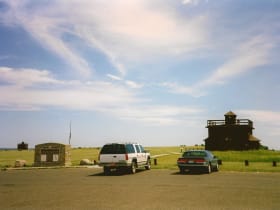
Fort Abraham Lincoln State Park
28 miles away
Fort Abraham Lincoln State Park: 7 miles south of Mandan off ND-1806. Entrance fee applies.
Gateway to Science
28 miles away
Gateway to Science: 1600 Canary Ave in Bismarck, near the university. Admission fee applies. Best for ages 3 to 12, with enough to hold older kids for a while.
Cross Ranch State Park
30 miles away
Cross Ranch State Park: about 15 miles south of Washburn off ND-1806. Entrance fee applies.