
Providence Canyon State Park
8930 Canyon Rd
Lumpkin, GA
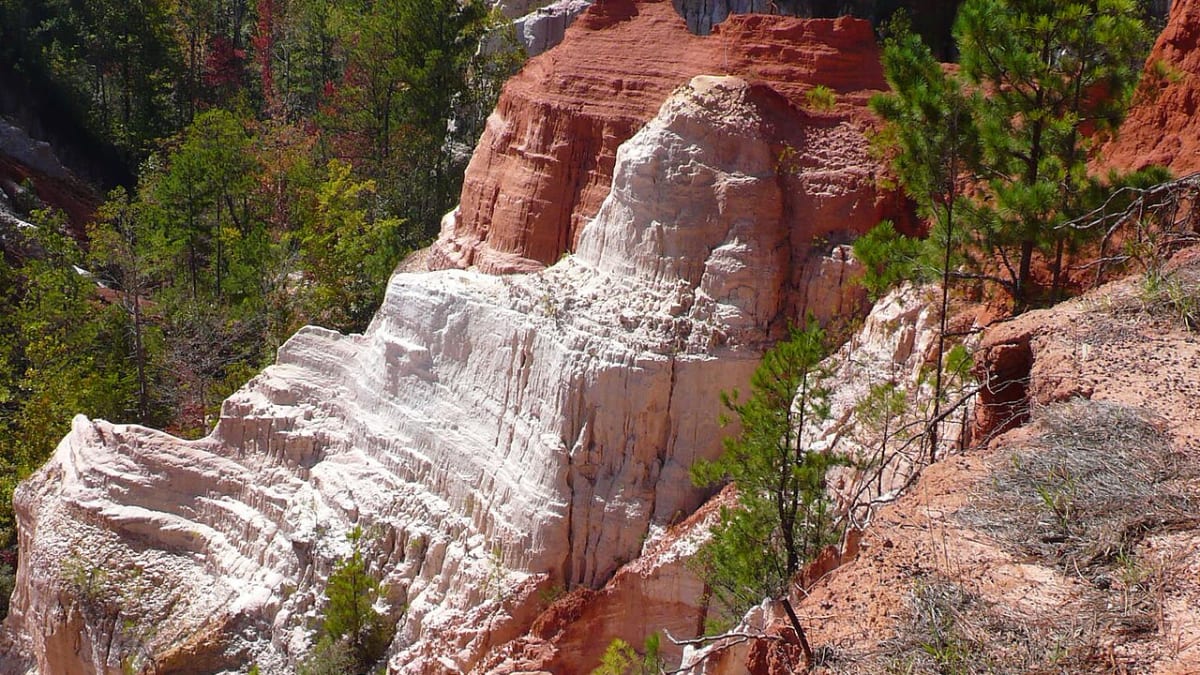
Georgia's Little Grand Canyon, a maze of pink, orange, and white gullies gouged from soft earth by nothing more than bad farming.
Providence Canyon is often called Georgia's Little Grand Canyon, a maze of deep, colorful gullies carved into the soft earth of the southwest part of the state. Its walls glow in bands of pink, orange, red, purple, and white, layers of clay and sand exposed and sculpted into spires, ledges, and narrow ravines that look like something from a desert in the American West.
But the twist is that Providence Canyon is not the work of a great river over the ages. It was created almost entirely by human carelessness. Poor farming methods in the 1800s stripped and gullied the land, and rainwater tore into the soft soil so quickly that a whole canyon system opened up in barely a century, a striking, beautiful accident born of erosion.
What Travelers Love
- The astonishing pink, orange, red, and white walls of the eroded canyons
- Hiking the canyon floor between towering, colorful gully walls
- The rim trail views out over the whole strange landscape
- Rare wild plumleaf azaleas blooming in summer along the canyon
Worth Knowing
- The canyon floor is often sandy and can be muddy or wet, so wear shoes you do not mind getting dirty
- The park welcomes visitors, with a small parking fee at most Georgia state parks
- Do not climb on the fragile canyon walls, which erode easily and can collapse
- Bring water and sun protection, as much of the hiking is exposed and warm in summer
Learn about Providence Canyon State Park
A canyon made by mistake
When settlers began farming this land in the early 1800s, they cleared the forest and plowed straight up and down the slopes, without the terracing or cover that holds soil in place. In the soft, sandy earth of the region, rainwater found the bare ground and cut into it fast, carving small gullies that grew, year by year, into deep ravines.
Within a few generations, what had been farm fields became a spreading system of canyons, some many stories deep. It is a vivid, cautionary lesson in soil erosion, and it is taught as such, yet the result is undeniably beautiful, a landscape of color and form that nature would ordinarily take ages to produce, wrought here in a startlingly short time.
Colors in the earth
The canyon walls owe their colors to the minerals in the exposed soil layers. Iron and manganese tint the earth in reds, oranges, pinks, and purples, while other layers stay white or cream, and the bands stack and blend into a palette that shifts with the light and the weather. After rain the colors deepen and glow.
The soil here is soft and easily worn, which is exactly why the canyons formed so fast and why they keep changing. That same softness means visitors must not climb or dig at the walls, which crumble readily. Seen from the rim or from the canyon floor, the layered, sculpted earth is the park's whole reason for being.
Trails and wildflowers
Two main ways of seeing the canyon draw visitors: a rim trail that traces the canyon edges with sweeping views into the gullies, and a loop that descends to the canyon floor and winds among the towering, colorful walls, often through soft sand and shallow water. Longer backcountry trails reach out into the surrounding forest.
Providence Canyon is also one of the few places to see the rare plumleaf azalea, a wild shrub that blooms in fiery orange and red through the summer heat, well after most azaleas have faded. Combined with the color of the canyons themselves, a summer visit can be surprisingly vivid, though the forest and gullies are striking in any season.
The land around Lumpkin
The park sits near Lumpkin, a small county-seat town in southwest Georgia's rolling farm and forest country. This region was Muscogee, or Creek, homeland before settlers arrived and the Creek were forced west in the 1800s, and much of it remains quiet, rural land of pine woods and back roads.
Providence Canyon pairs naturally with other nearby sights, from the Chattahoochee River corridor to the Jimmy Carter sites at Plains and the National Infantry Museum at Columbus. But the canyon stands on its own as one of the most unusual and photogenic landscapes in the state, a place where a mistake became a wonder.
Closest Boutels
The closest Boutel™ stays, so you can turn this stop into an overnight. Each is a place we chose through independent editorial review, never a paid placement.
Details
Lumpkin, GA
Frequently asked questions
What is Providence Canyon State Park?
Providence Canyon State Park, near Lumpkin in southwestern Georgia, protects a stunning landscape of colorful canyons often called Georgia's Little Grand Canyon, one of the most surprising and beautiful natural sights in the state. The dramatic canyons, with their vividly colored walls of pink, orange, red, and white soils, were actually created by erosion resulting from poor farming practices in the nineteenth century, an accidental beauty that has become a scenic wonder. Rim trails offer breathtaking overlooks, and a trail descends into the canyons themselves, revealing the colorful gullies up close. With its colorful canyons, Providence Canyon State Park offers a spectacular destination in Georgia.
What can you do at Providence Canyon State Park?
You can take in the breathtaking views of the colorful canyons from the rim trail and overlooks, hike the trail down into the canyons to walk among the vividly colored gullies and walls, photograph the striking landscape, and visit the interpretive center. The colorful canyon views, the rim and canyon trails, and the dramatic, surprising scenery are the draws, making it a spectacular and photogenic natural destination. Walking among the colorful walls is a highlight. With its canyons and trails, Providence Canyon State Park offers a rewarding experience in Georgia.
Is Providence Canyon State Park safe to visit?
The rim overlooks and trails offer safe access, but caution is important, as the canyon rims and edges can be unstable and have drops, so staying on marked trails and behind any barriers, keeping back from the canyon edges, and watching children closely are wise. The canyon-floor trail can be muddy and involves uneven terrain and sometimes water, so sturdy shoes and care help. Respecting the fragile, eroding canyon walls by not climbing on them protects both you and the site. Staying on trails and using care ensure a safe visit to Providence Canyon State Park in Georgia.
When is the best time to visit Providence Canyon State Park?
The mild months of spring through fall offer the most pleasant weather for hiking the rim and canyon trails, with spring bringing wildflowers, including a rare native azalea, and fall bringing comfortable temperatures and color, while summer can be hot and the canyon floor muddy after rain. The colorful canyon walls are striking in good light. For wildflowers aim for spring, or visit in fall for comfortable weather, at Providence Canyon State Park in Georgia.
What is near Providence Canyon State Park?
Providence Canyon State Park is near Lumpkin in southwestern Georgia, within reach of the National Infantry Museum in Columbus, the Jimmy Carter Boyhood Farm in Plains, Callaway Gardens, and southwestern Georgia. That makes Providence Canyon State Park a spectacular stop to combine with the Jimmy Carter Boyhood Farm and the other attractions of southwestern Georgia on a visit to the state.
Outside the Park
Lakepoint State Park
13 miles away
Lake Eufaula is one of the great fishing waters of the South, a 45,000-acre reservoir where the Chattahoochee is dammed along the Georgia line, and Lakepoint State Park is the base for exploring it.

Shorter Mansion
17 miles away
Eufaula has dozens of grand old homes, but this is the one to step inside.
Museum of Wonder Drive-Thru
22 miles away
This is about as off-the-map as folk art gets. Near the crossroads hamlet of Seale, self-taught artist Butch Anthony built what he bills as the world's first drive-thru museum, a row of shipping conta...