
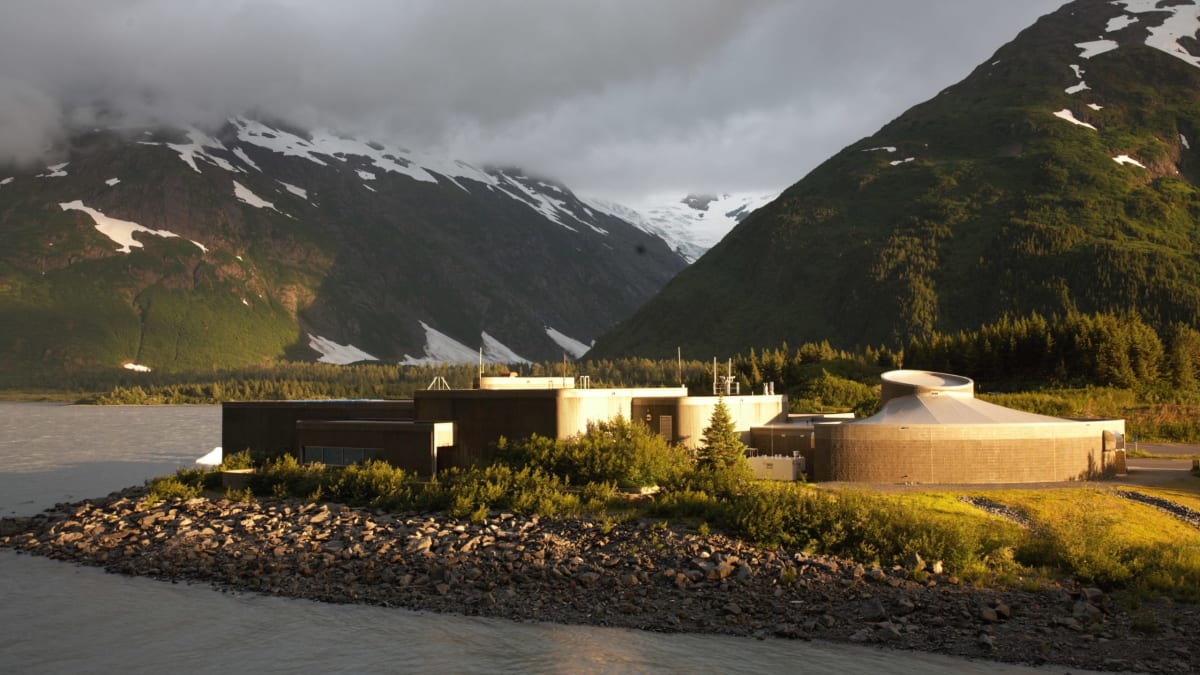
Portage Glacier and Begich Boggs Center
Portage Glacier Road
Portage Valley, AK
A boat glides across an iceberg-flecked lake to the face of a blue glacier, at the end of a valley an hour from Anchorage that ranks among the most visited corners of Alaska.
Portage Glacier is one of the most visited glaciers in Alaska, and for good reason: it lies barely an hour from Anchorage at the end of a valley walled with waterfalls and hanging ice. A tour boat crosses Portage Lake, weaving among floating icebergs, to reach the glacier's blue face where it meets the water.
The valley is also home to the Begich Boggs Visitor Center, a Forest Service center perched above the lake with exhibits on glaciers, ice worms, and the forces that shaped this country. Together the boat and the center make Portage the classic first glacier for many travelers, an accessible window onto the ice that still covers so much of Alaska.
What Travelers Love
- Cruising Portage Lake to the glacier's face past floating icebergs
- The Begich Boggs Visitor Center's exhibits and glacier-view windows
- How many other glaciers you can spot from the valley road
- An easy, family-friendly taste of tidewater ice country near Anchorage
Worth Knowing
- Portage Glacier has retreated out of view from the visitor center, so a boat tour is now the reliable way to see its face up close
- The glacier tour boat runs in summer only; the visitor center also keeps a seasonal schedule
- The valley is often cooler, windier, and wetter than Anchorage, so bring a warm layer even on a bright day
- Nearby Byron Glacier is a short, easy walk if you want to reach ice on foot
Learn about Portage Glacier and Begich Boggs Center
A glacier on the move
Portage Glacier flows down from the Sargent Icefield in the Chugach Mountains, part of a broad field of ice that feeds many of the glaciers around Prince William Sound. It ends in Portage Lake, a body of water that did not exist much more than a century ago.
The lake is itself a record of retreat. As recently as the early 1900s the glacier filled the basin where the lake now sits, and it has pulled back steadily since, leaving open water in its place. When the Begich Boggs Visitor Center was built in the 1980s, the glacier could still be seen from its windows; it has since retreated around a bend and out of that view, a plain, visible measure of a warming climate.
That retreat is exactly why the boat tour matters now. Because the glacier's face no longer shows from shore, the reliable way to see it up close is to cross the lake by boat to where the ice still calves into the water, sending small bergs drifting back across the lake.
The boat tour and the lake
The tour boat departs from a dock near the visitor center and crosses Portage Lake to the glacier's terminus. The ride threads among icebergs, some newly broken from the face and glowing with the deep blue of dense, air-starved glacial ice, and brings you within a safe distance of the towering wall of the glacier itself.
Guides on board explain how the glacier formed, how it moves, and how to read the blue color and the sounds of ice cracking and calving. On a still day the lake mirrors the surrounding peaks, and the scale of the ice against the boat gives an honest sense of a glacier's size.
The tour runs during the summer season. Because weather in the valley shifts quickly, dress warmly for the open water even when the parking lot feels mild.
The Begich Boggs Visitor Center
The visitor center is named for two congressmen, Nick Begich of Alaska and Hale Boggs of Louisiana, who disappeared on a small-plane flight over Alaska in 1972 and were never found. It stands above the lakeshore with big windows framing the water and the surrounding mountains.
Inside, Forest Service exhibits explain how glaciers form and carve the land, and introduce oddities like the ice worm, a small dark worm that genuinely lives within glacial ice. A relief model of the icefield and a film help make sense of the country you are looking at, and rangers can point you to nearby trails and viewpoints.
The center makes a good first stop, orienting you to the valley before you board the boat or set out on foot.
Around Portage Valley
The valley itself is scenic driving. Portage Glacier Road passes several other glaciers and countless waterfalls streaming off the walls, and a short trail leads toward Byron Glacier, where you can walk close to the ice and, in early summer, sometimes find snow lingering on the path.
The same road continues to the one-lane tunnel to Whittier, a tiny port town on Prince William Sound reached by driving through a shared railroad tunnel bored through a mountain, an experience in itself. The wetlands near the highway are good for spotting moose, and salmon spawn in Williwaw Creek in late summer, drawing bears and eagles.
All of this sits within Chugach National Forest, an easy and rewarding detour off the drive between Anchorage and the Kenai Peninsula.
Closest Boutels
The closest Boutel™ stays, so you can turn this stop into an overnight. Each is a place we chose through independent editorial review, never a paid placement.
Details
Portage Valley, AK
Frequently asked questions
What is Portage Glacier and the Begich, Boggs Visitor Center?
Portage Glacier and the Begich, Boggs Visitor Center, in the mountains southeast of Anchorage near Portage along the Seward Highway, Alaska, is a beautiful glacier and lake area with an excellent visitor center, one of the most popular glacier destinations near Anchorage. The visitor center, set on the shore of Portage Lake, offers exhibits on glaciers and the region, while boat tours on the lake bring visitors close to the face of Portage Glacier amid icebergs and stunning mountain scenery. Nearby, other glaciers and the Whittier tunnel add to the area's appeal. A gorgeous and accessible glacier destination, it delights visitors. With its glacier and lake, Portage offers a spectacular destination in Alaska.
What can you do at Portage Glacier and the Begich, Boggs Visitor Center?
You can explore the visitor center's exhibits on glaciers and the region, take a boat tour across Portage Lake to see the face of Portage Glacier and its icebergs up close, enjoy the mountain scenery, watch for wildlife, and explore nearby glaciers and trails. The glacier boat tours, the visitor center exhibits, the mountain and lake scenery, and the nearby glaciers are the draws, making it a rewarding glacier destination close to Anchorage. The boat tour to the glacier is a highlight. With its glacier and center, Portage offers a rewarding experience in Alaska.
When is the best time to visit Portage Glacier and the Begich, Boggs Visitor Center?
The summer months are the prime time to visit, when the visitor center is open, the boat tours to the glacier are running, and the weather is mildest for enjoying the lake and scenery, while the area is quieter and services more limited in other seasons. Because the visitor center and boat tours are seasonal, checking current hours and tour availability before you go is wise. For the boat tour and full experience, aim for summer at Portage Glacier and the Begich, Boggs Visitor Center in Alaska.
What should I know before visiting Portage Glacier?
Portage is a mountain glacier area where weather can be cool, wet, and changeable even in summer, so bringing layers and rain gear is wise, and the boat tour on the cold lake calls for warm clothing. This is bear and wildlife country, so being bear-aware on trails matters, and the nearby Whittier tunnel, shared by cars and trains, runs on a schedule worth checking if you plan to continue to Whittier. Dressing warmly and being wildlife-aware ensure an enjoyable visit to Portage Glacier in Alaska.
What is near Portage Glacier and the Begich, Boggs Visitor Center?
Portage Glacier and the Begich, Boggs Visitor Center are near Portage along the Seward Highway southeast of Anchorage, Alaska, within reach of Whittier through the tunnel, the Kenai Peninsula and Seward to the south, and Anchorage to the north. That makes Portage Glacier a spectacular stop to combine with the attractions of the Kenai Peninsula and Anchorage on a visit to Alaska.
Nearby

Alaska Native Heritage Center
42 miles away
Many visitors race through Anchorage to reach the glaciers and miss the one place that explains who has lived on this land for thousands of years.

Anchorage Museum
46 miles away
For a museum, this one hides a real treasure most people do not expect: hundreds of Alaska Native objects on long-term loan back from the Smithsonian, shown with the voices of Native elders explaining...
Kenai Fjords National Park
49 miles away
Nearly 40 glaciers pour off the Harding Icefield down to a coast of fjords, whales, and seabirds.

Exit Glacier
50 miles away
The only road-accessible part of Kenai Fjords National Park, Exit Glacier is a walk-up river of ice flowing off the vast Harding Icefield.