
Paul Bunyan Statue
519 Main Street
Bangor, ME
A 31-foot lumberjack with an axe and a peavey, guarding a city that once called itself the lumber capital of the world and still claims Paul Bunyan as a native son.
Rising 31 feet over Main Street in Bangor, this brightly painted Paul Bunyan grips an axe in one hand and a peavey, the logger's spiked pole, in the other. Bangor erected him in 1959 for the city's 125th anniversary and boldly declares that the legendary giant lumberjack was born right here, a claim that several other logging towns dispute and that Bangor wears with a grin.
The statue is more than a roadside curiosity. It is a monument to what Bangor once was: in the mid 1800s the city billed itself as the lumber capital of the world, the point where the timber of the vast Maine woods was floated down the Penobscot, sawn, and shipped out to build a growing nation. Paul Bunyan stands as the folk hero of that era, oversized and tireless, exactly as the legend demands.
What Travelers Love
- A giant, cheerfully painted lumberjack that makes an irresistible roadside photo
- Bangor's bold claim that Paul Bunyan was born right here
- A quick, free stop on the way through town or north toward Katahdin
- A window into the city's history as a lumber-shipping powerhouse
Worth Knowing
- The statue stands outdoors beside the Cross Insurance Center and is free to visit any time
- Several American cities claim Paul Bunyan; Bangor's claim is part of the fun, not settled history
- It is a short detour from downtown Bangor and the Penobscot River waterfront
- Pair it with the nearby Stephen King house and Thomas Hill Standpipe for a quick Bangor loop
Learn about Paul Bunyan Statue
The giant on Main Street
Bangor's Paul Bunyan went up in 1959 to mark the city's 125th birthday. He towers 31 feet tall, painted in a lumberjack's plaid, holding an axe and a peavey, the long spiked lever that river drivers used to steer floating logs. A time capsule was placed inside him at his dedication, meant to be opened well into the future.
He has become one of Bangor's best-loved landmarks and a favorite photo stop, big enough to be seen from the road and friendly enough to draw a smile. The author Stephen King, a longtime Bangor resident, even worked the statue into his novel It, where it takes on a decidedly more sinister life.
Who owns Paul Bunyan?
Paul Bunyan is a figure of American folklore, the impossibly strong lumberjack whose tall tales spread through logging camps and were later popularized in print and advertising. Because the legend belongs to the whole northern timber country, several places lay claim to him, and towns in the Upper Midwest raise their own giant statues and stories.
Bangor's claim, that Paul was actually born in the city, is part boast and part civic humor, staked on Bangor's genuine standing as a lumber capital. Rather than settle the argument, the statue leans into it, a hometown hero for a city that shipped the timber the legend was built on.
Bangor and the lumber era
In the first half of the 1800s, Bangor sat at the meeting point of the Penobscot River and the tide, the natural gateway for the immense forests to the north. Logs cut across the Maine woods were driven downriver each spring, milled in and around the city, and loaded onto ships bound for ports along the coast and beyond. For a stretch of the mid century, Bangor was among the busiest lumber ports on earth.
That wealth built the handsome downtown and riverfront mansions still standing today. The Penobscot River, which carried the logs and the fortunes, remains the spine of the city and the traditional homeland of the Penobscot Nation, whose people continue to live in the region and hold their reservation upriver at Indian Island.
A quick Bangor stop
The statue is an easy, free pause on any trip through Bangor, and the city makes a natural jumping-off point for the North Woods. Many travelers roll through here on the way to Baxter State Park and Mount Katahdin, the northern end of the Appalachian Trail, an hour and a half or so to the north.
Downtown Bangor rewards a longer look, with a revived waterfront on the Penobscot, a walkable center, and a couple of other quirky landmarks close by, including the wooden Thomas Hill Standpipe and the famous red house of Stephen King. Together they make a short, offbeat loop through a city with an outsized story.
Closest Boutels
The closest Boutel™ stays, so you can turn this stop into an overnight. Each is a place we chose through independent editorial review, never a paid placement.
Details
Bangor, ME
Frequently asked questions
What is the Paul Bunyan Statue in Bangor?
The Paul Bunyan Statue, in Bangor, Maine, is a giant statue of the legendary lumberjack folk hero, standing over thirty feet tall, that the city claims as one of the largest such statues and celebrates as a symbol of its logging heritage. Bangor, once a booming lumber town, embraces the Paul Bunyan legend, and the towering, colorful statue, holding an axe and peavey, watches over the city as a beloved landmark. Fittingly, the statue even makes an appearance in a Stephen King novel set in a fictional version of Bangor. With its towering lumberjack, the Paul Bunyan Statue offers a fun roadside landmark in Bangor, Maine.
Why is there a Paul Bunyan statue in Bangor?
There is a Paul Bunyan statue in Bangor because the city was once one of the great lumber capitals of the world during the logging boom, shipping vast quantities of timber, so it embraces the legendary lumberjack Paul Bunyan as a symbol of that proud logging heritage. The city erected the giant statue to celebrate this history and its identity. Bangor even claims a connection to the origins of the Bunyan legend. This deep logging heritage is why the towering Paul Bunyan statue stands proudly in Bangor, Maine.
What can you do at the Paul Bunyan Statue?
You can view and photograph the towering, thirty-plus-foot Paul Bunyan statue with his axe and peavey, enjoy the fun roadside landmark celebrating Bangor's logging heritage and the beloved folk hero, and appreciate its pop-culture fame, including its cameo in a Stephen King novel. The giant lumberjack is the whole delight, especially for families and lovers of quirky Americana. It is a quick, fun stop. With its towering lumberjack and logging-heritage charm, the Paul Bunyan Statue offers a fun roadside stop in Bangor, Maine.
When is the best time to visit the Paul Bunyan Statue?
As an outdoor roadside statue, the Paul Bunyan Statue can be visited and photographed year-round in any season, making it an easy stop any time you pass through Bangor, though the warmer months from late spring through fall offer the most comfortable weather for lingering and taking photos. Winter visits are fine but can be cold and snowy. For the most pleasant weather, aim for the warmer months, though the towering Paul Bunyan Statue makes a fun stop any time of year in Bangor, Maine.
What is near the Paul Bunyan Statue?
The Paul Bunyan Statue is in Bangor, Maine, within reach of the Stephen King House, the Thomas Hill Standpipe, the Maine Discovery Museum, and the route toward Mount Katahdin and the Moosehead Lake region to the north. That makes the Paul Bunyan Statue a fun stop to combine with the Stephen King House, the Maine Discovery Museum, and the other Bangor attractions on a visit to Maine.
Nearby
Maine Discovery Museum
0.3 miles away
The Maine Discovery Museum in downtown Bangor is the biggest children's museum in the state, and it gives kids three full floors to burn energy and explore.

Stephen King House
0.5 miles away
Fans make the pilgrimage to West Broadway in Bangor to see it: the rambling blood-red Victorian where Stephen King has lived for decades, guarded by a black wrought-iron fence woven with bats, spiders...

Thomas Hill Standpipe
0.5 miles away
Locals know the secret of the big shingled tower on the hill, and a few times a year they let everyone in.
Fort Knox State Historic Site
16 miles away
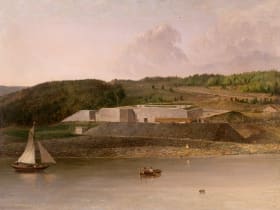
Maine's largest historic fort, a vast granite fortress on the Penobscot River that you can explore through dim passages, spiral staircases, and cannon batteries.

Acadia National Park
38 miles away
Granite peaks meet the Atlantic on Mount Desert Island, with the first sunrise in the country from the top of Cadillac Mountain.