

Nebraska National Forest at Halsey
Circle Rd, Thedford, NE
Thedford, NE
The largest hand-planted forest in America, a green woodland that people grew tree by tree in the heart of the grassy Sandhills.
The Nebraska National Forest at Halsey is one of the most improbable places in the country: the largest hand-planted forest in the United States, a green expanse of pine and cedar rising out of the treeless Sandhills. Every one of its trees traces back to human effort, a bold and slightly quixotic experiment begun more than a century ago to see whether a forest could be grown where nature had planted only grass.
The result is a woodland island in a grassland sea, where shady pine stands give way suddenly to rolling, grass-anchored dunes stretching to the horizon. A fire lookout tower, trails, campgrounds, and the winding Middle Loup River make it a fine place to explore, and the sheer oddity of a forest that people willed into being makes it unlike anywhere else in Nebraska.
What Travelers Love
- The strange wonder of a large forest planted entirely by human hands
- The Scott Lookout fire tower and its views over the Sandhills
- Trails and camping in a shady woodland surrounded by open grass
- The Middle Loup River winding through the dunes
Worth Knowing
- The forest is remote, so fuel up and stock supplies in advance
- Fire risk can be high in dry seasons, so heed all restrictions
- The surrounding Sandhills grassland is as much a draw as the trees
- Wildflowers and grassland birds are best in late spring and early summer
Learn about Nebraska National Forest at Halsey
A forest grown by hand
At the turn of the twentieth century, foresters and boosters looked at the vast, treeless Sandhills and wondered whether trees could be made to grow there. The idea was championed by early conservationists, and a federal forest reserve was established in the region, with the goal of raising a working forest and a nursery to supply seedlings for planting across the plains. Beginning in the early 1900s, crews planted seedlings by hand across the dunes.
It was a monumental effort, and not an easy one. Wildfires, harsh weather, and the simple difficulty of establishing trees in sandy, dry ground meant many losses and much replanting over the decades. But enough took hold to create the forest that stands today, the largest human-planted forest in the nation, a living monument to a stubborn and visionary experiment in reshaping the land.
An island of trees in a sea of grass
What makes Halsey so striking is the contrast. Step out of the pines and you are instantly in the open Sandhills, the largest sand dune formation in the Western Hemisphere, its dunes held in place by a fragile skin of grass. The abrupt boundary between planted forest and native grassland is unlike anything else, and it makes vivid just how deliberate and artificial the forest is.
That juxtaposition also creates rich edges for wildlife. Deer, turkey, grouse, and many birds move between the woods and the grass, and the mix of habitats supports more variety than either would alone. Exploring the forest and its grassland surroundings together gives the fullest sense of the place and the ambition behind it.
The lookout, the river, and the trails
One of the forest's landmarks is the Scott Lookout Tower, a fire lookout that rises above the trees and offers a sweeping view over the woodland and the endless dunes beyond. Climbing it drives home how small the planted forest is against the immensity of the Sandhills, and how far the grass runs in every direction.
The Middle Loup River threads through the area, one of the clear, spring-fed streams that lace the Sandhills and give the dry-seeming country its hidden abundance of water. Trails wind through the forest for hikers and riders, and campgrounds let visitors stay the night in the rare shade, listening to the wind move differently through planted pines than through open grass.
The Sandhills all around
The forest sits in the heart of the Sandhills, a landscape long used as some of the finest cattle range in the country and, for thousands of years before that, part of the homeland of Plains peoples who hunted and traveled its grasslands. Today it is ranching country, thinly settled and enormous, with an emptiness and quiet that many travelers find deeply restorative.
Because the area is remote, a visit takes some planning. Fuel and supplies are limited nearby, so it pays to stock up in advance, and dry-season fire restrictions should always be respected in a forest that has fought wildfire throughout its existence. Those who make the trip find a genuinely singular place, a hand-made woodland in one of the least crowded corners of the plains.
Closest Boutels
The closest Boutel™ stays, so you can turn this stop into an overnight. Each is a place we chose through independent editorial review, never a paid placement.
Details
Thedford, NE
Frequently asked questions
What is the Nebraska National Forest at Halsey?
The Nebraska National Forest at Halsey, in the Sandhills of central Nebraska, is a remarkable forest famous as one of the largest hand-planted forests in the country, an unusual expanse of trees planted by people amid the treeless grass-covered hills. Beginning over a century ago, foresters planted this woodland on the open Sandhills, creating a surprising forest of pines and other trees where none grew naturally, complete with trails, a lookout tower, camping, and a tree nursery. It is a fascinating human-made forest and a peaceful outdoor destination. A unique and green oasis in the Sandhills, it delights visitors. With its planted forest, the Nebraska National Forest at Halsey offers a fascinating destination in Nebraska.
Why is the Nebraska National Forest at Halsey special?
The Nebraska National Forest at Halsey is special because it is one of the largest hand-planted forests in the country, a woodland created by people on the naturally treeless Sandhills, where foresters planted vast numbers of trees beginning over a century ago. This ambitious effort turned open grassland into a surprising forest, an unusual and impressive feat that makes the site unlike a natural forest. Its human-made origin and green expanse amid the grass hills set it apart. This distinctive history makes the Nebraska National Forest at Halsey a fascinating destination in Nebraska.
What can you do at the Nebraska National Forest at Halsey?
You can hike and explore the trails through the planted forest, climb or view the historic fire lookout tower, camp, picnic, watch for wildlife, and learn about the forest and its tree nursery. The unusual hand-planted woodland, the trails, the lookout tower, and the peaceful setting are the draws, making it a distinctive outdoor stop in the Sandhills. The contrast of forest and surrounding grassland is striking. With its forest and trails, the Nebraska National Forest at Halsey offers a rewarding experience in Nebraska.
When is the best time to visit the Nebraska National Forest at Halsey?
The mild months of spring through fall are the most pleasant for hiking the forest trails, camping, and enjoying the outdoors, with spring and fall especially comfortable and the setting green and inviting, while summer is popular for camping. Because conditions and any fire restrictions vary by season, checking current information before you go is wise. For the most pleasant weather and best hiking, aim for spring through fall at the Nebraska National Forest at Halsey in Nebraska.
What is near the Nebraska National Forest at Halsey?
The Nebraska National Forest at Halsey is in the Sandhills of central Nebraska near Halsey and Thedford, within reach of the vast Sandhills, the Middle Loup River, and the scenic byways and small towns of the region. That makes the Nebraska National Forest at Halsey a fascinating stop to combine with the other attractions of the Nebraska Sandhills on a visit to the state.
Nearby
Merritt Reservoir Dark Sky
57 miles away
Merritt Reservoir State Recreation Area: about 26 miles southwest of Valentine on Highway 97. Nebraska state park permit required.
Merritt Reservoir State Recreation Area
57 miles away
Open water sits in a bowl of grassy hills in the Nebraska Sandhills, near Valentine, and every summer it hosts a big star party under some of the darkest skies on the Great Plains.
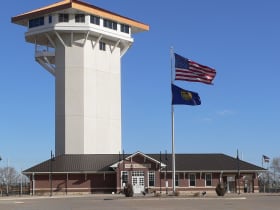
Golden Spike Tower and Bailey Yard
58 miles away
Golden Spike Tower: on North Homestead Road on the north side of North Platte, overlooking Bailey Yard.