
Mushroom Rock State Park
119-149 Randy St, Brookville, KS
Brookville, KS
A handful of giant stone mushrooms balanced on slender stems, a natural sculpture garden left behind when softer rock washed away around them.
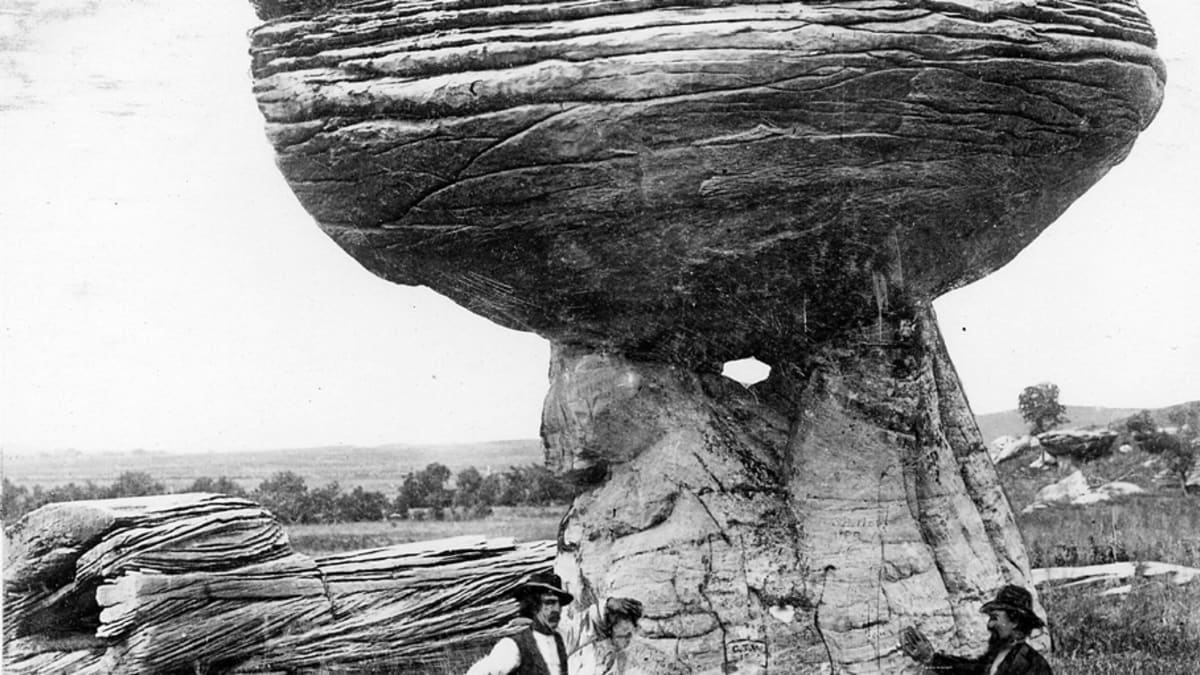
Mushroom Rock State Park is the smallest state park in Kansas, and it earns its name honestly. Scattered across a few acres of prairie are enormous sandstone formations, wide caps of hard rock balanced on narrower stems, that look for all the world like giant mushrooms sprung from the grass. The largest caps stretch more than a dozen feet across.
These strange shapes are the work of erosion. The rock here was laid down as sediment along the shore of an ancient sea, and the caps are made of harder, cemented sandstone sitting above softer layers. Over long stretches of time wind and water wore away the weaker rock faster than the hard, leaving the resistant caps perched on slender pedestals. They stand today as one of the most photographed natural oddities in central Kansas.
What Travelers Love
- Walking among giant balanced rocks that really do look like mushrooms
- How close you can get to touch and photograph the formations
- The quiet, uncrowded feel of the smallest state park in Kansas
- A quick, easy stop that packs a lot of geologic wonder into a small space
Worth Knowing
- This is a very small park, best as a short stop rather than a full day; there are minimal facilities
- Climbing on the fragile formations is discouraged, as the soft rock erodes and carved graffiti is a real problem
- Bring water and sun protection, since there is little shade out on the prairie
- Pair it with nearby Kanopolis State Park to make a fuller outing
Learn about Mushroom Rock State Park
How the mushrooms grew from the plains
The rock at Mushroom Rock dates to the Cretaceous period, when a shallow inland sea covered much of the middle of the continent. Sand and sediment deposited along its margins hardened over time into sandstone, and in places minerals cemented the grains into especially tough concretions. Those hardened caps are the reason the formations survive.
Erosion did the sculpting. As wind and rain went to work, the softer surrounding rock wore away far faster than the cemented caps, undercutting them until only narrow stems remained beneath the broad tops. The result is a small gallery of balanced rocks, mushroom shapes and rounded boulders, that record millions of years of weathering in stone.
Landmarks on the trail
The formations were landmarks long before they were a park. This part of central Kansas lay near routes used by Native peoples and later by travelers on the Smoky Hill and Santa Fe trail corridors, and the distinctive rocks served as meeting points and waypoints in an otherwise open landscape. Their unusual shapes made them easy to describe and easy to find.
The land was long the range of Plains nations, including the Kaw, or Kanza, for whom Kansas is named, and the Cheyenne and Arapaho who hunted the central and western grasslands. Frontier-era travel and settlement in the mid-1800s brought wagon roads, the railroad through nearby Brookville, and eventually the small state park that protects the rocks today.
Protecting a fragile place
The very softness that shaped the mushrooms also makes them vulnerable. The sandstone erodes easily, and generations of visitors carving initials and climbing on the formations have taken a visible toll. Park stewards ask people to look, touch gently, and photograph rather than climb or carve, so the shapes last for those who come after.
Because the park is so small, it works best as a focused stop, a chance to wander among the rocks for an unhurried hour, take pictures in the good light of morning or evening, and appreciate a genuinely unusual landscape without the crowds of a larger destination.
The Smoky Hills around it
The surrounding Smoky Hills are a region of low, rolling uplands broken by outcrops of the same distinctive sandstone, including the Dakota formation whose rusty ledges show up across central Kansas. It is ranch and farm country, quiet and open, with the Smoky Hill River and Kanopolis Reservoir shaping the land to the south.
Just down the road, Kanopolis State Park offers hiking, riding trails, and rock formations of its own around a reservoir, making an easy pairing with Mushroom Rock. Together they let travelers see the geology of the Smoky Hills up close, from balanced boulders to canyon-cut sandstone.
Closest Boutels
The closest Boutel™ stays, so you can turn this stop into an overnight. Each is a place we chose through independent editorial review, never a paid placement.
Prairie Lodge Motel
Honorable Mention1219 Old US Highway 56, Council Grove, KS
79 miles away|Learn More ›
Evergreen Inn Motel & RV Park
Honorable Mention20001 W. US Highway 54, Pratt, KS
84 miles away|Learn More ›
Details
Brookville, KS
Frequently asked questions
What is Mushroom Rock State Park?
Mushroom Rock State Park, near Kanopolis in central Kansas, is the smallest state park in the state, protecting a cluster of striking mushroom-shaped rock formations rising from the prairie. The unusual rocks formed as erosion wore away softer stone beneath harder caprock, leaving behind balanced, top-heavy formations that resemble giant mushrooms, some quite large. Long a landmark for Native peoples and pioneers, these distinctive formations make a memorable and photogenic quick stop. Though tiny, the park packs a big geological punch with its whimsical stone mushrooms. With its mushroom-shaped rocks, Mushroom Rock State Park offers a fascinating destination in Kansas.
What can you do at Mushroom Rock State Park?
You can walk among and photograph the whimsical mushroom-shaped rock formations, marvel at their balanced, top-heavy shapes, and learn how erosion created them, all in a compact, easy-to-visit park. The distinctive mushroom rocks, the fun photo opportunities, and the quick, easy access are the draws, making it a memorable roadside stop, especially paired with nearby Rock City. To protect the fragile formations, admiring them without carving or damaging them is important. With its mushroom-shaped rocks, Mushroom Rock State Park offers an enjoyable experience in Kansas.
How did the mushroom rocks form?
The mushroom rocks formed through differential erosion, as wind and water wore away the softer sandstone beneath layers of harder, more resistant caprock, leaving behind the balanced, top-heavy formations that resemble giant mushrooms. The durable caps protected the stone beneath them while the surrounding softer rock eroded away, creating the distinctive shapes over long ages. These formations were landmarks for Native peoples and early travelers. Understanding this natural process adds interest to a visit to Mushroom Rock State Park in Kansas.
When is the best time to visit Mushroom Rock State Park?
The mild months of spring through fall offer the most pleasant weather for the quick outdoor stop, with spring and fall especially comfortable, while summer can be hot on the shadeless prairie, so morning or evening hours help. The soft light of morning and evening is beautiful for photographing the formations. For the most pleasant weather to enjoy the mushroom rocks, aim for spring through fall at Mushroom Rock State Park near Kanopolis, Kansas.
What is near Mushroom Rock State Park?
Mushroom Rock State Park is near Kanopolis in central Kansas, within reach of Rock City near Minneapolis to the north, Kanopolis State Park and reservoir, the central Kansas plains, and Salina with Rolling Hills Zoo. That makes Mushroom Rock State Park a fascinating stop to combine with Rock City and the other attractions of central Kansas on a visit to the state.
Outside the Park

Coronado Heights
16 miles away
Coronado Heights: north of Lindsborg via a marked gravel road that climbs the bluff. Free, open daylight hours.
Rolling Hills Zoo
17 miles away
Rolling Hills Zoo: 625 N Hedville Rd, Salina, west of town off I-70. The winding wooded paths make it feel more like a walk in the woods than a typical zoo, good for ages 3 and up.
Rock City
33 miles away
Rock City: 1 mile south of Minneapolis, KS on K-106. Open daily April-October, with limited availability November-March. A small admission is charged.