
Kalmia Gardens
1108 Pine Lake Dr, Hartsville, SC
Hartsville, SC
A steep, unexpected bluff of blooming laurel and azalea drops down to a boardwalk over a black-water swamp, a small wild garden with a devoted following.
Kalmia Gardens is a small wonder tucked onto the edge of Hartsville, a public garden that drapes down a steep bluff to the black waters of Black Creek. That kind of slope is a genuine surprise in the flat coastal plain of the Pee Dee, and it is what allows mountain laurel, an evergreen shrub of the Appalachian highlands, to thrive far from the mountains. The garden takes its name from that plant, whose scientific name is Kalmia.
The garden was created out of an act of civic love and given to a local college to be kept for the public. It layers formal beds of camellias and azaleas near the top with wilder trails and boardwalks that lead down through beech and holly to a cypress-and-tupelo swamp along the creek. Small, free to enjoy, and quietly beautiful, it has a loyal following among gardeners and walkers.
What Travelers Love
- A surprisingly steep, laurel-covered bluff, rare in the flat coastal plain
- Waves of spring color from azaleas, camellias, and mountain laurel
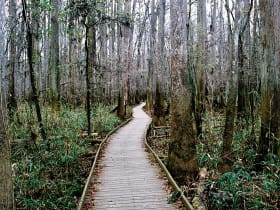
- Boardwalks and trails winding out over the tea-colored blackwater swamp
- A peaceful, walkable garden cared for by a local university
Worth Knowing
- The garden welcomes visitors and is a favorite quiet spot in the Pee Dee
- The bluff trails are steep in places, with steps down toward the creek
- Late winter and spring are the showiest, when laurel and azalea bloom
- Bring insect repellent near the swamp boardwalks in the warm months
Learn about Kalmia Gardens
A garden made from a hard bluff
The land that became Kalmia Gardens was once called Breezy Hill, a steep, wooded bluff above Black Creek that was long considered too rough to farm. In the 1930s a Hartsville woman named May Roper Coker set out to turn that difficult slope into a garden, clearing paths and planting azaleas, camellias, and other flowering shrubs among the native laurel and hardwoods. It was Depression-era work that gave employment and beauty at once.
She later gave the garden to Coker College, now Coker University, which has cared for it ever since as a public garden and a place for teaching about plants and the natural world. That stewardship is why the garden survives as a green refuge on the edge of a growing town, its trails open for anyone to walk.
Mountain laurel where it shouldn't be
The garden's namesake, mountain laurel, is an evergreen shrub best known from the Blue Ridge and Appalachians, where it forms dense thickets and blooms in clusters of pink and white cups in late spring. Its presence on this bluff far to the east is a quirk of geology: the steep, cool, moist north-facing slope creates a pocket of conditions that mimic the mountains, letting laurel and other highland plants hang on hundreds of miles from their usual range.
Around the laurel, the garden layers azaleas, camellias, dogwoods, and tea olives near the top, so that from late winter into spring the bluff blooms in successive waves of color. Lower down, the plantings give way to native beech, holly, and magnolia, and finally to the wild swamp forest along the creek, a gradient from cultivated garden to true wildness in a short walk.
Black Creek and the blackwater swamp
At the foot of the bluff runs Black Creek, a classic Southern blackwater stream. Its water is stained the color of strong tea, not by mud but by tannins leached from decaying leaves and cypress in the surrounding swamp, and it moves slowly through a forest of bald cypress and water tupelo whose bases flare into wide, buttressed trunks.
Boardwalks and low bridges carry the trails out over this wetland, letting visitors walk dry-shod through a habitat that would otherwise be impassable. It is a fine place to watch turtles, frogs, and dragonflies in the warm months, and to hear the deep quiet of a Southern swamp broken only by birdsong and the occasional splash.
Season by season
Late winter is the surprise season, when camellias bloom against the evergreen laurel and the garden gets its first color while the rest of the region is still bare.
Spring is the peak, with azaleas, dogwoods, and mountain laurel blooming in overlapping waves and the swamp coming green and loud with frogs and returning birds. Summer is warm and deeply shaded on the bluff, a cool refuge, with the swamp boardwalks alive with turtles and dragonflies. Fall brings turning hardwoods and crisp, quiet walks, and the garden settles into its calm winter beauty to begin the cycle again.
Closest Boutels
The closest Boutel™ stays, so you can turn this stop into an overnight. Each is a place we chose through independent editorial review, never a paid placement.
The Station by Compo Hotels
Boutel745 Old Buncombe Rd, Travelers Rest, SC 29690, Travelers Rest, SC
139 miles away|Learn More ›
Details
Hartsville, SC
Frequently asked questions
What are Kalmia Gardens?
Kalmia Gardens, in Hartsville in the Pee Dee region of South Carolina, are a beautiful public botanical garden set on a dramatic bluff above Black Creek, known for their unusual and diverse landscape. Named for the mountain laurel, or Kalmia, that blooms there, the gardens descend the steep bluff through a remarkable range of habitats, from laurel thickets and a blackwater swamp to pine and hardwood forest, laced with trails, boardwalks, and seasonal blooms of azaleas, camellias, and wildflowers. A lovely and tranquil garden free to enjoy, it showcases the region's natural beauty. With its bluff-side trails and diverse plantings, Kalmia Gardens offers a delightful destination in South Carolina.
What can you do at Kalmia Gardens?
You can walk the trails and boardwalks descending the bluff through varied habitats, from the mountain laurel thickets and blackwater swamp of Black Creek to pine and hardwood forest, admire the seasonal blooms of azaleas, camellias, laurel, and wildflowers, watch for birds and wildlife, and enjoy the tranquil, scenic setting, all free of charge. The diverse landscape, the bluff-side trails, and the spring blooms are highlights, offering a beautiful and peaceful nature walk. With its trails, boardwalks, and varied plantings, Kalmia Gardens offer a rewarding experience in Hartsville, South Carolina.
When is the best time to visit Kalmia Gardens?
Spring is especially beautiful, when the azaleas, camellias, mountain laurel, and wildflowers bloom in a lovely display, a favorite time, while other seasons offer their own appeal, with lush greenery in summer, color in fall, and interest year-round in the varied landscape. The gardens are pleasant in the milder months. For peak blooms aim for spring, and for pleasant weather to enjoy the trails, spring or fall, at Kalmia Gardens in Hartsville, South Carolina.
What safety tips apply at Kalmia Gardens?
The trails descend a steep bluff and can be uneven, with stairs and boardwalks over the swamp that may be damp or slippery, so wear sturdy shoes and watch your footing, especially on the descent and near the creek. Bring insect repellent for the swampy areas in the warm months, along with water and sun protection. Watch children near the water and steep areas. Wearing good shoes, watching your footing on the bluff trails, and preparing for insects ensure a safe and enjoyable visit to Kalmia Gardens in South Carolina.
What is near Kalmia Gardens?
Kalmia Gardens are in Hartsville in the Pee Dee region of South Carolina, within reach of the Florence area with the Florence County Museum and Lynches River County Park, Woods Bay State Park, and the coastal plain. That makes Kalmia Gardens a delightful stop to combine with the Florence area attractions and the other sights of the Pee Dee region on a visit to South Carolina.
Nearby
Florence County Museum
23 miles away
A free art and history museum of real ambition is not what most travelers expect in Florence, but here it is.
Dizzy Gillespie Home Site Park
24 miles away
People know Dizzy Gillespie invented bebop; few realize he came from a small town in the South Carolina Pee Dee.
Lynches River County Park
25 miles away
A well-built county park that gives kids a lot to do beside a wild blackwater river.
Congaree National Park
57 miles away
One of the tallest deciduous forests left in the world, a floodplain of champion old-growth hardwoods.