
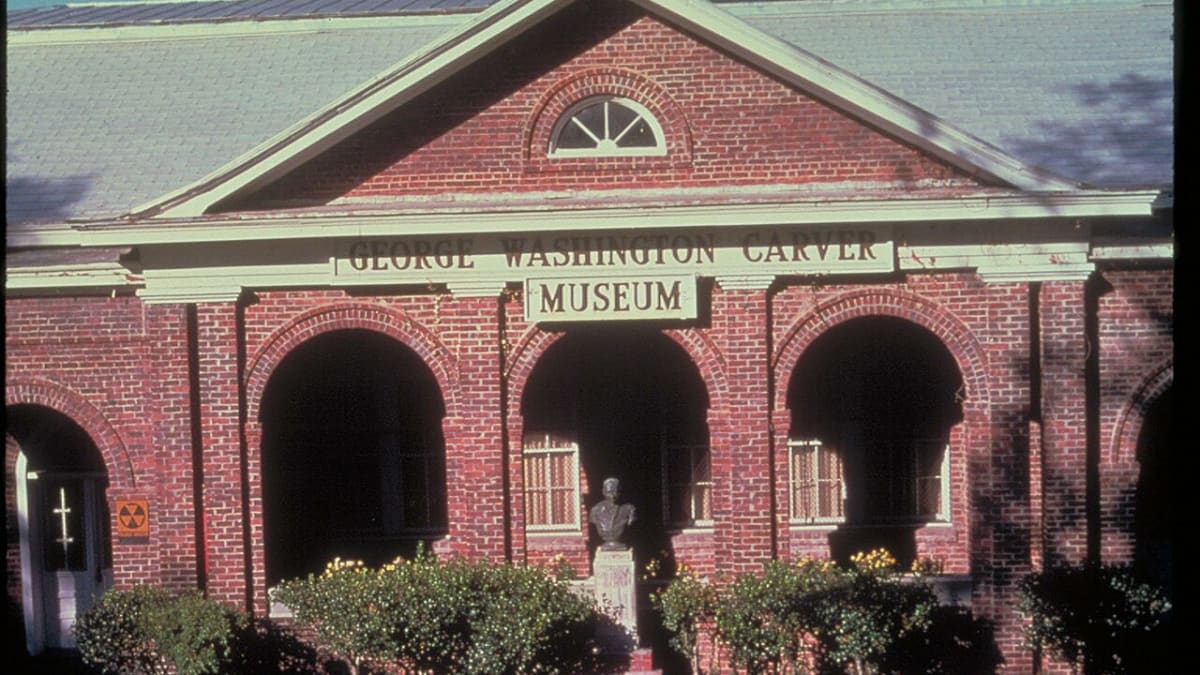
George Washington Carver Museum
1212 W Montgomery Rd, Tuskegee, AL
Tuskegee, AL
The museum where George Washington Carver's own laboratory work, plant specimens, and paintings tell the story of a formerly enslaved boy who became one of America's most inventive scientists.
The George Washington Carver Museum sits on the historic campus of Tuskegee, where the great scientist did his life's work, and it is one of two centerpieces of the Tuskegee Institute National Historic Site, run by the National Park Service. Carver, born into slavery in Missouri near the end of the Civil War, became one of the most inventive and beloved scientists in American history, and the museum tells his story through his own laboratory equipment, plant specimens, and personal belongings.
Carver is remembered above all for his work with the peanut, the sweet potato, and soil health, teaching struggling Southern farmers to renew their worn-out cotton land with alternative crops. But the museum shows a fuller person, an artist who painted and did fine needlework, a teacher, and a quiet, deeply spiritual man. Together with Booker T. Washington's home nearby, it preserves the heart of a school that transformed Black education in the American South.
What Travelers Love
- Seeing Carver's actual laboratory tools, specimens, and experiments
- His lesser-known paintings and needlework alongside his science
- Walking the historic Tuskegee campus that he and Booker T. Washington built
- A National Park Service site that welcomes visitors and tells a powerful story
Worth Knowing
- The museum is part of the Tuskegee Institute National Historic Site and welcomes visitors
- Pair it with The Oaks, Booker T. Washington's preserved home, on the same historic campus
- The nearby Tuskegee Airmen National Historic Site tells a related and important story
- It is a working university campus, so respect the students and the grounds
Learn about George Washington Carver Museum
From slavery to science
George Washington Carver was born into slavery in Missouri around the end of the Civil War, and as an infant he was kidnapped along with his mother in a raid, an experience that shaped a childhood of hardship and loss. Freed by emancipation and raised by the family that had enslaved his mother, he pursued an education against long odds, moving from place to place to find schools that would admit a Black student and eventually earning college degrees in agriculture.
In 1896 Booker T. Washington invited Carver to lead the agriculture program at Tuskegee, and Carver spent the rest of his long life there. He turned a modest department into a center of practical science aimed at helping poor Southern farmers, especially Black farmers, escape the trap of soil-exhausting cotton by rotating in nitrogen-restoring crops like peanuts and sweet potatoes.
The work he is remembered for
Carver became famous for finding dozens of uses for the humble peanut and the sweet potato, part of a campaign to give farmers a reason to grow the crops that would heal their land. He carried this science directly to the people, sending out simple bulletins and even a mobile classroom, a wagon that brought agricultural know-how to rural communities that could not come to the school.
His approach was as much about dignity and self-reliance as about chemistry. By showing farmers how to enrich their soil, use what they grew, and depend less on cotton and store-bought goods, he helped struggling families gain a measure of independence. His fame eventually reached presidents and Congress, yet he lived simply and gave much of his recognition and savings back to the work at Tuskegee.
Inside the museum
The museum preserves Carver's own laboratory equipment, the tools and glassware of his experiments, along with plant specimens and displays of the products he developed. It also reveals sides of him that many visitors do not expect, including his paintings and delicate needlework, evidence of a real artistic gift, and personal items that bring the private man into focus.
The exhibits set his science within the mission of Tuskegee and the wider story of Black education and agriculture in the post-slavery South. It is a museum that honors not just a list of inventions but a way of putting knowledge to work in service of a community, and it welcomes visitors as part of the National Park Service site.
Tuskegee and its historic campus
The museum stands on the campus founded in 1881 as Tuskegee Institute under Booker T. Washington, a school built largely by its own students, who made the bricks and raised the buildings themselves. A short walk away is The Oaks, Washington's preserved home, also part of the National Historic Site, and the surviving campus is now Tuskegee University, a working center of learning.
Nearby, the Tuskegee Airmen National Historic Site tells the story of the pioneering Black military pilots trained in the area during World War II, another chapter in the town's outsized role in American history. Together these sites make Tuskegee a place of deep significance, well worth the drive into east Alabama.
Closest Boutels
The closest Boutel™ stays, so you can turn this stop into an overnight. Each is a place we chose through independent editorial review, never a paid placement.
Details
Tuskegee, AL
Frequently asked questions
What is the George Washington Carver Museum?
The George Washington Carver Museum, in Tuskegee, Alabama, is part of the Tuskegee Institute National Historic Site and honors the life and remarkable work of George Washington Carver, the renowned scientist, educator, and inventor. Born into slavery and rising to become one of the most celebrated scientists of his era, Carver spent decades at the Tuskegee Institute, where he transformed Southern agriculture through his research on crops such as peanuts and sweet potatoes and championed education for Black Americans. The museum preserves his laboratory, artifacts, and story, alongside the broader history of the historic Tuskegee Institute founded by Booker T. Washington. A moving tribute to genius and perseverance, it offers a meaningful destination in Alabama.
Who was George Washington Carver?
George Washington Carver was a pioneering American scientist, educator, and inventor, born into slavery, who overcame enormous obstacles to become one of the most celebrated scientists of his time. At the Tuskegee Institute in Alabama, he spent decades researching agriculture, developing hundreds of uses for crops like peanuts and sweet potatoes, teaching struggling farmers better methods, and advancing education and opportunity for Black Americans. His work helped transform Southern farming and made him a revered figure. The museum honors his life and achievements, making the George Washington Carver Museum a meaningful destination in Tuskegee, Alabama.
What can you see at the George Washington Carver Museum?
You can see exhibits on the life and scientific work of George Washington Carver, including his laboratory, inventions, artwork, and artifacts, and learn about his agricultural research and his role as an educator, alongside the broader history of the Tuskegee Institute and its founder Booker T. Washington. The museum, part of the Tuskegee Institute National Historic Site, also connects to other historic sites on the campus. Carver's laboratory, his story, and the history of the institute are the heart of a meaningful visit. With its exhibits and history, the George Washington Carver Museum offers an inspiring visit in Tuskegee, Alabama.
What should visitors know before visiting the George Washington Carver Museum?
Visitors should know that the museum is part of the Tuskegee Institute National Historic Site, a place of deep significance in African American history and education, best approached with respect and reflection, and that the site includes other historic locations on the historic Tuskegee University campus worth exploring. As a National Park Service site, admission is typically free, though checking current hours and any tour details before you go is wise. Allowing time to appreciate the full history is worthwhile. Approaching it thoughtfully ensures a meaningful visit to the George Washington Carver Museum in Tuskegee, Alabama.
What is near the George Washington Carver Museum?
The George Washington Carver Museum is in Tuskegee, Alabama, part of the Tuskegee Institute National Historic Site on the Tuskegee University campus, near other historic sites honoring Booker T. Washington and the institute, within reach of Auburn and Opelika to the north and Montgomery to the west with its Civil Rights landmarks. That makes the George Washington Carver Museum a meaningful stop to combine with the Tuskegee historic sites, the Montgomery Civil Rights landmarks, and the other historic sites of east-central Alabama on a visit to the state.
Nearby

Chewacla State Park
16 miles away
Chewacla packs a lot of Piedmont scenery into a short drive from Auburn.

Wind Creek State Park
16 miles away
Lake Martin is one of the clearest large lakes in the Southeast, a 41,000-acre reservoir on the Tallapoosa River ringed by pine woods and dotted with wooded islands.

Museum of East Alabama
24 miles away
This free downtown Opelika museum is a friendly, varied stop that keeps kids curious.