
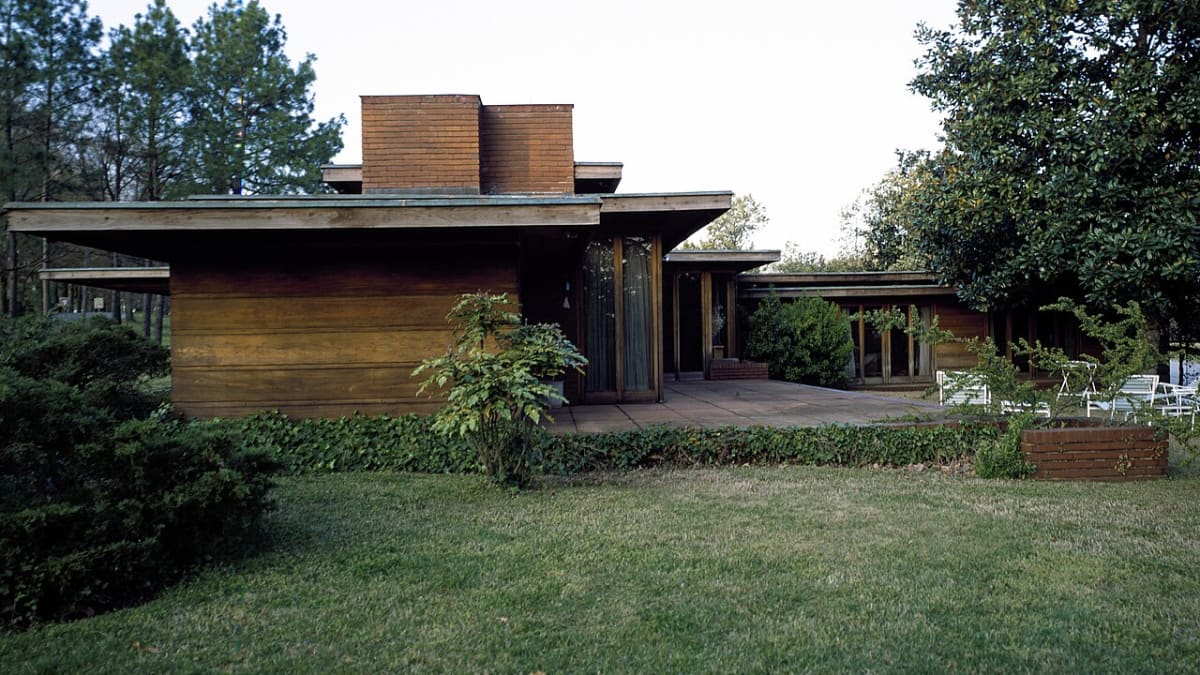
Frank Lloyd Wright Rosenbaum House
601 Riverview Dr, Florence, AL
Florence, AL
A low, cypress-and-brick Usonian home that Frank Lloyd Wright designed for a young Florence couple, the only building he ever built in Alabama.
The Rosenbaum House in Florence is the only building Frank Lloyd Wright ever designed and built in Alabama, and it is considered one of the purest surviving examples of his Usonian style. Wright created it in 1939 for Stanley and Mildred Rosenbaum, a young Florence couple, and it embodies his idea of an affordable, beautiful home for the ordinary American family: low and horizontal, open in plan, built from natural cypress and brick, and closely tied to its site.
What makes the house special is not grandeur but intimacy and integrity. The Rosenbaums lived in it for decades, raising their family within Wright's carefully designed rooms, and the house passed to the city and was meticulously restored as a museum. Walking through it, you see Wright's built-in furniture, warm wood, bands of windows, and human scale exactly as intended, a small masterpiece hiding on a residential street in northwest Alabama.
What Travelers Love
- Touring the only Frank Lloyd Wright building in the entire state
- Wright's signature Usonian details, built-in furniture, and warm cypress interiors
- The story of one family living in the same architect-designed home for decades
- A quiet, human-scaled masterpiece rather than a grand mansion
Worth Knowing
- The house is a museum shown by guided tour, so plan around the tour schedule
- Interiors are compact and original, so groups move through in small numbers
- Photography rules vary inside a preserved historic home, so ask your guide
- Pair it with the Shoals music studios and the W.C. Handy birthplace for a full day in Florence
Learn about Frank Lloyd Wright Rosenbaum House
Wright's Usonian vision
By the late 1930s Frank Lloyd Wright had turned his attention to what he called Usonian houses, moderately priced homes meant to bring good design within reach of middle-class Americans. These houses shared a common language: a single story, flat or low roofs, open living areas rather than a warren of small rooms, radiant-heated concrete floors, and an honest use of natural materials like brick and wood.
The Rosenbaum House is a textbook example. Long and low, it hugs its lot, opens to the outdoors through walls of windows and glass doors, and uses built-in furniture and cypress throughout to create a seamless, unified whole. Wright designed not just the building but many of its fittings, so the house works as a single coherent idea rather than a shell to be filled with unrelated furniture.
The Rosenbaum family
Stanley Rosenbaum was a young man from a Florence family when he and his wife Mildred commissioned Wright to design their first home. The couple worked closely with the architect and his studio, and as their family grew, Wright later designed an addition to the house, so the building reflects two stages of his work for the same clients.
Remarkably, the Rosenbaums lived in the house for the rest of their lives, making it one of the longest single-family occupancies of any Wright home. That continuity helped preserve the building's integrity, and when the family's connection to the house ended, the city of Florence acquired it and undertook a careful restoration to reverse decades of wear and return it to Wright's intent.
Visiting the house
The Rosenbaum House is now a house museum shown by guided tour, and a visit takes you through the compact, light-filled rooms exactly as Wright designed them. Guides point out the hallmarks of his method: the way the low entry opens into a bright living space, the built-in seating and shelving, the bands of glass that dissolve the line between inside and out, and the warm glow of the original cypress.
Because the interiors are original and intimate, tours move through in small numbers, and photography rules can vary, so it is worth asking your guide. The house is easy to combine with Florence's other attractions and the Shoals music trail nearby, making it a rewarding stop for anyone interested in architecture or design.
Florence and the Shoals
Florence is a college town on the north bank of the Tennessee River, part of the four-city cluster known as the Shoals along with Muscle Shoals, Sheffield, and Tuscumbia. It has a lively downtown and a deep cultural streak, and it was the birthplace of W.C. Handy, the composer remembered as the Father of the Blues, whose log-cabin birthplace is preserved in town.
Just across the river in Muscle Shoals and Sheffield are FAME Recording Studios and Muscle Shoals Sound Studio, where some of the most beloved records in American music were made. Pairing the Rosenbaum House with those music landmarks makes for a rich day exploring the unexpected creative legacy of this quiet corner of Alabama.
Closest Boutels
The closest Boutel™ stays, so you can turn this stop into an overnight. Each is a place we chose through independent editorial review, never a paid placement.
Sportsman's Lodge at Dale Hollow
Honorable Mention1201 Livingston Hwy, Byrdstown, TN
186 miles away|Learn More ›
Details
Florence, AL
Frequently asked questions
What is the Frank Lloyd Wright Rosenbaum House?
The Frank Lloyd Wright Rosenbaum House, in Florence, Alabama, is the only building in the state designed by the famed architect Frank Lloyd Wright, a beautifully preserved example of his celebrated Usonian home style. Built in the late 1930s and early 1940s for the Rosenbaum family, the house exemplifies Wright's vision of affordable, elegant American homes integrated with their surroundings, featuring his signature open plans, natural materials, built-in furnishings, and harmony with the landscape. Now a house museum, it offers tours that showcase Wright's design genius. A rare architectural treasure, the Frank Lloyd Wright Rosenbaum House offers a fascinating destination in Alabama.
What is a Usonian house?
A Usonian house is a style of home designed by the famed architect Frank Lloyd Wright, conceived as an affordable, elegant, distinctly American home for middle-class families. Usonian homes are known for their single-story open floor plans, natural materials, flat roofs, built-in furnishings, abundant natural light, and close integration with the surrounding landscape, embodying Wright's ideals of organic architecture. The Rosenbaum House in Florence is a fine and well-preserved example of this style. Understanding the Usonian concept deepens appreciation of Wright's design at the Frank Lloyd Wright Rosenbaum House in Alabama.
Can you tour the Frank Lloyd Wright Rosenbaum House?
Yes, the Rosenbaum House is preserved as a house museum and offers guided tours that take visitors through Wright's Usonian design, highlighting the open plan, natural materials, built-in furnishings, and integration with the landscape. Tours run on a schedule, so checking current days and hours before you go is wise, and reservations may be helpful. Comfortable shoes and respect for the historic home are appreciated. Architecture and design lovers especially treasure it. Planning around the tour schedule ensures a rewarding visit to the Frank Lloyd Wright Rosenbaum House in Florence, Alabama.
When is the best time to visit the Frank Lloyd Wright Rosenbaum House?
As an indoor house museum, the Rosenbaum House can be visited year-round in any weather, with tours running on a schedule, so checking current days and hours before you go is wise. The mild months are pleasant for also enjoying Florence and the Muscle Shoals area, and pairing a visit with the nearby music-history studios makes a rich day. For the best experience, visit during posted tour hours, and confirm the schedule ahead, at the Frank Lloyd Wright Rosenbaum House in Florence, Alabama.
What is near the Frank Lloyd Wright Rosenbaum House?
The Frank Lloyd Wright Rosenbaum House is in Florence, Alabama, part of the Muscle Shoals area, within reach of FAME Recording Studios and the Muscle Shoals Sound Studio, the Tennessee River, the Key Underwood Coon Dog Memorial Graveyard, and the northwestern Alabama countryside. That makes the Frank Lloyd Wright Rosenbaum House a fascinating stop to combine with the Muscle Shoals music studios and the other attractions of northwestern Alabama on a visit to the state.
Nearby

Muscle Shoals Sound Studio
2.6 miles away
The address on the record labels, 3614 Jackson Highway, is a real place you can walk into.

FAME Recording Studios
4.5 miles away
People are always surprised the Muscle Shoals sound came out of a plain brick building on Avalon Avenue.
Key Underwood Coon Dog Memorial Graveyard
21 miles away
This has to be one of the strangest and most touching spots in Alabama: a graveyard in the deep woods for coon dogs, and coon dogs only.