
Fort Frederica National Monument
Frederica Rd, St. Simons Island
St. Simons Island, GA
Walk the quiet, live-oak-shaded ruins of a whole colonial town, and the marsh where a small British force turned back a Spanish invasion and settled the fate of Georgia.
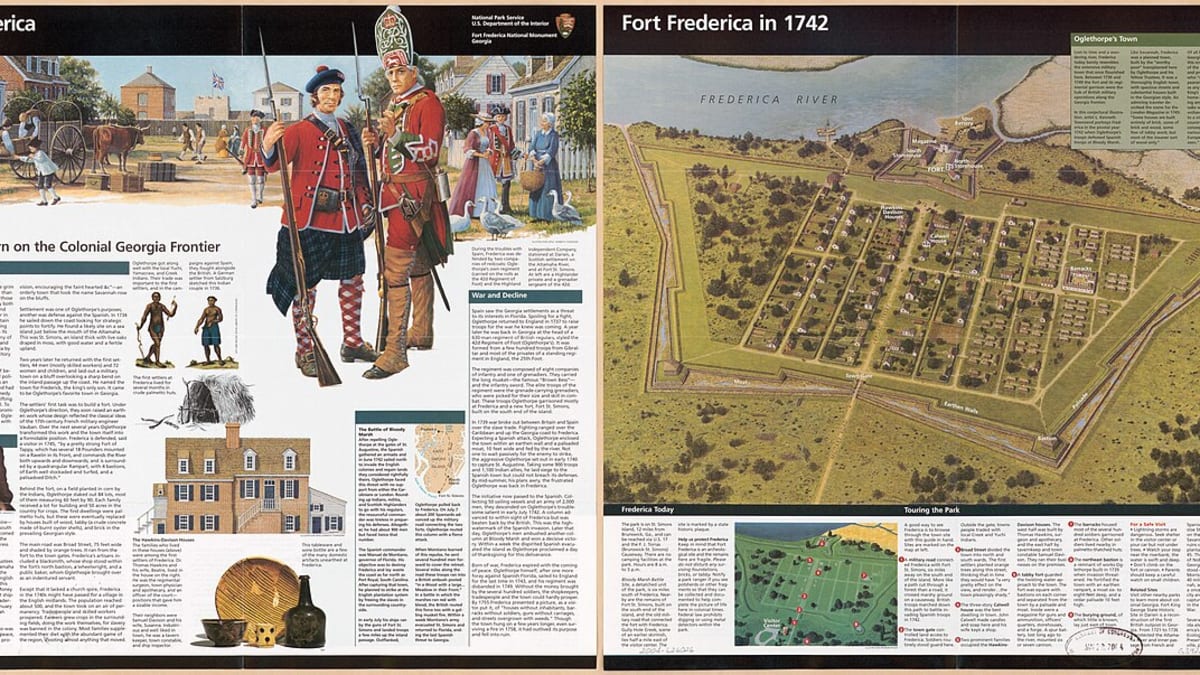
Fort Frederica is not just a fort, it is the ghost of an entire town. In 1736 James Oglethorpe, the founder of Georgia, chose this bend of the Frederica River on St. Simons Island to build a fortified settlement that would guard his three-year-old colony against the Spanish in Florida to the south. Around the fort rose a walled town of soldiers and civilians, and for a short, intense decade it was one of the most important places in colonial America, the anchor of British power on a contested frontier.
Today what remains is quiet and green: the low tabby ruins of the fort and a few buildings, the marked outlines of house lots along shaded lanes, and the wide salt marsh beyond, much as it looked when the town was abandoned. But a few miles away lies Bloody Marsh, where in 1742 the fate of the whole colony turned in a single afternoon, and it is that story, of a fragile town that punched far above its weight, that gives this peaceful place its weight.
What Travelers Love
- Walking among real colonial ruins and marked house lots of a vanished 1730s town
- The dramatic story of the Battle of Bloody Marsh at the nearby memorial site
- The peaceful, live-oak-shaded grounds along the marsh and the Frederica River
- A well-told visitor center film and exhibits that bring the town's short life to life
Worth Knowing
- The Bloody Marsh Memorial is a separate unit a few miles away on the island, worth pairing with the main site
- Much of the visit is an outdoor walk in coastal Georgia, so bring sun protection and insect repellent, especially in the marsh
- The tabby ruins are fragile historic fabric, so stay on paths and do not climb on the walls
- Give yourself a couple of hours to watch the film, walk the town site, and reach the fort by the river
Learn about Fort Frederica National Monument
Oglethorpe's town on the frontier
James Oglethorpe founded Georgia in 1733 as a buffer colony, a barrier between the wealthy plantations of South Carolina and Spanish Florida. Fort Frederica, begun in 1736, was the sharp end of that plan: a strong point pushed far south onto St. Simons Island to hold the line. It was named for Frederick, the Prince of Wales, the son of King George II, with a feminine ending added to distinguish it from a Fort Frederick already in the Carolinas.
Oglethorpe did not just build a fort but a full town beside it. The first arrivals, dozens of men and many more women and children, laid out streets and lots behind an earthen wall, and over the next years colonists from England, Scotland, and the German states settled in. By the early 1740s Frederica was a thriving community of several hundred people, with houses, shops, and a garrison, the largest and most important British settlement on this dangerous southern edge of the empire.
The Battle of Bloody Marsh
The showdown everyone had feared came in the summer of 1742. Georgia had raided Spanish St. Augustine two years earlier, and now Spain struck back, landing a large invasion force on St. Simons Island with the aim of destroying Fort Frederica and ending the British colony. Oglethorpe was heavily outnumbered.
On July 7, 1742, in a marshy, wooded stretch of the island, British troops and their allies ambushed the advancing Spanish column. In confused fighting among the marsh grass and trees, the Spanish were thrown back with losses, and the encounter came to be called the Battle of Bloody Marsh. Though the actual fighting was smaller than legend later made it, the result was decisive: the Spanish gave up the invasion and withdrew to Florida, and the threat to Georgia and the Carolinas was effectively ended for good. A quiet memorial now marks the ground where the colony's future was decided.
From boomtown to ruins
Frederica's importance was tied to the Spanish threat, and once that threat was gone the town's reason for being faded with it. The regiment that had filled its streets was disbanded, families drifted away, and a fire in 1758 destroyed much of what remained. By the early 1760s the fortified town was essentially abandoned, its buildings crumbling back into the coastal landscape.
That very abandonment preserved it. Because no later town was built over Frederica, archaeologists have been able to trace its streets and house lots, and the tabby ruins, made from a colonial concrete of oyster shell, lime, sand, and water, still stand along the river. The site was set aside as a national monument in 1936, and walking it today, under the moss-hung live oaks with the marsh stretching away, you can read the outline of a whole vanished community and stand where a small, stubborn colony held its ground.
Closest Boutels
The closest Boutel™ stays, so you can turn this stop into an overnight. Each is a place we chose through independent editorial review, never a paid placement.
Details
St. Simons Island, GA
Frequently asked questions
What is Fort Frederica National Monument?
Fort Frederica National Monument, on St. Simons Island on the Georgia coast, preserves the remains of a colonial-era British fort and town founded in the eighteenth century to defend the young colony of Georgia against Spanish Florida. Established by Georgia's founder James Oglethorpe, the fort and its surrounding town were a frontier military settlement, and the area saw a decisive battle that helped secure Georgia for Britain. Today the site preserves the ruins of the fort and town, along with a visitor center and exhibits telling the story of colonial Georgia, its soldiers and settlers, and the conflicts of the era. With its colonial ruins and history, Fort Frederica National Monument offers a fascinating destination in Georgia.
What can you see at Fort Frederica National Monument?
You can explore the ruins of the colonial fort and town, walk among the foundations and remains amid moss-draped oaks, visit the visitor center with exhibits on colonial Georgia, and learn about the soldiers, settlers, and the conflicts with Spanish Florida, including the decisive nearby battle. The colonial ruins, the historic town site, the exhibits, and the scenic coastal setting are the draws, offering an engaging look at early Georgia history. The peaceful ruins evoke the frontier past. With its ruins and history, Fort Frederica National Monument offers a rewarding experience in Georgia.
Why was Fort Frederica important?
Fort Frederica was important as a frontier military settlement founded by Georgia's founder James Oglethorpe in the eighteenth century to defend the new British colony of Georgia against the threat of Spanish Florida to the south. The fort and its garrison played a key role, and a decisive battle fought nearby helped secure Georgia and the region for Britain, shaping the future of the colony. The site preserves this pivotal colonial history. Understanding this importance enriches a visit to Fort Frederica National Monument in Georgia.
When is the best time to visit Fort Frederica National Monument?
The mild months of spring through fall offer the most pleasant weather for exploring the outdoor ruins and grounds, while summer can be hot and humid, so mornings help and insect repellent is useful near the marshes, and the visitor center offers an indoor option. Fall and spring are especially comfortable. Because hours can vary, checking the current schedule before you go is wise. For the most comfortable weather to explore the ruins, aim for spring or fall at Fort Frederica National Monument in Georgia.
What is near Fort Frederica National Monument?
Fort Frederica National Monument is on St. Simons Island on the Georgia coast, within reach of the St. Simons Lighthouse and Museum, the Marshes of Glynn Overlook Park, Jekyll Island with Driftwood Beach and the Historic District, and the Golden Isles region. That makes Fort Frederica National Monument a fascinating stop to combine with the St. Simons Lighthouse and the other attractions of the Golden Isles on a visit to Georgia.
Nearby

Marshes of Glynn Overlook Park
5.9 miles away
The Marshes of Glynn are among the largest and most intact salt marshes on the Atlantic coast, and Overlook Park puts you right at their edge on the Brunswick side of the St. Simons causeway.
St. Simons Lighthouse and Museum
6.2 miles away
A trim white 1872 tower still guiding ships into St. Simons Sound, with 129 steps to a gallery view over the marsh, pier, and Jekyll Island.

Driftwood Beach
9.2 miles away
Driftwood Beach is a boneyard beach, one of the clearest places on the coast to watch a barrier island in motion.