
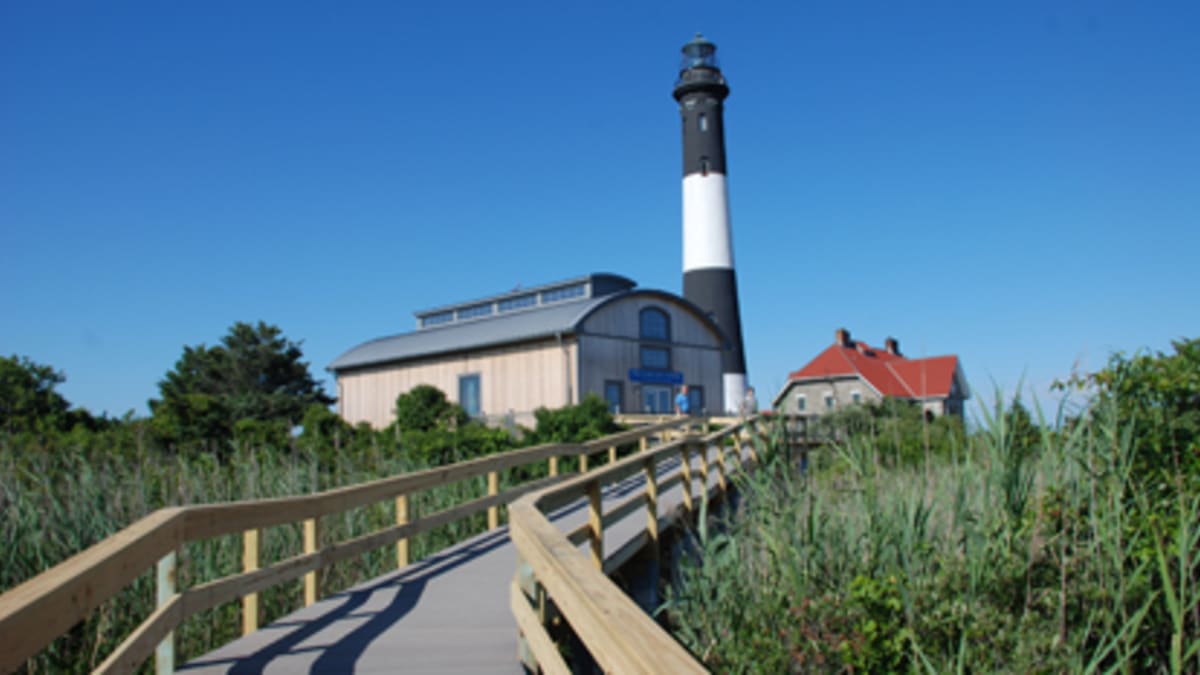
Fire Island Lighthouse
1 Robert Moses State Pkwy, Kismet, NY
Fire Island, NY
A bold black-and-white tower standing at the western end of a thin barrier island, watching over the Atlantic where thousands of ships once made their first American landfall.
The Fire Island Lighthouse stands at the western tip of Fire Island, a black-and-white tower nearly 170 feet tall that has guided ships along the south shore of Long Island for well over a century. For countless immigrants crossing the Atlantic, this light was the first sight of America, the signal that New York Harbor lay just ahead. Its bold striped pattern, a daymark, let mariners identify it by day just as its beam marked it by night.
The lighthouse you see today was raised in 1858 to replace an earlier, shorter tower that ships kept failing to see in time. It was decommissioned in the 1970s and nearly torn down, then rescued by a community group that restored it and relit its beam. Around it spreads the Fire Island National Seashore, a rare stretch of undeveloped barrier beach with dunes, salt marsh, and wide empty sand.
What Travelers Love
- Climbing the spiral stair to the gallery for a wide view of ocean, bay, and the thin ribbon of island
- The bold black-and-white daymark pattern that makes the tower unmistakable from far off
- Walking the boardwalk and dune trail out to the light through beach grass and bayberry
- Watching for shorebirds, deer, and, in season, monarch butterflies moving down the barrier beach
Worth Knowing
- The tower and its museum keep seasonal hours, so check the schedule before planning a climb
- The walk from the Robert Moses parking area is a flat mile or so across the dunes, longer in soft sand
- Summer weekends are busy; spring and fall are quieter and cooler for the walk
- This is fragile barrier-beach habitat, so stay on the boardwalks and marked trails to protect the dunes
Learn about Fire Island Lighthouse
The story of the light
The first Fire Island lighthouse was built in 1826, a squat tower that proved too short and too dim for the busy shipping lane offshore. After a series of wrecks, a much taller replacement was completed in 1858, its walls of Connecticut brick faced with the striped pattern sailors could read from miles out. Fitted with a powerful lens, it became one of the most important lights on the American coast.
For generations this was the landfall light for transatlantic ships bound for New York, and vessels crowded with immigrants would pass it in the night. Keepers and their families lived beside the tower in isolation, tending the light through storms that reshaped the beach around them. In 1973 the Coast Guard shut the light down and let it fall dark, and for a time demolition seemed likely. A local preservation group formed, raised the money to restore the tower and its keepers' quarters, and in 1986 the beam shone again. Today it operates as a private aid to navigation and a museum, cared for by that same community effort.
A barrier beach that never holds still
Fire Island is a barrier island, a long bar of sand thrown up between the ocean and the mainland, and it is constantly on the move. Waves and longshore currents carry sand from east to west along the beach, so the island slowly lengthens at its western end. When the 1858 tower was built it stood near the very tip of the island, but the beach has since grown so far past it that the light now sits well back from the point.
Behind the ocean beach lie rolling dunes anchored by beach grass, then thickets of bayberry and holly, and finally salt marsh along the bay. This layered barrier-beach system absorbs the force of storms and shelters the south shore of Long Island behind it. It is also fragile, which is why the walk to the light stays on boardwalks that keep feet off the shifting, plant-held dunes.
Wildlife along the seashore
The barrier beach is a migration corridor as much as a shoreline. In spring and fall, shorebirds and songbirds funnel along it, and hawks and falcons ride the coastal winds. Ospreys nest on platforms over the marsh, and terns and plovers nest right on the open sand, which is one more reason to keep to marked paths in nesting season.
The island's white-tailed deer are famously bold and often graze near the dune trails. In autumn, clouds of monarch butterflies drift down the island on their way south, pausing on the goldenrod and seaside flowers. Offshore, seals haul out on the winter beaches, and whales and dolphins pass in the deeper water beyond the surf.
Season by season
Summer is warm and lively, with the full sweep of ocean beach open and the light's museum in full swing, though the parking areas and boardwalk fill on hot weekends. Spring is cool and quiet, the dunes greening up and the first migrant birds arriving, a fine time for the walk out to the tower without the crowds.
Fall may be the best season of all here, with warm sand, thinner crowds, the monarch migration, and hawks streaming overhead. Winter is stark and beautiful, the beach swept empty and the tower standing against gray Atlantic skies, with seals offshore and the wind doing as it likes.
Closest Boutels
The closest Boutel™ stays, so you can turn this stop into an overnight. Each is a place we chose through independent editorial review, never a paid placement.
Details
Fire Island, NY
Frequently asked questions
What is the Fire Island Lighthouse?
It is a historic black-and-white striped lighthouse within Fire Island National Seashore, a beloved landmark on Long Island's south shore. Visitors can climb the tower for sweeping views and explore free museum exhibits in the keeper's quarters and related buildings. Standing where mariners once relied on its light, it combines maritime history, striking scenery, and an accessible boardwalk approach into one rewarding, family-friendly outing on the barrier island.
Can you climb the Fire Island Lighthouse tower?
Yes. A tower tour takes you up roughly 182 steps, eased by landings along the way, to the top for panoramic views of the Atlantic, the barrier island and bays, and on a clear day even the distant Manhattan skyline. Plan about half an hour. There is a modest tower fee, and for safety climbers must be at least 42 inches tall and in good health, so keep that in mind for young children.
How do you get to the Fire Island Lighthouse?
The easiest way is to drive to Robert Moses State Park, Field 5, and walk a flat, accessible boardwalk of about three-quarters of a mile to the lighthouse. Alternatively, you can take a ferry and a walk or water taxi from the mainland. The grounds, walking trails, and museum exhibits are free and open year-round, with only the tower climb requiring a ticket.
When is the best time to visit the Fire Island Lighthouse?
Spring through fall is ideal for the boardwalk walk and clear tower views, with summer busiest. Tower-climb hours vary by season, and on weekdays when school is in session, school groups get priority, so it is wise to call ahead before a midweek visit to be sure the tower is open to the public. Note the last tower admission is well before closing, and special sunset tours can sometimes be arranged.
What should I know before visiting the Fire Island Lighthouse?
Wear appropriate, sturdy footwear for the tower stairs, and remember the climb requires being at least 42 inches tall and in reasonable health. Bring water and sun protection for the exposed boardwalk and grounds. Even if you skip the climb, the free museum exhibits, lens building, and beach walks make it worthwhile, and it pairs naturally with a day at the Fire Island or Robert Moses beaches.
Nearby
Jones Beach and the Dune Boardwalk
15 miles away
Jones Beach is a barrier-island beach on a grand scale, miles of clean white Atlantic sand backed by dunes, opened in 1929 as one of Robert Moses signature projects.
Old Westbury Gardens
23 miles away
This is the Long Island of The Great Gatsby, and one of the few Gold Coast estates you can actually walk through.

Sagamore Hill
23 miles away
Most travelers pass through Oyster Bay without knowing a president lived and is buried nearby.