
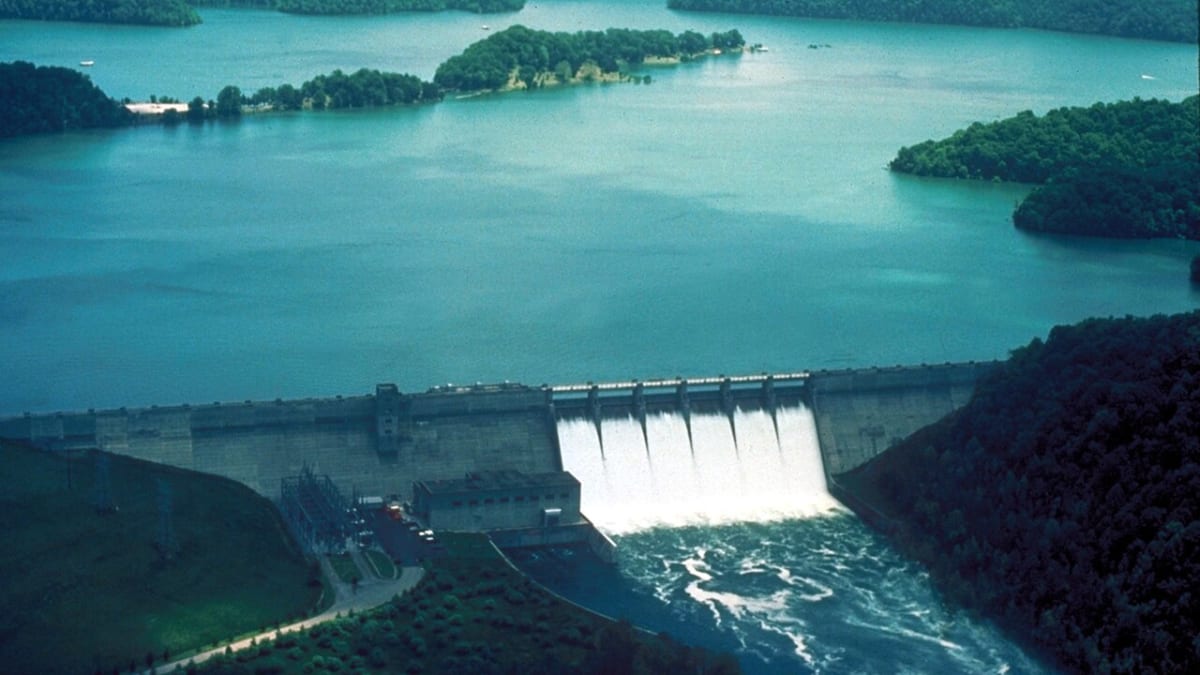
Dale Hollow Dam
Dale Hollow Dam Rd
Celina, TN
A 200-foot wartime dam that drowned a whole valley, holding back one of the clearest lakes in the country and a world-record fishery below.
Dale Hollow Dam is a 200-foot wall of concrete across the Obey River, and everything striking about this corner of Tennessee flows from it. Above the dam it holds back Dale Hollow Lake, a sprawling reservoir reaching into six counties in Tennessee and Kentucky, prized for water so clear that scuba divers come to explore it. Below the dam, the cold water released from deep in the lake feeds a tailwater famous among trout and smallmouth anglers. It is a piece of mid-century engineering that quietly reshaped an entire river valley.
The dam was a wartime project. Authorized under Depression-era flood-control law and built by the U.S. Army Corps of Engineers, it was completed in 1943, with hydroelectric generators added over the following decade. Its job was to tame the flooding Obey and Cumberland and to send power to a country at war. Making it, though, meant erasing a valley, including an entire town, and the people displaced still gather each year to remember what the water covers.
What Travelers Love
- Standing atop or below a 200-foot dam and taking in the scale of the Obey River project
- Dale Hollow Lake above it, some of the clearest, most beautiful water in the East
- The cold trout tailwater below the dam and the national fish hatchery beside it
- The lore of the world-record smallmouth bass, still unbeaten after decades
Worth Knowing
- This is an active flood-control and hydropower dam; follow all posted signs and safety closures, especially near the tailwater
- The tailwater below the dam runs cold and can rise fast when the powerhouse generates, so wading anglers must watch the water
- The lake is a boating and fishing destination; ramps and marinas ring the shore, busiest in summer
- The nearby national fish hatchery welcomes visitors with an aquarium and self-guided grounds by day
Learn about Dale Hollow Dam
A dam built for war and floods
Dale Hollow was authorized under the Flood Control Act of 1938, part of the federal push to master the flood-prone rivers of the Cumberland basin. The Army Corps of Engineers designed it and oversaw its construction on the Obey River, a short distance above where the Obey meets the Cumberland. The dam was finished in 1943, in the middle of World War II, when both flood control and dependable electric power carried real urgency.
Hydroelectric generators went in over the following years, in 1948, 1949, and 1953, and the power from the 200-foot dam is still marketed to the region today. What had been a wild, flooding river became a controlled reservoir and a source of steady power, one link in the long chain of Corps dams that changed how the whole Cumberland country lived with its water.
The town beneath the water
Filling a reservoir means flooding a valley, and Dale Hollow drowned a lived-in landscape of farms, homes, roads, and churches along the Obey. The most poignant loss was the town of Willow Grove, which the government bought out in 1942 so the rising water could cover it. Its residents scattered, but they never fully let go: former townspeople and their descendants still hold a reunion around Labor Day each year to remember the place now lying beneath the lake.
That buried history is part of what makes Dale Hollow feel deeper than a pretty lake. Under the clear water are old foundations, home sites, and the shape of a valley people farmed for generations. When divers descend into the exceptionally clear depths, they are swimming above a countryside that was traded away, willingly or not, so the dam upstream could hold back the floods.
Clear water and a record fish
Dale Hollow Lake is famous for its clarity, cold and blue-green and startlingly transparent, which makes it a favorite for boating, swimming, and even scuba diving, unusual for a reservoir. But its greatest fame is a fish. In 1955 an angler pulled a smallmouth bass weighing 11 pounds, 15 ounces from these waters, and it still stands as the world-record smallmouth, a benchmark serious anglers have chased here for generations. The lake and its tailwater remain a pilgrimage for smallmouth fishermen.
Just below the dam, the cold water pouring from deep in the lake creates a trout tailwater, and the Dale Hollow National Fish Hatchery has stood beside it since 1965. The hatchery raises well over a million trout a year to stock cold waters across the Southeast, and it welcomes visitors with an aquarium of native fish, walking paths, and an accessible fishing pier. Between the record bass above and the trout below, this may be the most storied stretch of fishing water in Tennessee.
Visiting Dale Hollow Dam
The dam sits on the Obey River near Celina, easily reached from Byrdstown to the east or Celina to the west, in the Upper Cumberland hills close to the Kentucky border. You can view it from above and below, and the setting, deep green ridges wrapped around clear water, is worth the stop on its own. Because it is a working flood-control and power dam, obey every posted sign and closure, and give the tailwater real respect: the water below can rise quickly and without warning when the generators run.
Pair the dam with the national fish hatchery next door, open by day with its aquarium and grounds, and with the lake itself, ringed by ramps, marinas, and swimming areas that hum with boats in summer. It is a fine full-day loop, a bit of wartime engineering, a submerged history, and some of the clearest recreational water in the East, all in one quiet fold of Tennessee.
Closest Boutels
The closest Boutel™ stays, so you can turn this stop into an overnight. Each is a place we chose through independent editorial review, never a paid placement.
Sportsman's Lodge at Dale Hollow
Honorable Mention1201 Livingston Hwy, Byrdstown, TN
16 miles away|Learn More ›
Details
Celina, TN
Frequently asked questions
What is Dale Hollow Dam?
Dale Hollow Dam, on the Obey River in the northern Middle Tennessee highlands, is a large dam that created Dale Hollow Lake, an impressive structure offering scenic views and excellent fishing in the cold, clear tailwater below. Built to provide flood control and hydroelectric power, the dam holds back the beautiful Dale Hollow Lake, and the cold, clear water released below the dam creates a renowned trout fishery, drawing anglers to the tailwater. The dam, its setting, and the fishing below make it a scenic and popular spot. A scenic dam and fishing destination, it delights visitors. With its dam and tailwater, Dale Hollow Dam offers a compelling destination in Tennessee.
What can you do at Dale Hollow Dam?
You can take in views of the impressive dam and the Obey River, fish the cold, clear tailwater below the dam, famous as a trout fishery, and enjoy the scenic setting, with the vast Dale Hollow Lake just above. The dam and river views, the renowned trout fishing in the tailwater, and the scenic surroundings are the draws, making it a rewarding stop for anglers and sightseers. The trout fishing below the dam is a highlight. With its dam and fishing, Dale Hollow Dam offers a rewarding experience in Tennessee.
Is fishing below Dale Hollow Dam safe, and what should I know?
Fishing the tailwater below Dale Hollow Dam can be excellent, but water released from the dam can raise the river level quickly and create dangerous currents, so heeding all warnings, signals, and posted rules about water releases, staying alert to changing water, wearing a life jacket when on or near the water, and never wading or boating carelessly are essential for safety. The cold water and swift currents demand respect. Heeding water-release warnings and practicing water safety ensure a safe visit below Dale Hollow Dam in Tennessee.
When is the best time to visit Dale Hollow Dam?
The mild months of spring through fall are the most pleasant for enjoying the dam's scenery and the tailwater fishing, with the trout fishery rewarding in the cooler seasons, while the water below the dam demands attention to release schedules year-round. Because water conditions depend on dam releases, checking current conditions and warnings before and during a visit is important. For scenery and fishing, aim for the mild months, always minding the water releases, at Dale Hollow Dam in Tennessee.
What is near Dale Hollow Dam?
Dale Hollow Dam is on the Obey River in the northern Middle Tennessee highlands, within reach of Dale Hollow Lake just above, Standing Stone State Park to the south, the Cookeville-area waterfalls, and the routes across the Cumberland Plateau region. That makes Dale Hollow Dam a compelling stop to combine with Dale Hollow Lake and the other attractions of Middle Tennessee on a visit to the state.
Nearby

Standing Stone State Park
5.0 miles away
Standing Stone is the low-key, uncrowded alternative to the busy waterfall parks.
Dale Hollow Lake
14 miles away
Dale Hollow Lake is a famously clear reservoir of limestone coves and cliffs straddling the Tennessee-Kentucky line, a short drive north of Byrdstown.
Cummins Falls State Park
21 miles away
For older kids who like an adventure, Cummins Falls delivers: a 75-foot waterfall pouring into a wide, shallow basin that families swim and wade in on hot days. The catch is getting there.

Mammoth Cave National Park
57 miles away
The longest known cave system in the world, with more than 400 mapped miles of passages.