

Basilica of St. Josaphat
2333 S 6th St, Milwaukee, WI
Milwaukee, WI
A soaring Polish basilica rising over Milwaukee's south side, its enormous dome and marble interior built in part from the salvaged stone of a demolished Chicago post office.
The Basilica of St. Josaphat rises unexpectedly over the tidy blocks of Milwaukee's south side, an enormous domed church that would look at home in Rome or Krakow rather than a Wisconsin neighborhood of cottages and corner shops. It was built at the turn of the twentieth century by Polish immigrants, mostly factory hands and laborers, who poured their savings and their labor into a church that would carry the faith and pride of their old country into their new one.
The most remarkable part of its story is what the walls are made of. When a large federal building in Chicago was slated for demolition, the parish bought its salvaged stone and iron and shipped it north to Milwaukee, giving the church its solid, monumental frame at a fraction of the cost. The result is one of the grandest churches in the Midwest, later honored by the Vatican as a minor basilica, standing as a monument to immigrant faith and thrift alike.
What Travelers Love
- Stepping in under the vast dome, one of the largest of any church in the country
- The murals, gilding, and stained glass covering nearly every surface inside
- The story that much of the stone came from a demolished Chicago post office
- A grand European-scale basilica built by immigrant parishioners of modest means
Worth Knowing
- This is an active parish church, so time a visit around Mass and services and enter quietly
- Guided tours are offered on a set schedule, so check ahead if you want the full story
- The neighborhood is residential, so be respectful of parking and the people who live nearby
- Photography is usually welcome, but pause during any service and follow posted guidance
Learn about Basilica of St. Josaphat
A church built by immigrant hands
In the late nineteenth century Milwaukee's south side filled with Polish immigrants drawn by work in the city's tanneries, foundries, and factories. Deeply Catholic, they founded parishes wherever they settled, and by the 1890s St. Josaphat's congregation had outgrown its first modest church. Under their pastor they resolved to build something far grander, a church worthy of their faith and their hopes, even though the parish was made up largely of working people of limited means.
The dream nearly bankrupted the parish, and the debt hung heavy for years. But the parishioners persisted, giving what they could and doing much of the labor themselves. Their determination produced a church of a scale rarely seen in a working-class immigrant neighborhood, and in the twentieth century the Vatican recognized it as a minor basilica, a rare honor that set it apart among American churches.
The post office that became a church
The building's origin is one of the great thrift stories in American church history. When the massive Chicago Federal Building, an old post office and customs house, was condemned and torn down, the parish's pastor learned that its cut stone, ornamental iron, and other materials were for sale as salvage. He arranged to buy them and had hundreds of railroad cars of stone hauled north to Milwaukee.
That salvaged stone gave the new basilica its heavy, monumental walls and its imposing presence, all for a fraction of what quarrying fresh stone would have cost. It is a fitting origin for a church built by people who understood the value of hard-won materials. The great dome that rises above it all became a landmark visible for miles, a beacon over the south side that it remains today.
Under the dome
Step inside and the interior overwhelms. The dome soars overhead, ringed with windows that pour light down onto an interior painted and gilded almost end to end. Murals depict scenes from scripture and the lives of the saints, and stained glass, much of it made by craftsmen brought from Europe, glows along the walls. The scale is genuinely European, the kind of interior that stops first-time visitors in their tracks.
The decoration was added over decades as the parish could afford it, so the basilica you see is the work of many hands across many years. Painters, plasterers, and glassmakers, some of them parishioners, filled the great shell with color and detail. The overall effect is of a church that grew richer and more beautiful with time, a labor of devotion that never quite ended.
The south side around it
The basilica anchors a neighborhood still shaped by its Polish and immigrant past, a district of narrow lots, corner taverns, and the small, sturdy cottages that Milwaukee became known for. Over the years the south side has welcomed new arrivals, including a large Latino community, and the streets around the basilica reflect that layered, working immigrant history.
A visit pairs naturally with a wander through the surrounding blocks, where old bakeries, markets, and churches tell the story of the people who built this part of the city. Downtown Milwaukee and the Lake Michigan shore are only a short drive away, so the basilica makes an easy first stop on a day of exploring the city's neighborhoods and lakefront.
Closest Boutels
The closest Boutel™ stays, so you can turn this stop into an overnight. Each is a place we chose through independent editorial review, never a paid placement.
Black Hawk Motel & Suites
Honorable Mention720 Race St, Wisconsin Dells, WI
102 miles away|Learn More ›
Details
Milwaukee, WI
Frequently asked questions
What is the Basilica of St. Josaphat?
The Basilica of St. Josaphat, in Milwaukee, is a magnificent Polish Catholic church and one of the most beautiful houses of worship in the state, distinguished by its enormous dome, one of the largest church domes in the country. Built in the early twentieth century by Milwaukee's Polish immigrant community, partly from salvaged materials of a demolished Chicago building, the basilica astonishes with its soaring dome, ornate murals, stained glass, and richly decorated interior. Designated a basilica in recognition of its significance, it stands as a monument to the faith and craftsmanship of Milwaukee's Polish heritage. With its grand dome and beautiful interior, the Basilica of St. Josaphat offers an awe-inspiring destination in Wisconsin.
What can you see at the Basilica of St. Josaphat?
You can admire the basilica's enormous dome, one of the largest in the country, and its breathtaking interior of ornate murals, stained-glass windows, painted ceilings, and richly decorated altars and columns, and learn about its construction by Milwaukee's Polish immigrant community and its designation as a basilica. The magnificent dome, the beautiful painted and stained-glass interior, and the Polish-heritage history are the highlights, offering a moving experience of art and faith. A visitor center shares its story. With its grand dome and ornate interior, the Basilica of St. Josaphat offers an inspiring visit in Milwaukee, Wisconsin.
Can visitors tour the Basilica of St. Josaphat?
Yes, visitors are welcome to see the Basilica of St. Josaphat, which offers times to view the beautiful interior and, at times, guided tours that share its history and art, while it remains an active Catholic church, so respectful behavior is expected. As it holds regular worship services, visiting outside of Mass times, dressing modestly, keeping quiet, and being mindful of anyone praying are important, and checking current visiting hours and any tour schedules before you go is wise. Visiting this active, sacred place with reverence ensures a meaningful experience at the Basilica of St. Josaphat in Milwaukee, Wisconsin.
When is the best time to visit the Basilica of St. Josaphat?
As an indoor church, the basilica can be visited year-round in any weather, though it is important to come during posted visiting hours and outside of worship services, as it is an active parish, so checking the current schedule before you go is wise. Daytime visits let the stained glass shine with natural light. The interior is stunning in any season. For the best experience, visit during posted visiting hours outside of Mass, honoring the active worship, at the Basilica of St. Josaphat in Milwaukee, Wisconsin.
What is near the Basilica of St. Josaphat?
The Basilica of St. Josaphat is in Milwaukee, within reach of the Pabst Mansion, the Milwaukee Art Museum and the lakefront, Discovery World, the Harley-Davidson Museum, and the Historic Third Ward. That makes the Basilica of St. Josaphat an inspiring stop to combine with the Pabst Mansion, the Milwaukee Art Museum, and the other attractions of Milwaukee on a visit to Wisconsin.
Nearby
Harley-Davidson Museum
2.0 miles away
Even if you have never ridden, this one lands. The Harley-Davidson Museum opened in 2008 on a riverfront campus, and it traces the company from a tiny Milwaukee shed in 1903 to a global icon.
Discovery World
2.6 miles away
Discovery World is built for hands-on kids, right on the Milwaukee lakefront next to the art museum.
Pabst Mansion
2.7 miles away
This is where the beer money lived. The Pabst Mansion, built in 1892 for Captain Frederick Pabst of Pabst Brewing, is a Flemish Renaissance showpiece wrapped in carved stone and terra cotta, a survivo...
Milwaukee Art Museum
2.8 miles away
The building performs, and people gather just to watch. The Milwaukee Art Museum's Quadracci Pavilion, finished in 2001, was Santiago Calatrava's first completed building in the United States, a soari...
Lake Park
5.2 miles away
Lake Park is Milwaukee's Olmsted masterpiece, designed by the same man who laid out Central Park, and it shows in the winding carriage paths, the arched footbridges, and the way the land opens to Lake...
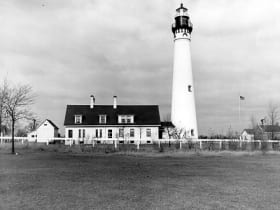
Wind Point Lighthouse
17 miles away
Wind Point is the classic Lake Michigan lighthouse, a slender white tower rising 108 feet on a point north of Racine, and it has been guiding ships since 1880, which makes it one of the oldest and tal...