
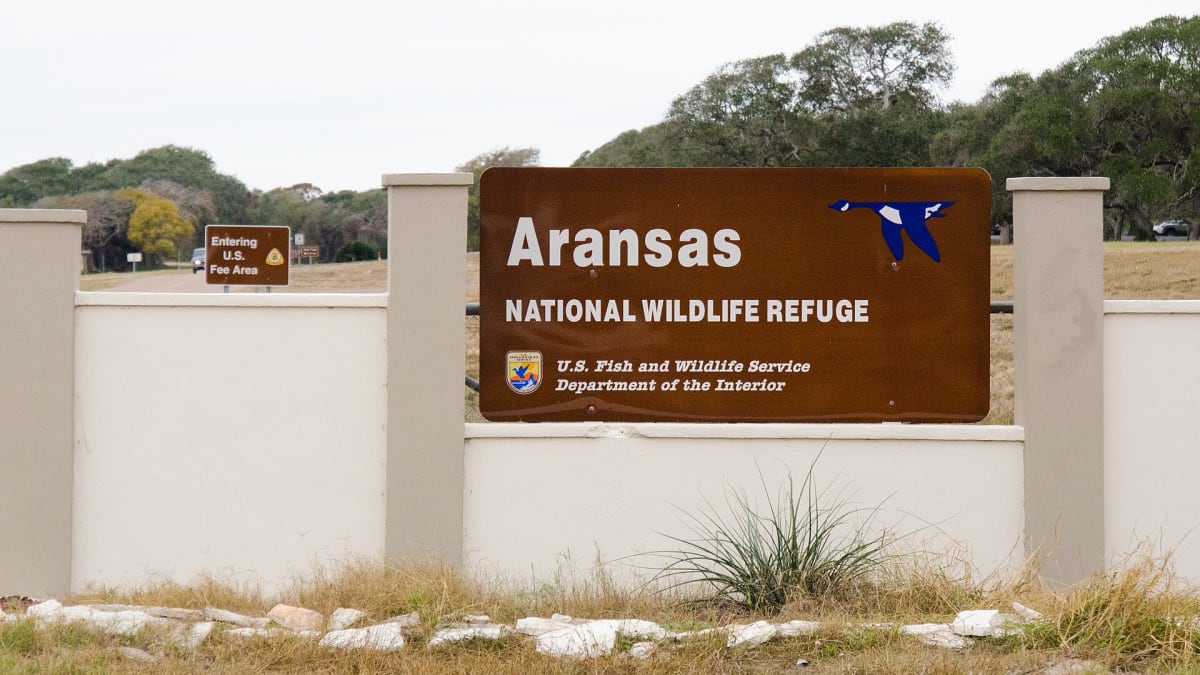
Aransas National Wildlife Refuge
1 Wildlife Circle, Austwell, TX
Austwell, TX
The winter home of the last wild flock of whooping cranes, tall white birds that came back from the very edge of extinction, on the marshes of the Texas coast.
Aransas National Wildlife Refuge on the central Texas coast is best known as the winter home of the last wild, self-sustaining flock of whooping cranes on Earth. These are among the tallest birds in North America, standing nearly five feet high, snow white with black wingtips and a red crown, and they came within a handful of individuals of vanishing forever in the 1940s.
Every autumn the flock flies more than two thousand miles from its nesting grounds in Canada to winter on these Texas marshes, and every spring it flies back. Their survival is one of the great conservation stories in the world, and Aransas is the place where that story plays out. Beyond the cranes, the refuge is a rich mosaic of marsh, flats, and woodland alive with alligators, deer, and hundreds of other birds.
What Travelers Love
- Seeing whooping cranes, among the rarest birds in North America, in their wild winter home
- The observation tower looking out over marsh, bay, and the crane flats
- Alligators, javelinas, deer, and hundreds of bird species along the drive and trails
- A wide-open, wild stretch of the Texas coast far from crowds
Worth Knowing
- Whooping cranes are here in the cooler months, roughly late fall through early spring; summer is quiet for them
- Bring binoculars or a spotting scope; the cranes are often at a respectful distance
- It is coastal country, so expect sun, mosquitoes in warm months, and few services nearby
- Boat tours out of Rockport and Port Aransas offer another way to see the cranes from the water
Learn about Aransas National Wildlife Refuge
The whooping crane's return from the brink
By the 1940s, hunting and the loss of wetlands had reduced the wild whooping crane population to only about fifteen birds, all of them wintering here on the Texas coast. The refuge, established in 1937, became the linchpin of a decades-long effort to save the species, protecting the marshes the cranes depend on through the winter.
Slowly, carefully, the flock recovered. Protection at both ends of the migration, along with captive breeding and research elsewhere, allowed the numbers to climb from that desperate low into the hundreds. The birds that winter at Aransas today are the direct descendants of those last fifteen, and watching them stalk the marsh is watching a species that was very nearly lost.
A coast full of life
Aransas is far more than its famous cranes. The refuge spreads across the Blackjack Peninsula, a patchwork of salt marsh, tidal flats, freshwater ponds, oak woodland, and coastal grassland, and that variety supports an extraordinary range of wildlife. American alligators bask in the sloughs, white-tailed deer and javelinas move through the brush, and armadillos root along the trails.
For birders, it is one of the great destinations of the Texas coast. Hundreds of species have been recorded here, from herons, egrets, and roseate spoonbills in the marshes to raptors overhead and clouds of migrating songbirds and shorebirds passing through in spring and fall. An auto tour route, several trails, and boardwalks make it easy to explore at a slow, watchful pace.
The peninsula and its human history
This stretch of coast was long the country of the Karankawa, coastal peoples who lived along these bays and barrier islands, fishing, gathering, and moving with the seasons before disease and displacement following Spanish and later Anglo settlement devastated their communities. The land later passed through ranching before it became a refuge.
Today the peninsula is protected precisely because it is one of the last large, undeveloped stretches of this coastline. Its marshes and flats are the same kind of habitat that sustained people for thousands of years, and they now sustain the cranes and countless other creatures. The observation tower gives a wide view over that landscape, out toward the shallow bays where the cranes feed on blue crabs and wolfberries through the winter.
Seasons and how to visit
The cranes define the calendar. They arrive in the cooler months, roughly from late fall into early spring, and that is the season to come if seeing them is the goal. Even at a distance they are unmistakable, and boat tours out of nearby Rockport and Port Aransas offer another way to watch them feeding along the shorelines from the water.
In the warmer months the cranes are gone, but the refuge stays alive with alligators, wading birds, and the resident wildlife of the peninsula. Expect coastal conditions, sun and open sky, mosquitoes in the warm season, and little in the way of services nearby, so come prepared. It rewards a slow, quiet visit, binoculars in hand, watching the marsh for movement.
Closest Boutels
The closest Boutel™ stays, so you can turn this stop into an overnight. Each is a place we chose through independent editorial review, never a paid placement.
Details
Austwell, TX
Frequently asked questions
What is Aransas National Wildlife Refuge?
Aransas National Wildlife Refuge, on the Texas Gulf Coast between Corpus Christi and Houston, is a vital coastal preserve of salt marshes, tidal flats, grasslands, and oak woodlands famous as the primary wintering home of the endangered whooping crane, one of the rarest birds in North America. Each winter, the majestic cranes journey thousands of miles to the refuge, drawing birdwatchers hoping to glimpse them, along with countless other birds, alligators, deer, and wildlife. Trails, drives, and an observation tower offer viewing. With its wintering whooping cranes and rich coastal wildlife, Aransas National Wildlife Refuge offers a remarkable destination on the Texas coast.
When can you see whooping cranes at Aransas National Wildlife Refuge?
The endangered whooping cranes winter at Aransas typically from around late fall through winter into early spring, making those months the time to see them, as the cranes migrate thousands of miles to spend the cold months in the refuge's coastal marshes before returning north. Viewing them can require patience, binoculars or a spotting scope, and sometimes a boat tour, as they range across the marshes. Always observe wildlife from a respectful distance. For the chance to see the rare whooping cranes, aim for late fall through winter at Aransas National Wildlife Refuge on the Texas coast.
What can you do at Aransas National Wildlife Refuge?
You can watch for wildlife, above all the wintering whooping cranes in the colder months, along with countless other birds, alligators, deer, and coastal creatures, drive the scenic auto tour route, hike the trails, climb the observation tower for marsh views, and enjoy the coastal scenery. Birdwatching is the main draw, especially the cranes, and boat tours from nearby offer closer crane viewing. With its whooping cranes, abundant birds and wildlife, trails, and observation tower, Aransas National Wildlife Refuge offers a rewarding wildlife-watching experience on the Texas coast, best enjoyed with binoculars and respect for the animals.
What should I know before visiting Aransas National Wildlife Refuge?
Bring binoculars or a spotting scope for the best wildlife viewing, as animals like the cranes are often seen at a distance, and dress for the coastal weather, with sun protection and insect repellent for the marshes, plus water. Alligators live in the refuge, so keep a respectful distance and watch children and pets. Observe all wildlife from a distance and stay on designated trails, roads, and viewing areas. Coming prepared for wildlife watching and respecting the animals and their habitat ensure a rewarding visit to Aransas National Wildlife Refuge on the Texas coast.
What is near Aransas National Wildlife Refuge?
Aransas National Wildlife Refuge is on the Texas Gulf Coast between Corpus Christi and Houston, near the coastal town of Rockport, within reach of the Texas State Aquarium and Padre Island National Seashore near Corpus Christi to the south. That makes Aransas National Wildlife Refuge a remarkable wildlife stop to combine with the Texas State Aquarium, Padre Island National Seashore, and the other attractions of the Texas Gulf Coast on a visit to the state.
Nearby
Goliad State Park and Presidio La Bahia
42 miles away
Presidio La Bahia is a fully restored 1700s Spanish fort with thick stone walls and a chapel that has held services for more than two centuries.
Texas State Aquarium
48 miles away
Texas State Aquarium: open daily, admission charged, children under 3 free. Allow 3-4 hours.

Padre Island National Seashore
69 miles away
Padre Island National Seashore protects 70 miles of barrier island on the Gulf of Mexico - the longest undeveloped stretch of barrier island in the world.