
Andrew Jackson State Park
196 Andrew Jackson Park Rd, Lancaster, SC
Lancaster, SC
A quiet backcountry park in the Waxhaws, marking the hardscrabble frontier where a future president grew up before the Revolution swept through.
Andrew Jackson State Park lies in the Waxhaws, the rugged backcountry along the North Carolina border where the seventh president of the United States was born and raised in the years before the American Revolution. The park is a modest, wooded place built around that history, with a museum, a schoolhouse replica, a small lake, and a striking statue of Jackson as a boy on horseback.
This was hard frontier in Jackson's day, a poor and often violent stretch of settled land where Scots-Irish families farmed thin soil and, during the Revolution, endured raids and battles between Patriots and the British. The park does not gloss over that difficulty. It presents the setting that shaped a scrappy orphan into one of the most combative figures in American history.
What Travelers Love
- A backcountry museum on Andrew Jackson's boyhood and the frontier Waxhaws
- A statue of the young Jackson on horseback by sculptor Anna Hyatt Huntington
- A small fishing lake ringed by an easy walking trail
- Wooded campsites and picnic areas in a peaceful, uncrowded setting
Worth Knowing
- The park charges a modest per-vehicle park fee like other South Carolina state parks
- The museum keeps its own hours, so check before timing a visit around it
- The lake is for fishing and paddling, not swimming
- Trails are gentle and family-friendly, good for a slow half-day
Learn about Andrew Jackson State Park
The Waxhaws frontier
The Waxhaws take their name from the Native people who lived in this region before European settlement, and by the mid-1700s it had filled with Scots-Irish immigrants pushing down the wagon roads from Pennsylvania and Virginia. It was a raw place of small farms, Presbyterian meetinghouses, and constant hardship, and the exact spot of Jackson's 1767 birth is still debated between South Carolina and North Carolina, since the two states share this ground.
Andrew Jackson grew up here as the son of immigrant parents, his father dead before he was born. The Revolution reached the Waxhaws with brutal force, including a notorious 1780 clash, and Jackson served as a teenage courier. Captured by the British, he was slashed by an officer's sword for refusing to clean the man's boots, a wound and an insult he carried for life. By war's end his mother and brothers were dead, and the orphaned boy left the region carrying a lifelong fury that would mark his presidency.
The museum and the statue
The park's museum interprets both Jackson's boyhood and the broader frontier world of the Waxhaws, with exhibits on early Scots-Irish settlement, the Revolution in the backcountry, and daily life on this hard edge of the colonies. A reconstructed one-room schoolhouse on the grounds gives a sense of the rudimentary education a frontier child might receive.
The visual centerpiece is a bronze statue of the boy Jackson astride a horse, sculpted by Anna Hyatt Huntington, the same artist whose work fills Brookgreen Gardens on the coast. It captures him not as the grim old president of the twenty-dollar bill but as the lean, defiant youth this country made him, which is fitting for a park built around his beginnings rather than his fame.
The lake, trails, and camping
Beyond the history, the park is simply a pleasant piece of Piedmont woods. A small lake sits at its center, stocked for fishing and open to paddling, ringed by an easy nature trail that makes for a gentle walk under pines and hardwoods. Picnic areas and open lawns give families room to spread out.
The park also offers wooded campsites, which make it a quiet overnight base for exploring the Old English District and the rolling farm country of the Carolina line. It is never crowded the way coastal or mountain parks can be, and that solitude is part of its appeal.
Visiting and the region around it
The park is an easy drive north of Lancaster and close to the North Carolina border, set among back roads and farmland that still evoke the frontier the exhibits describe. It rewards visitors who like their history quiet and their parks uncrowded, and it works well as a half-day stop rather than a full destination.
The wider Old English District holds other backcountry Revolution and settlement sites, and the Catawba Nation's homeland lies not far to the northeast near Rock Hill. Together they let a traveler trace the layered story of this contested corner of the Carolinas, from the Native peoples who named the Waxhaws to the immigrant families who farmed it and the war that tore through it.
Closest Boutels
The closest Boutel™ stays, so you can turn this stop into an overnight. Each is a place we chose through independent editorial review, never a paid placement.
The Station by Compo Hotels
Boutel745 Old Buncombe Rd, Travelers Rest, SC 29690, Travelers Rest, SC
93 miles away|Learn More ›
Details
Lancaster, SC
Frequently asked questions
What is Andrew Jackson State Park?
Andrew Jackson State Park, near Lancaster in the Waxhaws region of South Carolina, is a state park honoring Andrew Jackson, the seventh president of the United States, who was born in this backcountry region along the Carolinas border. The park features a museum on Jackson's early life and the region's history, a statue of the young Jackson on horseback, a one-room schoolhouse, a scenic lake for fishing and paddling, hiking trails, camping, and picnic areas. Blending presidential history with outdoor recreation and natural beauty, it is a pleasant destination. With its Jackson history, museum, and lake, Andrew Jackson State Park offers an engaging destination in South Carolina.
What can you do at Andrew Jackson State Park?
You can visit the museum on Andrew Jackson's early life and the region's history, see the statue of the young Jackson on horseback and a historic one-room schoolhouse, fish and paddle the scenic lake, hike the trails, camp, and picnic in the park. The Jackson history, the museum, and the lake recreation are highlights, offering a blend of history and outdoor fun. It is a pleasant family stop. With its presidential history, museum, lake, and trails, Andrew Jackson State Park offers a rewarding experience near Lancaster in South Carolina.
What is Andrew Jackson's connection to the area?
Andrew Jackson, the seventh president of the United States, was born in the Waxhaws, the backcountry region straddling the North and South Carolina border where the park is located, in the mid-eighteenth century, and he spent his early years there before rising to fame as a general and president. The exact birthplace site is debated between the Carolinas, but the region shaped his youth. Andrew Jackson State Park honors this connection with a museum and a statue of the young Jackson. This presidential heritage is central to the park's identity in South Carolina.
When is the best time to visit Andrew Jackson State Park?
Spring and fall offer the most pleasant weather for enjoying the park's trails, lake, and outdoor sites, with mild temperatures and, in fall, lovely color, while summer is warm and humid but good for the lake, and the museum offers an indoor option in any weather. The park is pleasant much of the year. Checking current museum hours before you go is wise. For the best combination of comfortable weather and outdoor recreation, aim for spring or fall at Andrew Jackson State Park near Lancaster, South Carolina.
What is near Andrew Jackson State Park?
Andrew Jackson State Park is near Lancaster in the Waxhaws region of South Carolina, within reach of Rock Hill with the Museum of York County and Glencairn Garden, Historic Brattonsville, the Catawba Cultural Center, and the Charlotte metro area to the north. That makes Andrew Jackson State Park an engaging stop to combine with the Rock Hill and York County attractions on a visit to South Carolina.
Outside the Park
Catawba Cultural Center
6.0 miles away
Most people driving past Rock Hill have no idea the Catawba Nation, whose pottery tradition may be the oldest continuously practiced in North America, has its cultural center right here.
Glencairn Garden
14 miles away
For a quick, free green break in Rock Hill, walk through Glencairn Garden.

Cherry Park
14 miles away
An easy, well-kept park to let kids run. Cherry Park in Rock Hill spreads across 68 acres with big open lawns, a pond ringed by a flat paved walking loop, playgrounds, and shaded picnic shelters.
Anne Springs Close Greenway
16 miles away
In a corner of the state filling fast with subdivisions, the Anne Springs Close Greenway keeps 2,100 acres green.

Museum of York County
19 miles away
People do not expect a regional museum in Rock Hill to hold a world-class African animal hall, but it does.
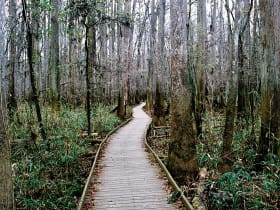
Congaree National Park
70 miles away
One of the tallest deciduous forests left in the world, a floodplain of champion old-growth hardwoods.