
Albert the World's Largest Bull
800 Market St, Audubon, IA
Audubon, IA
A thirty-foot concrete Hereford standing guard over a small western Iowa town, built to celebrate the cattle that built the county.
Albert the World's Largest Bull rises about thirty feet tall on the edge of Audubon, Iowa, a hollow-concrete Hereford weighing roughly 45 tons and built to honor the cattle industry that shaped this corner of the state. Painted in the deep red and white of a Hereford, he looks out over a small park that has drawn road-trippers off the western Iowa highways for decades.
The statue grew out of a local cattle-marketing effort in the 1960s, a booster's idea to give travelers a reason to slow down and remember Audubon. Reinforced with old telephone poles and steel and skinned in tons of concrete, Albert has become the town's proud landmark, the kind of oversized roadside oddity that Iowa does especially well.
What Travelers Love
- The sheer scale of a bull built at thirty feet tall and weighing about 45 tons
- A classic bit of American roadside folk art, perfect for a photo stop
- The small, easy park setting that welcomes visitors any time of year
- A window into the cattle-country pride of western Iowa
Worth Knowing
- This is an outdoor roadside stop, so there is little shade; dress for the weather
- The park is a quick visit, easy to pair with a meal or errand in Audubon
- The statue photographs best in the softer light of morning or late afternoon
- Audubon has a walkable small downtown a short drive away for food and fuel
Learn about Albert the World's Largest Bull
The story of a giant bull
Albert was conceived in the mid 1960s by Audubon's business community as a tribute to Operation T-Bone, a local cattle-drive celebration that had put the town on the map when ranchers shipped their steers to Chicago by rail. The idea was to build something so large that people driving the western Iowa highways could not help but stop, and a giant Hereford bull fit the county's identity perfectly.
Volunteers and local tradesmen framed the animal over a skeleton of salvaged telephone poles and reinforcing steel, then packed on tons of concrete to form his broad body and heavy head. He was named Albert after Albert Kruse, a local banker and booster who helped drive the project. Since his completion he has stood as the town's mascot, patched and repainted over the years by residents who take pride in keeping their bull looking sharp.
Cattle country and the T-Bone tradition
Audubon County sits in the heart of western Iowa's livestock country, where family farms have raised cattle and hogs alongside their corn and soybeans for generations. The town's Operation T-Bone celebration, which inspired Albert, dates to the era when rail cars carried finished cattle east to the great Chicago stockyards, and it survives today as a summer community festival.
Standing beside the bull, you get a sense of just how central beef has been to this region's economy and self-image. Albert is not a random oddity but a monument to a way of life, a good-humored way for a small county to say that raising fine cattle is something worth being proud of.
Roadside giants of Iowa
Albert belongs to a long tradition of oversized roadside attractions that dot the American heartland, built to lure travelers off the highway in the age of the family car. Iowa has more than its share, from giant statues to unusual museums, and part of the fun of a drive across the state is spotting them one after another.
These giants were rarely built for art's sake. They were civic advertisements, ways for a small town to compete for the attention and dollars of passing motorists. What time has done is turn them into beloved folk landmarks, and Albert is among the most photographed of them all, a friendly welcome to anyone passing through Audubon.
The land and its people
The rolling farmland around Audubon lies within the ancestral homelands of the Ioway, for whom the state is named, along with the Sauk and Meskwaki peoples who lived and traveled across this part of the Midwest. Their descendants remain part of Iowa today, with the Meskwaki owning their Settlement to the east near Tama.
Nineteenth-century settlers, many of them of German and Scandinavian descent, broke the tallgrass prairie here into farms, and the pattern of section-line roads, grain elevators, and courthouse squares they laid down still defines the landscape. Audubon itself is named for the naturalist and painter John James Audubon, a fitting namesake in a county where wide skies and farm fields still shape daily life.
Closest Boutels
The closest Boutel™ stays, so you can turn this stop into an overnight. Each is a place we chose through independent editorial review, never a paid placement.
Details
Audubon, IA
Frequently asked questions
What is Albert the World's Largest Bull?
Albert the World's Largest Bull is a giant statue of a Hereford bull in the town of Audubon in west-central Iowa, a beloved roadside landmark standing many feet tall and built to honor the region's cattle and livestock heritage. This enormous concrete-and-steel bull, a proud piece of small-town roadside Americana created decades ago to celebrate the local beef industry, delights travelers with its impressive size and makes a fun photo stop. Charming and free to visit, Albert captures the playful spirit and agricultural pride of rural Iowa. With its giant bull honoring cattle country, Albert the World's Largest Bull offers a delightful roadside stop in Audubon, west-central Iowa.
Why was Albert the World's Largest Bull built?
Albert the World's Largest Bull was built decades ago in Audubon to honor the region's important cattle and livestock heritage and to celebrate the local beef industry, giving the small town a proud landmark and a way to draw attention to its agricultural roots. Named Albert after a local figure connected to the effort, the giant Hereford bull was constructed with a steel frame and concrete over a community effort. It has stood ever since as a symbol of cattle country and small-town pride. This heritage and community spirit make Albert a fitting and fun landmark in Audubon, west-central Iowa.
What can you do at Albert the World's Largest Bull?
You can view and photograph the giant Hereford bull statue, marvel at its impressive size, enjoy a lighthearted break on a road trip, and experience a charming bit of small-town roadside Americana celebrating Iowa's cattle country in Audubon. It is a quick, free, family-friendly stop that adds a smile to a country drive. The enormous bull is the whole fun of it, and kids enjoy standing beside it for scale. With its giant bull and agricultural charm, Albert the World's Largest Bull offers an enjoyable roadside stop in west-central Iowa.
When is the best time to visit Albert the World's Largest Bull?
As an outdoor roadside attraction, Albert the World's Largest Bull can be visited and photographed year-round in any season, making it an easy stop any time you pass through Audubon, though the warmer months from late spring through fall offer the most comfortable weather for lingering and taking photos, and pair well with exploring the surrounding west-central Iowa countryside. Winter visits are fine but can be cold. For the most pleasant weather, aim for the warmer months, though Albert makes a fun stop any time of year in Audubon, Iowa.
What is near Albert the World's Largest Bull?
Albert the World's Largest Bull is in the town of Audubon in west-central Iowa, within reach of the Danish heritage town of Elk Horn with its Danish Windmill, the Loess Hills country to the west, and the central Iowa countryside toward Des Moines to the east. That makes Albert a fun roadside stop to combine with the Danish Windmill at Elk Horn and the other attractions of west-central Iowa on a visit to the state.
Nearby
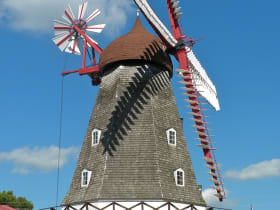
Danish Windmill
11 miles away
Elk Horn and neighboring Kimballton form one of the largest rural Danish settlements in the country, and the windmill is the reason to stop.
Lincoln Highway Heritage Byway
24 miles away
Iowa's stretch of the Lincoln Highway, America's first coast-to-coast road, laid out in 1913 and now a marked heritage byway.

Loess Hills Scenic Byway
44 miles away
The Loess Hills run in a narrow band along Iowas western edge, steep ridges of wind-deposited silt so deep and rugged that this landform reaches comparable scale in only one other place on earth.

Madison County Covered Bridges
51 miles away
Six weathered 1800s wooden covered bridges are scattered across the farm roads around Winterset, about a half hour southwest of Des Moines off Interstate 80.

Hitchcock Nature Center
52 miles away
Hitchcock Nature Center sits in the Loess Hills north of Council Bluffs. The ridges here are steep wind-built silt, and restored hilltop prairie is slowly returning across the preserve.